  1. Home
  2. Emerging Tech
  3. Legacy Archives

Spring Unveils Its Dual-Screen Alex eReader

Add as a preferred source on Google

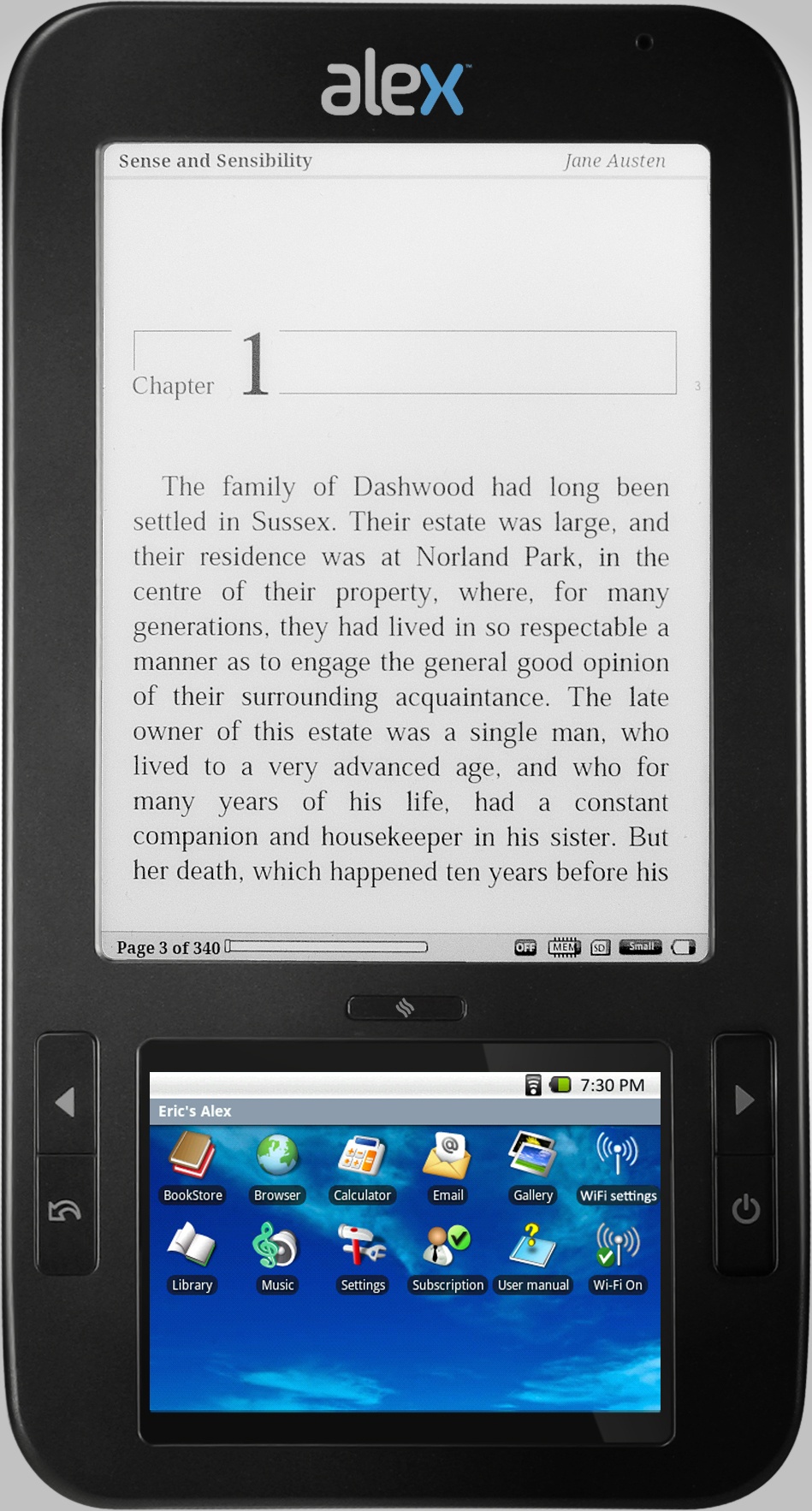
Alex_eReaderIt’s time for another eReader announcement, America, and we think you’ll like this one. Spring Design announced it will unveil its Android-based, dual-screen Alex eReader at CES this week. Spring says Alex is quite the mobile eReader having network connections with WiFi, 3G, EVDO/CDMA and GSM.

The company says it will demonstrate Alex’s full browser capabilities and “unique” dual screen technology today and tomorrow at CES. Its Duet Navigator technology enables the eReader multitask—users can search the Internet on the 3.5” color browser LCD screen while displaying books, periodicals and even personal, educational and corporate documents all at the same time. The Alex eReader sports a paper-like 6” EPD screen, a virtual keyboard, access to email, a calculator, and Spring says this device will accommodate a growing number of programs from the Google Android community.

Recommended Videos

“We designed Alex to expand the users’ reading enjoyment, enriching the content whether it is reading for pleasure, education or business, and enhancing the capabilities with access to the growing suite of Android applications,” said Spring Design Vice President of Sales and Marketing, Eric Kmiec. “We believe Alex enables readers to transcend the printed page to an interactive multi-media reading experience; letting children browse classic picture books with music to serious students who can view videos of science experiments online on the LCD screen while reading textbooks on the EPD screen.”

Alex can be purchased for $399.00 starting February 22, 2010 on the www.springdesign.com site with other availability to be announced.


Dena Cassella
Former Digital Trends Contributor
Haole built. O'ahu grown
Google just canceled its AI Studio mobile app, and it’s not all bad news
Logo, Symbol, Disk

Google AI Studio was on track to make its way to Android and iPhone, giving developers and AI enthusiasts a dedicated place to build prompts and experiment with Google's latest models from their phones.

That's no longer happening. In a post shared by the official Google AI Studio account on X, Google confirmed that it's canceling the standalone AI Studio mobile app before launch. The announcement comes despite the company saying nearly 800,000 people had already pre-ordered the app across iOS and Android.

Read more
Google Earth’s AI misadventure lasted only a day. It was a tale of dangerous ignorance.
Nuclear reactors, tanks, and historical destruction on a life-like satellite map? Yeah, that's bad.
Nano Banana AI image generator representation.

Technology behemoths are clearly not reading the room, or they are just moving faster than they should when it comes to AI deployment. Google has already stuffed its Gemini AI in every corner of its software stack, from Android to daily productivity tools like Gmail that are used by hundreds of millions of users every day. AI is everywhere. Not all of it is bad, mind you. But in a few places, it just feels forced.

In its latest AI-fication experiment, the company targeted Google Earth. The idea was to let the audience use its Nano Banana 2 AI image generator and make images that can be placed on the map view. On paper, it's a cool idea. What would the Colosseum of Rome look like in your urban neighborhood? Yeah, fun stuff like that.

Read more
Google’s new AI gives robots better balance, smarter hands, and teamwork capabilities
Google just made robots a lot less clumsy and a lot more helpful.
Gemini robotics 2.0

Google DeepMind just brought sci-fi robots closer to reality, and it is very exciting. Building on its original Gemini Robotics model, the company has introduced Gemini Robotics 2, an AI system designed to help robots think, move, and even work together. Unlike most robots today, which rely on pre-programmed routines or someone controlling them remotely, this new system lets robots figure things out on their own when situations get unpredictable.

Can robots finally handle whole-body tasks?

Read more