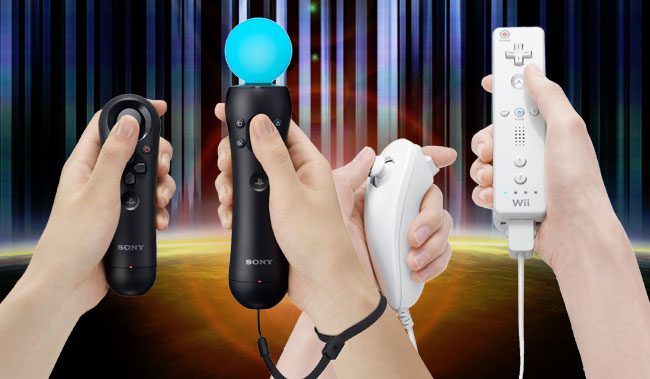
Sony has transformed a swank event space in downtown Seattle into a sea of make believe. Journalists smack ping-pong balls, wield swords and buzz the hair off imaginary scalps. Five years ago, this demo of Sony’s upcoming PlayStation Move motion controller might have elicited giggles and raised eyebrows from the grown men and women men milling through, cocktails in hand, but this is the post-Wii age. No one bats an eye.
And that might be a problem for Sony. The glowing neon balls are new, but we know the concept all too well. Sony’s PlayStation Move looks a lot like an overhyped, late-to-market version of the Wii.
So why isn’t it the Wii, again? Despite the overwhelming similarity, Sony’s Move controller does add a new dimension to the motion control we know and love. Here’s how.
 The Magic is in the Ball
 The Magic is in the Ball
Ask any of Sony’s code maestros just how the Move is different from the Wii and they’ll adopt the same look of veiled exhaustion. They’ve heard it more than a few times tonight.
“We have these!” one Sony dev grins after pausing for a moment to decide how to cover it for the hundredth time. He holds up the colored balls on the end of the Move controllers.
He’s not exaggerating. The ping-pong ball look-alikes at the end of the Move controllers are precisely what set Sony’s technology apart from anything Nintendo or even Microsoft will offer. While the accelerometers inside the controller act much as a Wii does, the balls provide what Sony calls a zero point – an absolute location in physical space for the system to peg all the other data to.
A what?
Sony engineer Anton Mikhailov compares the inertial sensors in a Wii remote to walking in a dark room: You know how quickly you’re walking, and can feel yourself turn, but without seeing your surroundings, you have only a vague idea where you actually are, even if you’ve navigated the room a dozen times.
“The problem with inertial sensors is that they tell you where you’re going, but not really where you end up,” Mikhailov explains. Although the Wii’s infrared sensor bar gives the remote some pointing ability, the triangulation used to roughly plot the Wii remote’s location results in some uncertainty. “You don’t know with the Wii sensor bar whether you’re turning – like in the pointer scenario – or moving. Because of that ambiguity, you can’t discern whether you’re moving in space.”
In contrast, the colored ball used on the Move remote tells the PlayStation exactly where you’re standing in front of the TV. Simple left and right movement of the dots can tell the system where you are on an X and Y axis, while the size of the ball tells the system how close or far you are from the TV – that critical Z axis. Attach all the accelerometer and gyroscope data to that point in space, and you have the Move.
Untapped Potential
 Untapped Potential
Boring technical minutiae aside, does it make any difference? The first titles certainly make it hard to tell.
Playing with the Move feels a lot like playing with the Wii. You punch, your character punches. You swing, your character swings. You dive, your character dives. There’s an extra degree of accuracy, to be sure, but the experience of playing feels much the same.
The real potential might still be left untapped by programmers still stuck in the groove of the Wii.
Anton fires up a technical demo. It takes a live feed of you standing in front of the TV and superimposes virtual objects into your hand. The remote becomes a mallet, a globe, a sword. And every single motion translates fluidly to the screen. You can take a ping-pong paddle and twist it around in your hand, watching the item do the same.
The Wii cannot do this.
In another demo, one controller turns into a spinning tube of clay on screen. The other controller deforms it like a finger on a virtual pottery wheel. In yet another, Anton effortlessly repositions images like posters in 3D space. He can even twist and bend them as if they’re real. After slapping a few down, he turns one controller into a virtual camera, looking around his newly created virtual living room as if he were there, while moving things around with his other hand. You could open a door with one hand and peek behind it with another. Take things apart naturally in 3D space without touching a mouse. Shoot 3D movies the same way you shoot real movies, without awkward camera controls.
The Camera Problem
 The Camera Problem
Relying on a camera for input has its downfalls. As the sun sets on Seattle, blades of sunlight fan through the upper windows across windows and walls. Sun-starved Northwesterners rejoice. Sony developers cringe.
The Move systems near the sun have stopped working. While workers outside scramble to tape butcher paper over the offending windows, a live camera feed on screen betrays the problem. To Sony’s EyeToy camera, the entire room is bathed in white, including the relatively weak LED-lit indicator balls on the Move remotes. Without this simple visual cue – so easily washed out by a setting sun – the system is paralyzed.
There’s no less precise Wii mode to revert to – it’s all or none. When your system can’t see the ball, it’s game over.
A Question of Code
Boxing, bubble-popping and virtual golf have been done. While Sony has developed what may become the most accurate, precise motion control game console in the world when it launches this fall, it may also tread dangerously close to its classic misstep: prioritizing realism and power over fun.
Will developers rise to the challenge of harnessing the Move’s most promising abilities? Like car designers building a car around one of the most potent engines ever developer, the success of failure ultimately depends on what they do with it.
We’ll wait and see.
For more on the PlayStation Move check out Hands On and Swinging with the PlayStation Move.