1. Home
  2. Emerging Tech
  3. Web
  4. Legacy Archives

‘Visually reminiscent of a greenhouse’ – Amazon unveils latest plans for ‘whimsical’ Seattle campus

Add as a preferred source on Google

amazon seattle design planIt’s a design that looks more botanical-garden than space-for-office-workers, but according to plans [pdf] released by Amazon for a new Seattle-based campus, there will be desks, meeting rooms and water coolers among all the foliage.

Designed by architecture firm NBBJ, the biosphere-like campus, located in the downtown area of the city, will comprise more than three million square feet of office space spread throughout three 37-story office towers and three enormous glass-and-steel spheres. That’s right, three enormous spheres. Up to 95 feet high, the spheres will incorporate work, dining, meeting and lounge spaces, and be home to “ecologies found around the globe”, NBBJ said in its plans.

Recommended Videos

The architecture firm added: “While the form of the building will be visually reminiscent of a greenhouse or conservatory, plant material will be selected for its ability to co-exist in a microclimate that also suits people,” a feature sure to delight any green-fingered employees among the Amazon workforce. And it’s not just plants that’ll be sprouting up around the office: “To encourage growth and maintain the health of the plants, the building’s interior will include high bay spaces….capable of accommodating mature trees.”

NBBJ said that ultimately the intent behind its design is “to create an alternative environment….where employees can work and socialize in a more natural, park-like setting.”
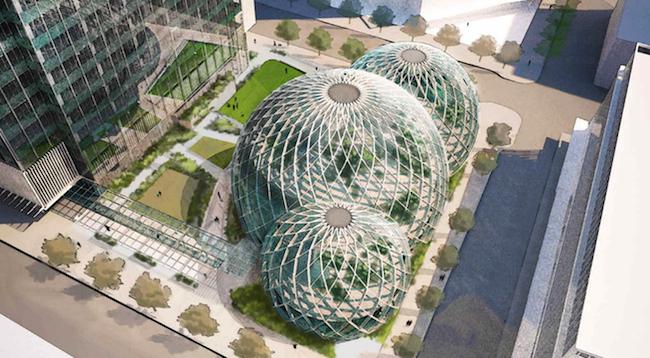
amazon spheres
Image used with permission by copyright holder

The green areas between the spheres would be open to the public, as would several retail spaces on the site.

Discussing Amazon’s plans at a Design Review Board meeting at Seattle’s City Hall on Tuesday evening, board member Gabe Grant described the design as “optimistic, forward-looking, experimental, exciting [and] whimsical.”

Summing up his firm’s plans, NBBJ’s John Savo told the board, “We’re striving to create an environment in which to work and think a little differently.”

Amazon’s “whimsical” design follows in the footsteps of other big players in the tech world. Apple is set to build its ‘spaceship’ campus in Cupertino, Facebook has plans for a striking new campus designed by internationally acclaimed architect Frank Gehry, and Google is set to build something out of the ordinary in London in the next couple of years.

[via Cnet, Seattle Times]

amazon seattle office plan
Image used with permission by copyright holder
Trevor Mogg
Contributing Editor
Not so many moons ago, Trevor moved from one tea-loving island nation that drives on the left (Britain) to another (Japan)…
Amazon is full of copycats and shady brands. This Chrome extension lets you avoid them.
Advertisement, Poster, Text

Shopping on Amazon used to be simple. You searched for a product, compared a few familiar brands, and checked out. These days, it often feels like you're scrolling through an endless parade of names that look like someone leaned on a keyboard before hitting publish. That's exactly the problem Knockoff is trying to solve.

Created by developer Josh Pigford, the Chrome extension doesn't promise to expose counterfeit products or magically tell you what's good. Instead, it tackles something arguably more annoying: the flood of unfamiliar, mass-produced brands that dominate Amazon search results.

Read more
AI agent reportedly carried out an entire ransomware attack on its own
AI didn't just write malware. It apparently clocked in for work.
Cybersecurity

Cybersecurity researchers say they have documented what could be the first ransomware attack carried out almost entirely by an autonomous AI agent, marking a significant shift in how cyberattacks could be conducted in the future. According to cloud security firm Sysdig, they have uncovered a ransomware operation dubbed JadePuffer that appears to have relied on a large language model (LLM) agent to perform nearly every stage of the attack without continuous human intervention.

If confirmed, the incident suggests AI is moving beyond writing malicious code and into actively planning, adapting, and executing cyberattacks in real time.

Read more
The Washington Post predicted how tech will advance 50 years ago and the success rate is humbling
The Washington Post predicted 2026 tech in 1976. It got a lot right.
Representative Image

Fifty years ago, when floppy disks were cutting-edge and the personal computer revolution had barely begun, The Washington Post attempted a remarkably ambitious exercise: predict what life in 2026 would look like. Some of those predictions now read like science fiction. Others feel surprisingly ordinary because they have become part of everyday life.

In a retrospective published for America's 250th anniversary, the newspaper revisited science editor Thomas O'Toole's 1976 article Inventing the Future, comparing its forecasts with today's technological reality. The results reveal that while predicting exact timelines is nearly impossible, identifying long-term scientific trends can be remarkably accurate.

Read more