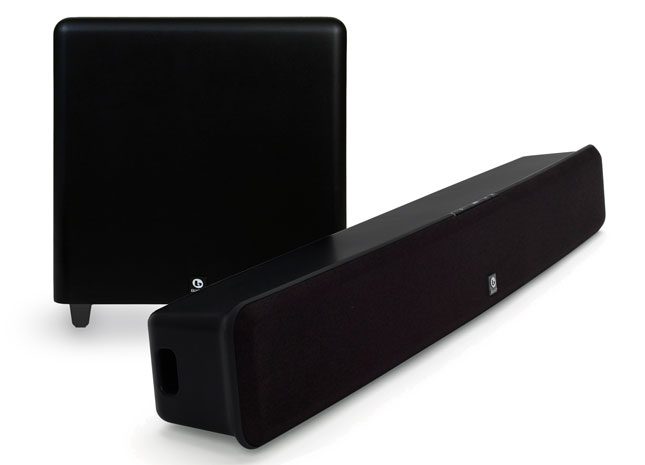

“Boston Acoustics’ latest Tvee soundbar delivers a huge step up from built-in TV speakers without the expense and tangled wires of a surround setup.”
- Extremely easy to install and use
- Solid Sound
- Great bang for your buck
- Subwoofer is easily localized
- Unnecessarily bright LED on sub
“Why you can trust Digital Trends – We have a 20-year history of testing, reviewing, and rating products, services and apps to help you make a sound buying decision. Find out more about how we test and score products.“
Introduction
The speakers built into our televisions have never really sounded very good. With the exception of the gargantuan rear projection TV cabinets we enjoyed in the ‘80s and ‘90’s, built-in TV speakers have always been small, underpowered and just plain lame sounding. Home theater systems bring the big sound your big picture deserves, but they are often bulky, expensive and complicated. A soundbar provides big sound in a slim, attractive package, but they are also expensive and most don’t come with a subwoofer. The folks at Boston Acoustics have recognized that some of us just want better sound than our TV can provide without sacrificing a lot of space and money so therefore came up with the Tvee Model 20 – a replacement for their popular TVee 2. Armed with a wireless subwoofer, this two channel soundbar solution promises to offer hassle-free big sound at a very affordable $299 price tag.
Out of the Box
The Tvee 20 system arrived packed in a single box. Inside, we found the 3-3/4” x 31” x 4” soundbar, 9 ½” x 10 ½” x 11” subwoofer, two AC cables, a 3 foot pair of RCA cables and a user manual. Simple.
 Features and Design
 Features and Design
As we set up the Tvee Model 20, we were struck by the recurring theme of simplicity. The soundbar includes 2 keyhole style mounts and is light enough (8.4 lbs) to be mounted to drywall with the use of a couple of drywall anchors. The recessed rear panel of the soundbar holds a power switch, trim switch, wireless channel selector and a stereo rca input.
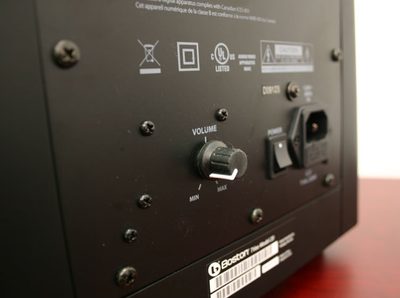
The wireless subwoofer need only be plugged into the wall and set to the same wireless channel as the soundbar. A multi-color LED lets you know when it’s linked with the sounbar and a volume control allows for the bass level to be adjusted to your preference.
The soundbar uses two 1 ½” x 6” drivers in a ported cabinet, a change from the previous four driver configuration used by the Tvee 2. This approach allows for better off-axis listening and should reduce “dead spots” where sound is out of phase. The subwoofer uses a 6” down-firing driver, also in a ported cabinet. The power rating for each amplifier is not given, though Boston Acoustics claims a total system power of 100 watts.
The soundbar gets its signal from a TV, cable or satellite box or any other line level signal). Our display offers the option of having a variable or fixed level signal through the RCA connections and for grins we tested both. We found that synching the Tvee 20 with our remote was easy enough, but took advantage of our displays ability to determine the volume level. Users will want to turn their TV speakers down or off entirely so as not to interfere with the output of the Tvee 20.
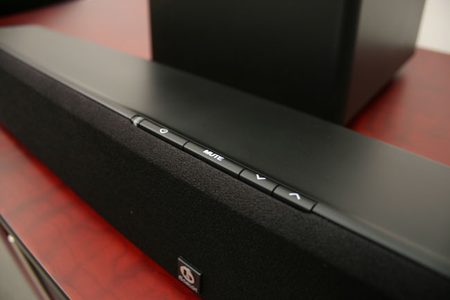 The Tvee 20 only offers one input, but that’s part of its appeal as a simple, straightforward product with one job: reproduce the sound from your TV and make it sound great. However connecting it directly to your TV means that any device connected to your TV can be played through the Tvee 20. For our review, we used an LG Blu-Ray player, Xbox360 and an iPod touch as sources in addition to television content that included satellite radio, high-def movies and good old standard cable channels.
The TVee 20 cleverly detects an input signal and will power itself up when you turn on your TV. There’s no need to turn it on beforehand. It will also automatically shut off roughly 20 seconds after it stops receiving a signal. We noticed that the subwoofer followed suit in powering up or down as needed.
The only quirk worth mentioning is the overly bright LED light on the subwoofer’s rear panel. It’s clear and bright enough to light up the lower portion of the wall it was sitting next to in our testing lab. If placed in a bedroom, you may be getting a little night-light out of the deal as well.
Performance
 Performance
Looking at the specs for the speakers inside the Tvee 20 soundbar, we found ourselves wondering how much better they would sound than our 37” LCD’s built in speakers. In theory, the controlled cabinet space and use of better quality drivers and more powerful amplifiers could make for better sound, but did Boston Acoustics put that much into the soundbar or does this system rely heavily on the subwoofer? To find out, we disengaged the subwoofer and ran a familiar CD from our LG Blu-Ray player through our display’s speakers and the Tvee 20. We learned that the Tvee 20 speakers did sound better than our display’s built-ins. The high frequencies were much cleaner and vocals had clarity to them that our LCD TV’s speakers could not match.
We then engaged the 6” subwoofer. At that point, the system really came alive. The sub filled in some critical lower midrange and bass frequencies to help create a room-filling sound that rivaled that of more expensive home-theater-in-a-box solutions that we’ve tested. We found that the subwoofer was punchy and able to produce bass quite low. Though not on par with larger, more powerful high-end subwoofers, the 6” TVee 20 sub sounded quite respectable when properly blended with the soundbar.
As our testing continued, we submitted the Tvee 20 to a wide range of source material that included music, movies, standard television and games. Musically, we felt that the TVee 20 sounded better than many high-end iPod speaker docks. It has a presence and authority that is difficult to fake without a subwoofer. Movies and games also benefitted greatly from use of the TVee 20. Sound effects were much more prominent and explosions had real impact. Television also sounded much better, but with TV broadcasts, we noticed that the quality of the broadcast had a lot to do with how good the TVee 20 ultimately sounded. There were some programs that we watched on Disney and Nickelodeon channels that were extremely aggressive in the high frequencies and the TVee 20 was sure to let us know it. When the signal is clean and balanced, the TVee 20 sounds clean and balanced, but minute changes in the sound quality of the TV program seemed to be exacerbated by the Tvee 20’s high frequency prowess.
 Subwoofer placement also plays a role in how good the TVee 20’s over-all sound will be. Since the 6” subwoofer is tasked with so many midrange frequencies, it is very easy to locate. Typically, subwoofers only produce extremely low frequencies that our ears aren’t able to locate. We just hear the bass. When a speaker starts to play above about 100 Hz, we can start to hear where it is coming from. We didn’t take measurements, but there is no doubt that the 6” subwoofer in this system is working well above the 120hz mark and, in doing so, gives it’s location away very easily. Don’t expect to place the sub just anywhere in the room. We recommend that you keep it as close to the soundbar location as possible. When in close proximity, the blend between soundbar and subwoofer is much better and the sound more enjoyable.
Conclusion
The Boston Acoustics TVee Model 20 offers a significant upgrade to your TV’s sound in a very simple and extremely easy to use package. The bang-for-your-buck factor here is excellent. For $299 you don’t get surround sound, but you do get the advantage of superior speakers and a wireless subwoofer that really brings your TV experience alive.
Highs:
- Extremely easy to install and use
- Solid Sound
- Great bang for your buck
Lows:
- Subwoofer is easily localized
- Unnecessarily bright LED on sub