“Shure’s SRH750DJ deliver studio sound in a sturdy package built to survive the ebb and flow of a club.”
- Extremely Durable Build Quality
- Great sound isolation
- Brilliant highs and deep bass
- Comfortable for long-term use
- Slightly clumsy
- Overly snug fit when wearing both earphones
“Why you can trust Digital Trends – We have a 20-year history of testing, reviewing, and rating products, services and apps to help you make a sound buying decision. Find out more about how we test and score products.“
Introduction
As a manufacturer, Shure is very well known for its professional audio products. The Shure SM57 and SM58 microphones are virtually synonymous with live music performance. Now, the company is making a big move on the DJ booth with its 750DJ headphones. Like Shure’s microphones, these DJ cans deliver outstanding performance in a very rugged package. Designed with a disc jockey’s needs in mind, the 750DJ headphones represent what Shure is known best for: Road-tested performance.
Out of the Box
The 750DJ headphones are simply packaged with a storage pouch, threaded ¼” adapter and a brief user manual. As we removed them from their packaging, we noted that they weren’t nearly as heavy as we expected them to be. Weighing in at 21 oz., they are one of the lighter sets of headphones that we’ve tested in this size class.
 Features and Design

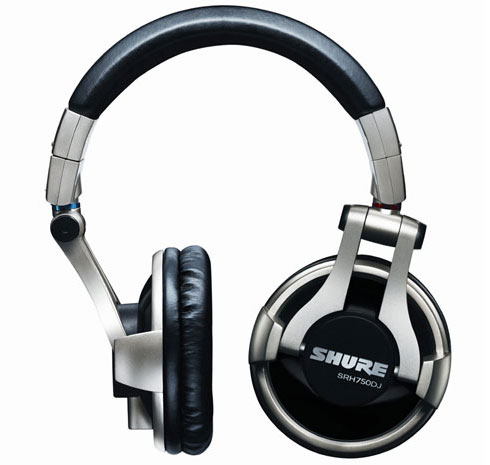
The Shure 750DJ headphones are clearly built to be durable under extreme conditions. The headband is particularly wide and extremely flexible, though quick to bounce back into form when relieved of stress. The two hinged joints on each side of the headphones move freely and are overbuilt to endure excessive strain. These joints allow 90 degrees of pivot for easy placement on one ear while also allowing the earcups to rotate 180 degrees for even easier manipulation.
The replaceable earcups on the 750DJ are a cushioned with a soft, black, leather-like material that we found wore very comfortably for long periods of time. Looking further, we discover the 50mm drivers are covered with ample speaker cloth and very well guarded by what seems to be a metallic speaker guard. To be sure, it would take some concerted effort to puncture through to the driver, so we feel confident in saying that nothing is going to accidentally damage the goods within. To make sure that any exterior damage is minimized, Shure designed the 750DJ headphones with extremely rigid, high impact plastic that has been painted silver and feels as if it could take repeated abuse without showing much in the way of battle scars.
The cord for the 750DJ headphones is coiled and extends to about 10 feet in length. The cable is terminated on the left side earcup with a bayonet tip that ensures it won’t break away as you bounce around the DJ booth. The cord is natively terminated with a 1/8” headphone jack but a threaded ¼” adapter is provided in the box.
Performance
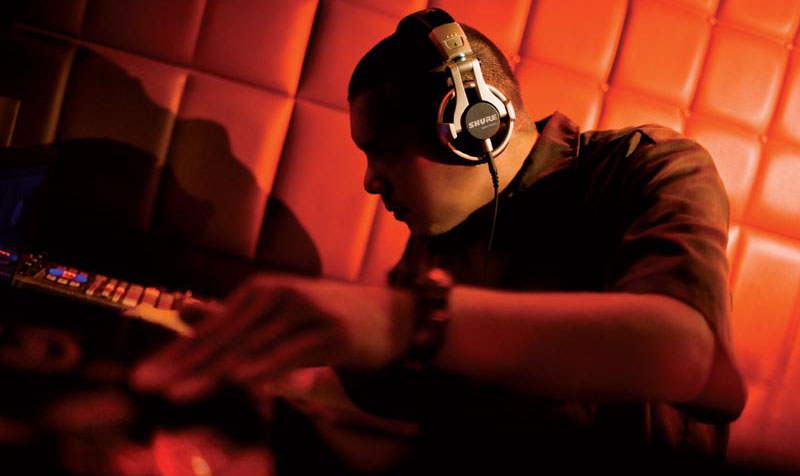
We spoke to three local DJs and asked them what they valued most in a headphone when mixing. There were three attributes found in common amongst those we polled: 1. Sound isolation 2.Clear, undistorted sound at high volumes and 3.High durability. Taking these values into account, we put the Shure 750DJ headphones through a number of stress tests and several listening sessions to determine how well they would perform while on the job at a club.
We noticed that the 750DJ headphones seemed rather easy to drive, considering their intentionally high impedance. This high impedance design allows the user to connect the 750DJ ‘phones to especially high-output mixing and monitoring boards without getting burned up. This high resistance usually comes with a loss of sensitivity, meaning an iPod won’t drive it to healthy volumes. However, the 750DJ units performed well in this regard and seemed equally at home with our iPod, A/V receiver and studio-grade mixing board.
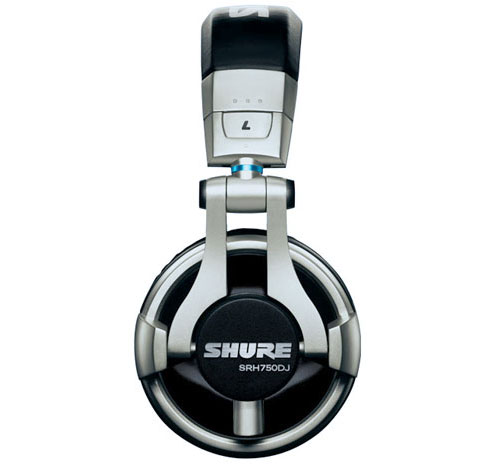 The 750DJ’s closed back design and well-sealing earcups provided extremely useful sound isolation and should prove a great advantage for those mixing in extremely loud or excessively noisy environments as well. If that sound isolation isn’t enough, the especially bright highs and robust bass output of these headphones is sure to cut through the din and get through with clarity.
We didn’t intentionally abuse our review pair, but we did knock them around a bit to see how resilient the finish was. We’re happy to report that some banging about in our studio produced no blemishes at all. Our cord stress tests revealed that the 10 foot coiled cord is capable of some serious strain and not likely to be the weak point in this well constructed set of professional DJ headphones.
Conclusion
The Shure 750DJ headphones are an extremely well-constructed set of high performance DJ headphones. Their brisk highs and forceful bass along with superior sound isolation and high comfortability should serve any DJ very well. As such, the units come highly recommended.
Highs:
- Extremely Durable Build Quality
- Great sound isolation
- Brilliant highs and deep bass
- Comfortable for long-term use
Lows:
- Slightly clumsy
- Overly snug fit when wearing both earphones