“Snell has managed to retain exemplary, balanced sound while providing a speaker that is more budget- and everyday placement-friendly than many other true audiophile speaker options.”
- Enthralling, well-balanced sound
- Powerful bass response
- Excellent imaging
- Simple, attractive cabinet design
- Finish is difficult to keep clean
- Lower sensitivity poses moderate concern for those with lower powered amps
“Why you can trust Digital Trends – We have a 20-year history of testing, reviewing, and rating products, services and apps to help you make a sound buying decision. Find out more about how we test and score products.“
Introduction
Among audiophiles, Snell Acoustics is both well-known and well-respected for producing some of the best-sounding speakers ever made in the U.S.A. The manufacturer’s zero-compromise approach to speaker design and enthusiasm for using the best available materials has resulted in a lineage of high-end speakers usually sold through hi-fi specialty stores. As such, the firm’s popularity has remained confined to the more enthusiastic amongst us audio fans. However, we think that the new IC(in cabinet)-K7 bookshelf speaker may nudge Snell into a new category that will have a whole new audience enjoying its products and their exceptional sound. With the IC-K7, Snell has designed a new high-performance, lower cost and quite handsome cabinet to house the same drivers and crossover components as their K7 bookshelf speaker. The result is a versatile, unassuming speaker that sounds just as incredible in a cabinet or on a bookshelf as it does sitting on a speaker stand.
Out of the Box
The Snell IC-K7 came to us in a very smart bit of packaging. Rather than use messy, environmentally unfriendly foam to protect the speakers, a well-engineered corrugated cardboard was used that effectively buffered the speakers in transit and wasted no room. The IC-K7 was sealed in heavy-gauge plastic with a card of self-adhering, black rubber foot pads and a short manual.
 Features and Design

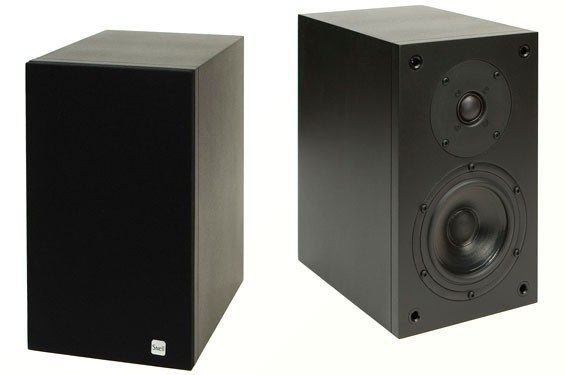
The 12”x7”x10.5” IC-K7 uses the same components as Snell’s more expensive K7 speaker. The tweeter is a 1” SEAS silk dome, the woofer a 5.25” treated paper. The cabinet is clearly the defining difference here. In place of the K7’s lush, painted hardwood and solid aluminum cabinet, Snell has outfitted the IC-K7 with a very rigid and anti-resonant HDF cabinet that is finished with textured, black anthracite paint. The speaker’s front baffle is covered by black grill-cloth adorned with Snell’s silver badge rather than the perforated aluminum grill found on the K7. The result is a resilient, attractive finish that is practical for a bookshelf or cabinet application and refined enough to be placed in the room as the star of an entertainment system.
Like the K7, the IC-K7 also features a boundary switch. However, with the IC-K7, this feature has been customized to benefit those who must place the speaker in a cabinet, bookshelf or otherwise constrained environment. As with all Snell speakers, each unit is hand-tuned to meet strict criteria before being given Snell’s approval.
Performance
For our evaluation of the IC-K7 we used a variety of amplification and sources that included a Harman/Kardon 430 stereo receiver; Onkyo TX-SR 702 surround receiver; Dynaco ST-70 tube amp; Oppo BDP-83 Blu-Ray player; and a Marantz turntable outfitted with an Ortofon OM5e cartridge. The speakers were auditioned in a two-channel setup with no subwoofer – the wiring used included a standard 12 AWG all copper wire terminated with banana plugs as well as KimberKable 8TC, also terminated with bananas.
After a 50-hour break-in session, we sat down to enjoy Snell’s latest bookshelf offering. We started with the speakers placed on speaker stands about 8’ apart and 19” from the front wall of our 12’X18’ testing lab. This is an admittedly ideal setup situation, but we wanted to gauge the IC-K7’s full potential as an in-room bookshelf speaker prior to taxing it within a cabinet or otherwise constrained space.
Adapting one’s ears to a new speaker can sometimes be a challenge. Many times, as listeners, we come to the table with certain expectations or a strong impression of the last great speaker we heard. With the IC-K7, we were immediately impressed.
 It was difficult not to notice the IC-K7’s outstanding bass response first. The spec sheet claims a capable bass response down to 50hz, which is impressively low for a speaker of this size to begin with. However, we are sure that this must be a conservative rating as we were experiencing bass well down into the 40hz range that had both presence and authority. Listening to the track “If I Ruled the World” from Jamie Cullum’s latest offering The Pursuit, we were treatedto an amazingly accurate reproduction of the recording’s use of the kick drum. Not only did it have a punch that caught us off guard, but the slow decay of this uncompressed and minimally mic’d bass drum resonated in such a way that we got a feel for the room in which it was recorded.
To push this bookshelf speaker a bit further we queued up The Jaco Pastorius Big Band’s The Word Is Out on SACD and listened to “Beaver Patrol” with electric bass bad-boy Victor Wooten holding down the low end. Only 20 seconds in, Victor’s telltale plucking technique gets shown off, testing any speaker’s ability to remain articulate and punchy while pumping out serious low end. The IC-K7 did well by any standard, let alone those usually associated with a small bookshelf speaker.
Just as impressive was the IC-K7’s high end. While listening to Wynton Marsalis’ Standard Time Vol. 3 we were entranced by the detail in the brushwork and sizzling cymbals of the session’s drummer, Jeff “Tain” Watts. We’ve used this recording on many occasions and it is difficult to recall a time when we heard so much grit and texture in the high end without some unwanted and overblown brightness elsewhere in the sound. We were also very happy with how the IC-K7 was able to maintain distinct separation amongst brass instruments and stringed instruments as we moved through the testing procedure.
We would have to describe the IC-K7’s midrange response as even, accurate and engaging. It is not uncommon to get a slightly pinched vocal response from a speaker that yields so much high end detail, but that was simply not the case here. Vocals sounded different on every recording we used, which is an indication that the speaker faithfully reproduces the recording without much coloration. To put it simply, Diana Krall sounded like Diana Krall, Peter Gabriel sounded like Peter Gabriel and Donald Fagen sounded just as snarky as he should.
Finally, we placed the IC-K7 in a number of challenging locations to determine what changes occurred when situated in an unfriendly environment. First we used an entertainment cabinet with sections intended for bookshelf speakers. Afterwards, we set the IC-K7 atop a rather high bookshelf with only inches of clearance behind it. We then placed it on top of a desk, against a wall and at close range to the listener.
Without first adjusting the speaker’s setting to “Boundary,” we were overcome with bass in all three placement scenarios. This is to be expected from a speaker with such prodigious bass response in an open room. Once switched, though, the booming, boxy bass was tamed down to an eerily appropriate level. Though we heard a little chuffing from the port when placed on the desk, the speaker sounded extremely good in all of the challenging scenarios. The bass was still sufficient, but not unruly; midrange seemed almost unaffected; and the highs suffered only to the degree that placement well above or below ear level is bound to bring.
The IC-K7’s flaws ultimately proved few and far between. We found that the coarsely-textured finish seemed to attract dust and wasn’t very easy to clean. Also, the relatively low sensitivity of this speaker could mean that pairing it with a low powered amp will yield less than ideal results. That said, we were able to power the speakers to considerable volumes with both a 35 watt tube amp and a 60 watt per channel solid state amp with little to no distortion at high volumes.
Conclusion
Snell has managed to retain exemplary, balanced sound while providing a speaker that is more budget– and everyday placement-friendly than many other true audiophile speaker options. While you won’t find this speaker sold through large brick and mortar retailers, you owe it to yourself to search out a dealer and give the IC-K7 a listen. Although taste in audio remains inexorably personal, we feel that the Snell will appeal to even the most discerning listener – a noteworthy accomplishment indeed.
Highs:
- Enthralling, well-balanced sound
- Powerful bass response
- Excellent imaging
- Simple, attractive cabinet design
Lows:
- Finish is difficult to keep clean
- Lower sensitivity poses moderate concern for those with lower powered amps