Amazon and Google respectively announced new iterations of their Dot and Mini speakers. The Amazon Echo Dot with Clock and the Google Nest Mini are two solid options for those who want to integrate a smart speaker into their homes but don’t want to spend a ton of cash. They’re what many consider to be ideal entry-level models and the first step toward upgrading your home to a smart home. And best of all, they boast powerful virtual assistants that can help keep you informed about all of your daily routines!
Which smart speaker is best for you? We break down the similarities and differences between the two devices in our Echo Dot vs. Nest Mini showdown. Let the smart speaker battle begin!
Design

The Echo Dot with Clock, much like the Echo Dot third generation, is encased in a fabric surround and sits at 1.7 inches tall and 3.9 inches in diameter. On top of the Echo Dot with Clock, you’ll find volume buttons, an action button, and a microphone off button to promote privacy. An LED light ring illuminates the circumference of the Echo Dot with Clock to help you communicate with the virtual assistant, Alexa. The light ring will illuminate blue when you say the wake word to indicate the device is listening, or it’ll illuminate yellow when you have a notification. The Echo Dot with Clock comes in four colors: Sandstone, heather grey, charcoal, or a new plum color. The Dot with Clock has an LED display that can show you the time, weather, or a timer.
Like the Echo Dot with Clock, the Nest Mini (2nd Gen) is similar at first glance to its predecessor, the Google Home Mini. It has a similar fabric design, and at 1.65 inches tall and 3.85 inches in diameter, it’s almost exactly the same size as the first generation Home Mini. While the Echo Dot has a light ring that serves as a visual cue to help you communicate with the device, the Nest Mini has lights on top that illuminate when you say the wake words. The Nest Mini also has capacitive touch controls on top of the speaker, and a physical microphone off slider switch on the side. The Nest Mini comes in four colors: Chalk, charcoal, coral, and a new sky color. It mounts on the wall, so you can inconspicuously hang it on a wall or shelf, instead of placing it on a desk or table. The fabric top on the Nest Mini is made from 100 percent recycled plastic bottles, while the external enclosure is made from at least 35% recycled plastic.
Sound

The Echo Dot with Clock has a 1.6-inch speaker, and it delivers rich and clear sound. You can also connect an external speaker using the 3.5 mm audio output jack. In terms of voice detection, the Dot with clock has four far-field microphones.
The Nest Mini has 360-degree sound and a (roughly) 1.6-inch speaker driver. However, according to Google, they were able to maximize the sound quality using proprietary audio tuning software. The Nest Mini is supposed to have twice the bass as the Original Home Mini, which already had okay sound quality for its size. If you want to connect an external speaker, you can do so using the Google Home app. The Nest Mini has three far-field microphones for voice detection, which is an improvement over the original Home Mini (which only had a two mic-array).
Upgrades over previous the model
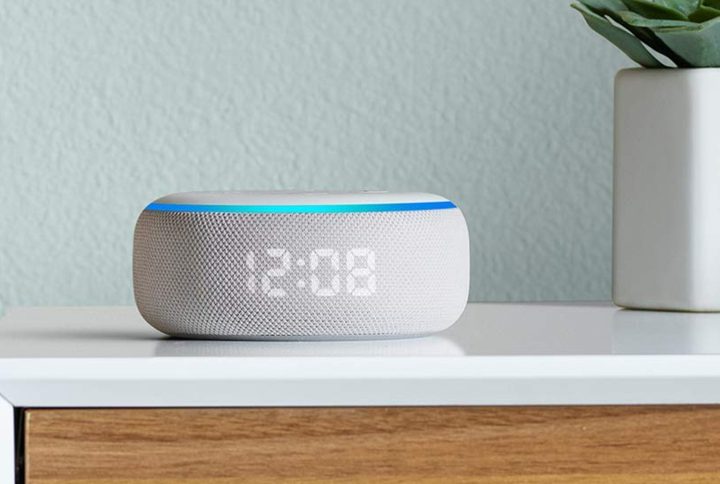
The Echo Dot with Clock is simply an Echo Dot 3rd generation with an LED display. The remaining specifications — sound quality and processing power — remain the same. The advantages the Echo Dot with Clock offer over the regular Echo Dot are that it’s a step up in terms of design, and you can see information right on the device. Therefore, you can place the Dot with Clock at your bedside, and use it as a clock. Since it also displays the temperature outside, and it can display a countdown timer, this can be helpful in areas like the kitchen as well.
The Nest Mini has more feature and specification upgrades. In addition to the improved sound quality and the ability to mount the device on a wall, another major upgrade comes in the form of its speed and processing power. The Nest Mini includes a dedicated machine learning chip with up to one TeraOPS of processing power. This allows the device to locally process commands, so the Nest Mini can respond faster. The Mini is more intuitive than ever before, lighting up volume buttons as your hand approaches the device and automatically increasing the assistant’s volume in noisy environments. You can also take advantage of features like stream transfer, which allows you to move your content from one speaker to another with just your voice, and calls through Google Duo, as your Nest Mini speaker essentially serves as a home phone as well.
Virtual Assistants

When deciding on a smart speaker, you’re also deciding on a virtual assistant. Should you go with Alexa on the Echo Dot with Clock or with Google Assistant on the Nest Mini? Deciding between Alexa and Google Home is kind of like deciding if you want to go with PlayStation or Xbox? Android or Apple? This is a highly personal decision. We will say that Alexa is compatible with more smart home products, and Amazon’s virtual assistant tends to be friendlier when it comes to overall compatibility. But Google assistant feels smarter, cleaner, and more intuitive.
Price
The Echo Dot with Clock retails for $60, and the Nest Mini retails for $49. There are typically sales throughout the year on both smart speakers that are accompanied by generous discounts, so it may be worth thinking about them when big shopping days come around. Due to their affordable cost, they make for excellent gifts to just about anyone.