  1. Home
  2. Cars
  3. Trash
  4. News

Elon Musk confirms Cybertruck won’t arrive until 2023 at the earliest

Add as a preferred source on Google

Tesla’s Cybertruck pickup won’t hit the road until 2023 at the earliest, CEO Elon Musk said on Wednesday, January 26.

His comments came during an earnings call with investors following the release of Tesla’s fourth quarter results for 2021, and confirm recent rumors that Cybertruck production had been delayed until next year.
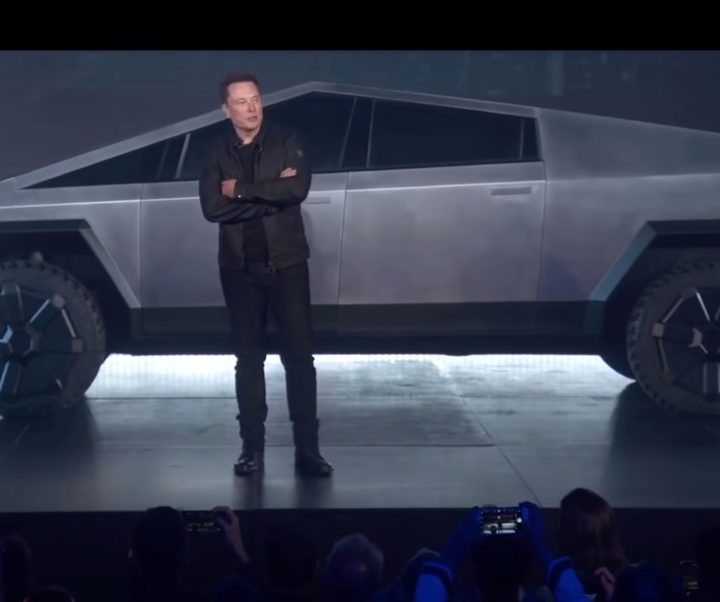
Tesla chief Elon Musk unveiling the Cybertruck in 2019.
Elon Musk unveiling the Cybertruck at a special event in November 2019. Tesla

“We will not be introducing new vehicle models this year,” Musk said in comments that also put to rest any hope of Tesla’s new Roadster sports car and Semi truck arriving before the end of 2022.

Confirmation of the Cybertruck delay will come as a disappointment to the million or so customers who have put down a deposit on the vehicle since it was unveiled in 2019.

Tesla had originally hoped to launch its electric pickup in at the end of 2021, but last summer the date slipped to 2022. Then, earlier this month, a change to the wording on its website suggested the Cybertruck wouldn’t hit the road until next year.

Musk said on Wednesday that the goal for 2022 was to boost production of its existing vehicles, adding that the complexity of introducing a new vehicle this year would dent output and therefore profit. The global chip shortage has also helped to dash hopes of new launches this year.

Indeed, Musk confirmed during the call that “the chip shortage, while better than last year, is still an issue,” adding that “there are multiple supply chain challenges.”

Despite the constraints, Tesla reported stronger-than-expected fourth-quarter results, posting a profit of $270 million from a global production run of 305,840 vehicles, marking a 70% increase over the same period a year ago.

For the entirety of 2021, revenue reached $17.7 billion, with profit coming in at $5.5 billion, up from $721 million in 2020. Tesla produced 936,172 vehicles globally over the 12-month period.

Tesla said in a statement that looking forward, the rate of growth “will depend on our equipment capacity, operational efficiency, and the capacity and stability of the supply chain.” The automaker said it’s also intent on further developing its Full Self-Driving feature that functions as an advanced driver-assist system, describing it as “a primary area of focus.”

Trevor Mogg
Contributing Editor
Not so many moons ago, Trevor moved from one tea-loving island nation that drives on the left (Britain) to another (Japan)…
Volvo is rolling out Apple Music to over 2 million cars with a simple OTA update
Your Volvo may soon get Apple Music without needing CarPlay
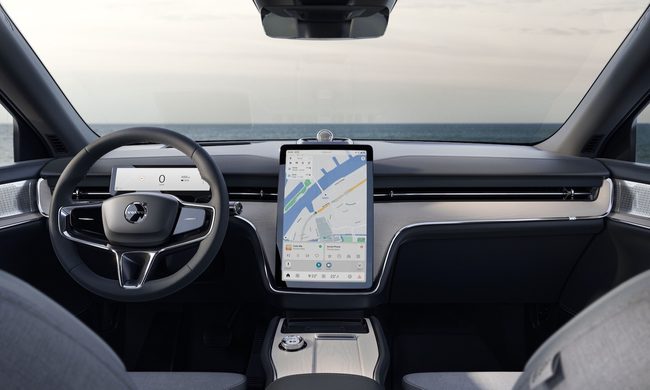
Interior view of the 2024 Volvo EX90.

The line between your smartphone and your car continues to blur. Volvo has announced that it is rolling out an over-the-air software update that brings Apple Music directly to the infotainment systems of more than 2 million vehicles worldwide. Instead of relying on Apple CarPlay or plugging in an iPhone, eligible drivers will be able to stream music natively from their car's built-in system, making Apple Music another integrated feature of Volvo's software experience.

The update is arriving for a wide range of Volvo models, including the EX90, ES90, XC90, S90, V90, XC60, S60, V60, XC40, EX40 and EC40, covering model year 2020 onwards. Availability, however, may vary depending on the vehicle.

Read more
Chery’s latest EV packs flagship tech for the price of a base Tesla, but you can’t buy it
Here's everything packed into Exeed's 2027 Exlantix ES, from its 27-sensor autonomous driving suite to its 860 km range, all starting under $31,000.
Car, Transportation, Vehicle

Chery's premium arm just dropped a sedan that makes you wonder why American EVs cost twice as much for half the tech.

Exeed's 2027 Exlantix ES ships with a driver-assist system called Falcon 700. It is built around an Nvidia Orin-Y chip and a genuinely stacked sensor suite.

Read more
A new AI model wants self-driving cars to think before they swerve
Forget guessing games, this self-driving AI actually shows its work.
Self driving car

Self-driving cars have gotten pretty good at driving. The harder problem is teaching them to drive safely in situations nobody planned for. We have heard horror stories of self-driving cars, behaving erratically in emergency situations, often times delaying first responders from reaching the scene.

A team at Seoul National University, led by professor Jun Won Choi from the Department of Electrical and Computer Engineering, thinks they have cracked part of that puzzle with a new AI model called SafeDrive. The research was recently selected as a highlight paper at CVPR 2026, a distinction that goes only to roughly 3% of all submissions.

Read more