  1. Home
  2. Emerging Tech
  3. News

Spooky NASA posters highlight the mysterious world of exoplanets

Add as a preferred source on Google
Image used with permission by copyright holder

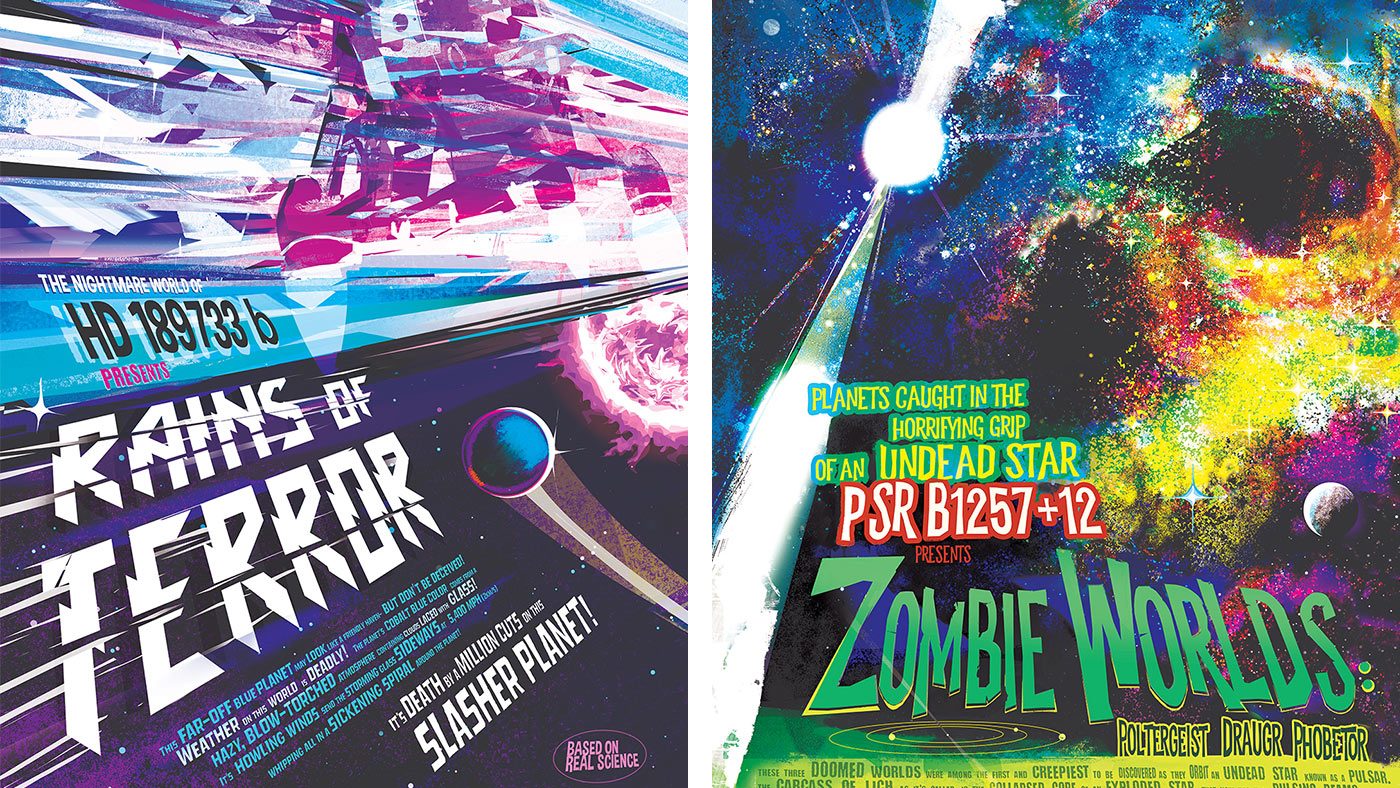
NASA’s newly released posters have a vintage horror movie look just in time for Halloween, and highlight exoplanets in a series called Galaxy of Horrors. 

The posters, created in collaboration with scientists and artists at NASA’s Jet Propulsion Laboratory (JPL), are meant to be informative about different exoplanets that have been discovered outside of our galaxy. The colorful posters are free to download. 

Recommended Videos

“In practical terms, I think for many people, the posters are an entryway,” said Gary Blackwood, manager of the Exoplanet Exploration Program, in a press release. “They make exoplanet science cool, and that opens a door for many members of the public — especially students — to learn more about the science behind the posters.”

There’s even a Galaxy of Horrors fake trailer to go along with the retro posters that explains exoplanets further. 

One poster is dubbed “Rains of Terror,” a play on the exoplanet’s atmosphere that is full of harsh winds of sand and glass, which NASA refers to as a “hellscape.” 

The other poster, called “Zombie Worlds.” focuses on PSR B1257+12, the remains of what used to be a star that isn’t quite dead yet and that has three exoplanets orbiting it. The dead star produces such intense radiation that it can be seen across its galaxy. 

The posters showcase that there’s more to exoplanets than finding planets similar to Earth. The exoplanets that harbor treacherous conditions are still equally important discoveries. 

“People are often most interested in finding exoplanets that could resemble Earth or potentially support life as we know it,” said Thalia Rivera, an outreach specialist at JPL who led the development of the new poster series. “But there are so many other amazing, mystifying planets out there that are completely unlike Earth and that show us the huge variety of ways planets can form and evolve. My favorite thing about exoplanets is how extreme they can get!”

NASA has confirmed the existence of more than 4,000 planets outside our solar system, like the recently discovered K2-18b Earth-like exoplanet. The sheer number of exoplanets is impressive, but even more so if you take into consideration that before 1992, we couldn’t find any exoplanets. 

Allison Matyus
Former Digital Trends Contributor
Allison Matyus is a general news reporter at Digital Trends. She covers any and all tech news, including issues around social…
Anti-surveillance clothing is getting cheaper, but don’t expect an invisibility cloak
Affordable shirts now claim to confuse facial recognition, although their protection depends heavily on the camera and software watching you
Chart, Plot, Adult

Anti-surveillance clothing is starting to look less like an art-school experiment and more like something you could actually wear outside. Shirts designed to confuse facial recognition systems now cost about as much as ordinary streetwear, although buying one won’t make you disappear.

The Guardian reports that designers are using face-like prints, unusual cuts and infrared lights to interfere with computer vision. These techniques target specific weaknesses, so their success depends on what happens to be watching you.

Read more
This spinning drone hides in plain sight using a visual illusion
This drone doesn't turn invisible. It tricks your brain into thinking it has.
Phantom Twist

For decades, engineers have chased the dream of an invisible drone. The usual approaches have involved transparent materials, camouflage coatings, or complex optical systems that bend light around an object. Researchers at Northwestern University decided to take a completely different route. Instead of hiding the drone itself, they chose to fool the human eye.

The result is Phantom Twist, an experimental drone that spins so rapidly it almost disappears into the background. It's not technically invisible, but to anyone watching, it looks more like a faint blur than a flying machine.

Read more
This smart knitted fabric can flip switches, count your steps, and even change shape
Grandma's knitting just entered its Iron Man era
Representative Image

For most of us, knitting brings to mind sweaters, scarves, and perhaps an ambitious grandmother determined to make winter more fashionable. Researchers at Harvard University, however, have a far more futuristic vision. They've transformed ordinary knitted fabric into a programmable material capable of changing shape, acting as an electrical switch, sensing movement, and potentially forming the foundation of tomorrow's wearable technology.

The research, published in Advanced Functional Materials by scientists at the Harvard John A. Paulson School of Engineering and Applied Sciences (SEAS), demonstrates how machine-knitted textiles can "snap" between multiple stable shapes without relying on motors or rigid mechanical parts.

Read more