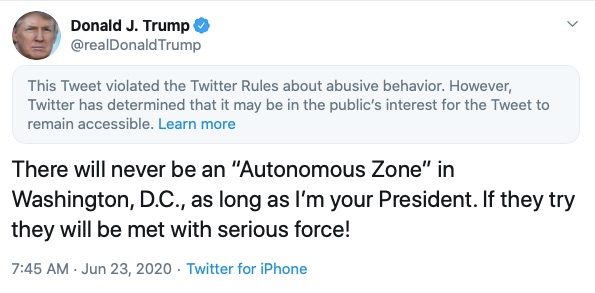
Twitter hid a tweet by President Donald Trump about deploying “serious force” against protesters in Washington, D.C. for violating the platform’s policy against threats of harm, the latest in a series of moderation moves by Twitter to address controversial statements from the president.
“There will never be an ‘Autonomous Zone’ in Washington, D.C., as long as I’m your President. If they try they will be met with serious force!” Trump tweeted early Tuesday.
Trump’s tweet refers to an autonomous zone, an area where a group of people declares to be self-governing and free of police.
A public interest notice was issued on Trump’s tweet from Tuesday for violating rules against abusive behavior. To see Trump’s tweet, you have to click on the “View” button of the Tweet’s notice about abusive behavior.
“We’ve placed a public interest notice on this Tweet for violating our policy against abusive behavior, specifically, the presence of a threat of harm against an identifiable group,” Twitter’s Safety team wrote.
Twitter told Digital Trends it doesn’t allow its users to wish or hope serious harm against either a person or a group of people — in this case, against people trying to organize at protests.
Trump’s tweet can’t be replied to or liked, though you can still retweet it with a comment.
Digital Trends reached out to Twitter for further comment on their decision to place a notice on this tweet. We will update this story when we hear back.
Last month, Twitter added a fact-check note to a pair of Trump’s tweets about mail-in ballots. That same week, Twitter hid and issued a public notice on Trump’s tweet about the Minnesota protests for the “glorification of violence.”
In that tweet, Trump stated, “Any difficulty and we will assume control but, when the looting starts, the shooting starts.”
Trump signed an executive order late last month in response to Twitter flagging his tweets, adding that he would shut down Twitter if he could. The order targeted social media platforms, pushing to make them liable for content posted onto their sites, and ordering the Federal Trade Commission and the attorney general to begin investigating the companies.
The order would make social media companies like Facebook and Twitter legally responsible for what others say and do on their platform, opening them up to civil lawsuits.