While showcasing the finalized version of Android Wear and the forthcoming Android “L”, Google took the time to confirm the rumored Samsung Gear Live at its I/O 2014 event, premiering the third smartwatch to feature the company’s integrated mobile platform alongside the LG G Watch and Moto 360. Featuring a Snapdragon 400 processor and equipped with a 1.65-inch LCD display, LG’s first foray into the smartwatch realm looks and feels every bit as bulky as predecessors such as Sony’s SmartWatch SW2 — but like the Gear Live — Android Wear remains the biggest device’s biggest selling point. The latter smartphone touts many of the same features, from the mobile OS to the various internal sensors, but how does the device’s other facets stack up against the LG G Watch? Check out our side-by-side breakdown below for a closer look at the hardware and software powering the two upcoming devices.
Additionally, check our our comprehensive comparison of the Gear Live, Gear 2, and Gear Fit to see how Samsung’s latest offerings compares to other wearable devices in the company’s lineup.
LG G Watch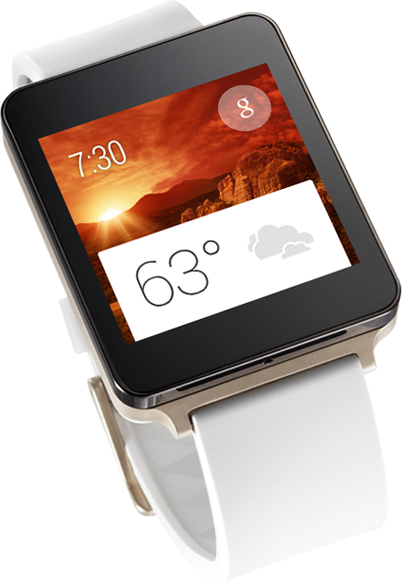 |
Samsung Gear Live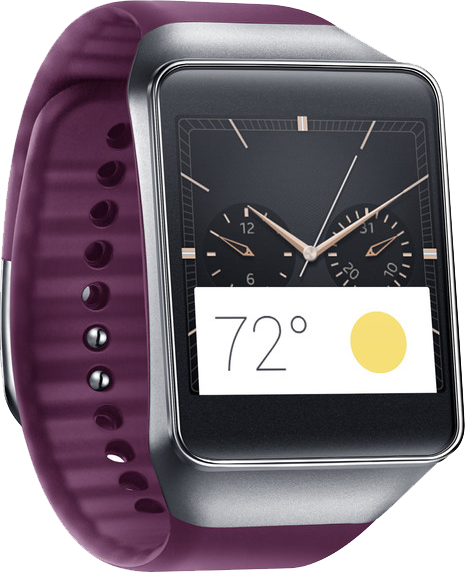 |
|
| Size | 37.9 x 46.5 x 9.95 (mm) | 37.9 x 56.4 x 8.9 (mm) |
| Weight | 63g | 59g |
| Strap | 22 (mm), changeable | 22 (mm), changeable |
| Screen | 1.65-inch IPS LCD | 1.63” Super AMOLED |
| Resolution | 280 x 280 pixels | 320 x 320 pixels |
| OS | Android Wear | Android Wear |
| RAM | 512MB RAM | 512MB RAM |
| Storage | 4GB eMMC | 4GB |
| Processor | Qualcomm Snapdragon 400 processor with 1.2GHz CPU |
1.2 GHz Processor |
| Water resistant | Yes, IP67 | Yes, IP67 |
| Heart-rate monitor | No | Yes |
| Sensors | 9 Axis (Accelerometer/Compass/Gyro) | Accelerometer/Compass/Gyro |
| Bluetooth | Yes, Version 4.0 | Yes, Version 4.0 |
| Battery | 400mAh | 300mAh |
| Charger | Micro USB via charging cradle | Magnetic charger |
| Colors | Black Titan or White Gold | Black and Wine Red |
| Price | $230 | $200 |
| Availability | Juy 2014 | July 7, 2014 |
| DT review | First impressions | Coming soon |
Power and productivity
It doesn’t take too much power most smartphones given their low-resolution displays and the current dearth of demanding apps. Although Samsung has yet to specify the exact specifications, both the G Watch and the Gear Live will run on a 1.2GHz processor, 512MB of RAM, and 4GB of internal storage — making them nearly identical when it comes to hardware capabilities. Additionally, both devices run Android Wear, a mobile OS that looks to seamlessly integrate Google Now with Android devices running version 4.3 and above. The synchronized OS will provide a steady stream of content in the form of vertical cards on both devices, presenting a variety of stripped apps for checking text message notifications and emails, directions, and weather for your current location among other notable information that relies on contextual awareness. You’ll also be able to check fitness summaries and engage in a variety of voice commands, and smartwatch updates will even automatically download and install once you sync either device with your smartphone.
However, although both devices tout similar processing power and internal software, there are other notable differences. For instance, the Gear Live features a 300mAh battery opposed to the G Watch’s 400mAh, while additionally providing a magnetic charging cradle in lieu of the G Watch’s Micro USB and charging cradle. The G Watch also features nine sensor axes encompassing an accelerometer, compass, and gyro akin to the Gear Live, but lacks the latter’s integrated heart-rate monitor. As expected, also both boast industry-standard Bluetooth 4.0.
Design
When it comes to design, there isn’t a substantial difference between the G Watch and the Gear Live. The dimension differences between the two competing devices is fairly negligible, though at 63 grams, the G Watch slightly outweighs Samsung’s counterpart. However, the Gear Live still possesses the upper hand even though it comes with a slightly smaller display, offering 320 x 320-pixel resolution within 1.63-inch Super OMOLED screen. Both rectangular devices allow you to customize your smartwatch with a standard 22-inch strap and one of two color options, while additionally offering dust and water resistance with a IP67 rating. You may not be able scuba dive with either offering, but you can still wear them for a quick shower or when washing your hands.
Price and availability
Thankfully, smartwatches don’t require a network contract the way smartphones do. However, though neither offering adheres to a subsided phone plan, they still both cost an upwards of $200. Th G Watch is currently available for order on Google Play for $230, with an expected launch date of July 7, 2014. The Gear Live on the other hand, also currently available on Google Play, will launch around the same time for $200. The lower price gives the Gear Live a slight advantage, but it’s likely not substantial enough to greatly deter potential customers from LG’s latest offering.
Conclusion
The Samsung Gear Live marks a considerable improvement over the company’s previous ventures in wearable tech, specifically the lackluster Gear Fit and Samsung-exclusive Gear 2. Still, neither option vastly outperforms the other at this point, even if the Gear Live also offers a heart-rate monitor, increased pixel resolution, and a lower price tag. Buyer choice may simply come down to individual aesthetics and customer preference, or how the two smartwatches perform and seamlessly integrate with their respective Android devices. Furthermore, the game may change again when the anticipated Moto 360 goes on sale later this summer.