“Why you can trust Digital Trends – We have a 20-year history of testing, reviewing, and rating products, services and apps to help you make a sound buying decision. Find out more about how we test and score products.“
Laptop batteries are often full of compromises — you’re usually giving up portability for capacity, or vice versa. Mophie’s Powerstation XXL is an external battery pack that wants to help.
The Powerstation XXL, the newest and largest in Mophie’s lineup of external battery packs, is one of the first with a USB Type-C charging port. It supports rapid charging rates up to 30 watts, and operates bidirectionally, meaning that the USB-C port both charges and discharges the Powerstation’s internal battery. Other nifty features include soft-touch housing, a pass-through charging mode, and an LED indicator. But the Powerstation XXL isn’t the only external battery competing for your hard-earned dollars. Here’s how it stacks up.
A stylish-but-functional design
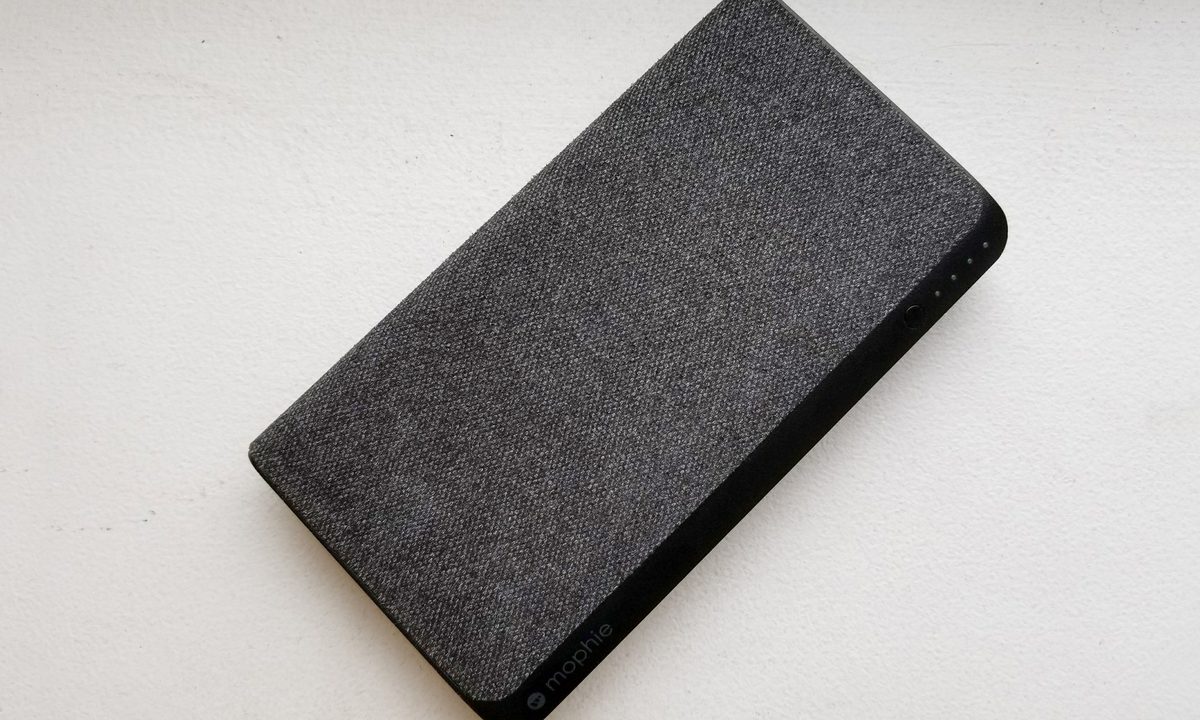
The Powerstation XXL has a tapered, fabric-wrapped design that looks and feels like its $150 price tag. In our testing, the Alcantara-like grippy material prevented the battery from falling off surfaces, protecting it from nicks and scratches. (It matched our t-shirts, too.)

We liked the four-LED capacity meter on the side, too, which also serves as a the Powerstation’s status indicator. Pressing and holding down on the power button lights up each LED sequentially in the direction of the charge, toward the USB ports when the Powerstation is discharging and away from the ports when it’s recharging.
Mophie says the LEDs will flash if there’s an error, but we’ll have to take their word for it — we never encountered one.
Power 101
It’s tough to contextualize the Powerstation XXL without basic electrical know-how, so let’s break it down. A battery’s charging power is based on electricity (energy), measured in Watts; current (electrical flow), measured in amps or milliamps; and voltage (electrical potential), measured in volts. Total power is determined by the product of the current (amps) multiplied by the the electrical flow (voltage).
It’s tough to contextualize the Powerstation XXL without basic electrical know-how.
So why don’t chargers with laptop-level wattage blow your iPhone 7 to smithereens? You can thank USB Power Delivery, the specs that dictate how quickly your phone, tablet, and laptop sip power, for that. Older specifications like USB 2.0 and USB 3.0 pull around 5 volts, while USB 3.1 maxes out at a whopping 20 volts.
As you know if you’ve ever plugged a new iPhone into a ten-year-old desktop, USB is backward compatible. That’s why your phone sips power happily from older chargers without short-circuiting — in USB devices with USB 2.0 and newer, a special chip called a CC pin communicates the device’s power requirements to the charger, and a micro-controller sets up the correct voltage and current settings.
A versatile charger
The Mophie Powerstation XXL is no different. A built-in Cyprus CCG2 chipset regulates the voltage, ensuring that plugged-in devices don’t receive more electricity than their circuits can handle.
How’s that work in practice? In output mode, the Powerstation’s USB-C port supplies up to 30 watts of power, or just over the 28-watt maximum of Qualcomm’s QuickCharge 4.0 spec. Mophie claims that’s enough to recharge a smartphone to 50 percent in 15 minutes.
Quick Charge 4.0-compatible devices are currently hard to come by, so we weren’t able to put those claims to the test. The Galaxy S8 Plus, which supports Samsung’s Adaptive Fast Charging tech, seemed to handle the Powerstation’s wattage just fine, as it noted it was fast charging. But with the phone plugged into the battery’s USB-C port, it took about 20 minutes to top off the battery from 90 percent — which may have taken so long due to Samsung’s fast charging technology. An HTC Bolt plugged into the USB-A port the same time as a Galaxy S8 Plus didn’t cause any problems, though it did not charge rapidly.

A Moto Z2 Force charged from 40 to 48 percent within 10 minutes via the USB-A port, which is far better than the results for the S8; and the Google Pixel XL went from 86 percent to 100 percent in 16 minutes, via the USB-C port.
The Powerstation lasted for hours. After a 9-to-5 day of charging a Galaxy S8 Plus, an HTC Bolt, and a ZTE ZMax Pro, the battery LED indicator showed two full bars of power remaining (about 10,000mAh).
In the course of our testing, we came to appreciate the Powerstation’s pass-through feature, which charges a plugged-in device via the USB-A port while the battery’s tethered to a wall charger. It’s not a feature most people are likely to use, considering the Powerstation’s capacity. But it’s handy if, say, you ever want to top off the battery and your phone/laptop/tablet at the same time.
As good an external battery as the Powerstation is, though, it has room for improvement. The Powerstation’s 19,500mAh capacity isn’t as high as cheaper competitors like the Intocircuit Power Monster (32,000mAh) and XTPower MP (30,000mAh). While the addition of USB-C is very much appreciated, we would’ve liked to see more than two charging ports.
Still, few external batteries with as much polish have come across our desk. It’s priced a little steeply at $150, but if you’re in the market for a battery that’ll charge virtually any USB device you plug into it, the Powerstation XXL’s the one for you.