
It’s not easy finding a new doctor. Whether the motivation is a big move to a foreign city or the simple swapping of insurance coverage, there’s a better way to find an MD than the yellow pages. It’s a search engine called Zocdoc, and starting on Tuesday, it will begin tapping machine learning to help surface physicians even better than it did before.
Zocdoc’s new feature is Patient-Powered Search, a “more intuitive” search experience that’s “built […] to bridge the gap between health care industry and human speak.” In simpler terms, it’s an AI-powered search bar that interprets what you type to help you find the specialist you need. Enter “hurt wrist,” for instance, and Zocdoc will recommend local orthopedic surgeons. “Post-election stress disorder” will serve up a list of psychologists. And searches for “stomach” and “tonsil” will show gastroenterologists and ENTs, respectively.
Patient-Powered Search corrects for common errors, too — the misspelled “hemroids” is interpreted as hemorrhoids, and “gyno” is entered as OB-GYN.
It’s filling a growing need. According to the Center for Disease Control and Prevention, nine in 10 Americans struggle to understand jargon-filled health information. “Patients [are] at a disadvantage, making it difficult to decipher what type of appointment they need or which specialist they should see to treat a specific symptom or condition,” a Zocdoc spokesperson said. “This disconnect between medical speak and patients’ own […] language […] can frustrate, intimidate, or even deter patients in their searches.”
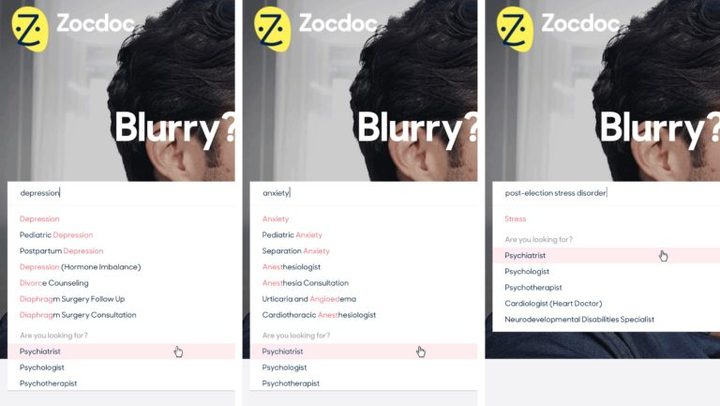
The secret is a machine learning algorithm derived from online medical literature, Zocdoc’s millions of users, and the more than 50 specialties and 1,000 different procedures that make up the app’s database of services. Zocdoc’s team developed a natural language processing model that can interpret human colloquialisms and “map” them, in effect, to specialties, visit reasons, and procedure types. Zocdoc calls it “semantic search.”
Patient-Powered Search’s machine learning algorithm works in tandem with “string-matching” technology that surfaces the most relevant results. A secondary AI, meanwhile, factors patient behavior into search results, automatically adjusting the ranking of selections based on popularity, trends, and other factors.
The end result is a measurable step up from the old system, a Zocdoc spokesperson said. Before People-Powered Search, users had to know the appropriate specialty for a given procedure and use precise medical terminology to describe their condition. Then, they had to select a specialist from a lengthy drop-down menu and select a procedure or reason for the visit from a pre-vetted list.
“[Zocdoc’s search feature] was working for millions of patients, but we knew we needed to evolve our search experience to one that was more dynamic, intuitive, and oriented around the patient,” a Zocdoc spokesperson said. “Patient-Powered Search lays an important foundation for the future.”
Patient-Powered Search is rolling out to Zocdoc’s mobile site and smartphone app this week.


