All kinds of strange phenomena exist in the universe beyond the boundaries of our solar system, and this week astronomers uncovered a new oddity: A planet several times the size of the dead star it orbits.
This odd couple was spotted using two NASA instruments, the planet-hunting telescope TESS (Transiting Exoplanet Survey Satellite) and the now-retired Spitzer Space Telescope.
The planet, WD 1856 b, is around the size of Jupiter, making it seven times the size of the white dwarf WD 1856+534, which it orbits around. A white dwarf is the remnant left behind after a star burns through all its fuel and dies, while still glowing hot. At the end of a star’s life, it swells to a huge size before collapsing to its core, and everything nearby to it, such as planets, is usually engulfed and destroyed.
But somehow, this particular planet survived, even though it is close enough to the white dwarf that it completes an orbit in just 34 hours. That’s 60 times faster than Mercury orbits the sun.
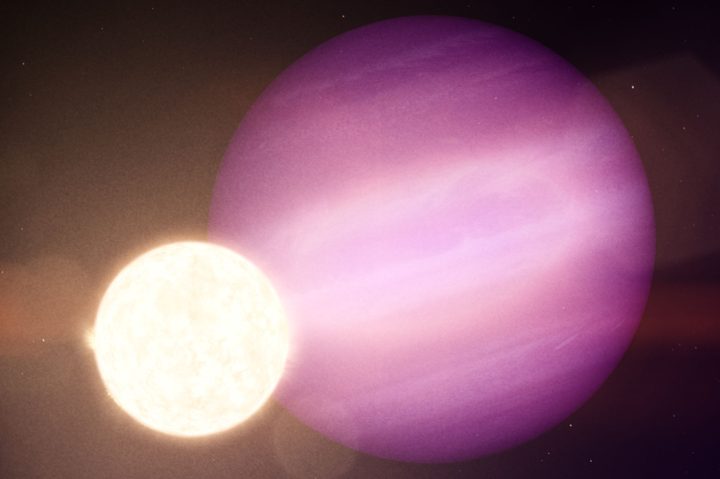
“WD 1856 b somehow got very close to its white dwarf and managed to stay in one piece,” Andrew Vanderburg, an assistant professor of astronomy at the University of Wisconsin-Madison, said in a statement. “The white dwarf creation process destroys nearby planets, and anything that later gets too close is usually torn apart by the star’s immense gravity. We still have many questions about how WD 1856 b arrived at its current location without meeting one of those fates.”
Astronomers are now debating how the planet could have survived. One idea is that the planet began its life further out from the star, but was pulled inward due to the white dwarf’s strong gravity. This phenomenon has been observed with smaller bodies, but has rarely been seen with something as large as a planet.
“We’ve known for a long time that after white dwarfs are born, distant small objects such as asteroids and comets can scatter inward toward these stars. They’re usually pulled apart by a white dwarf’s strong gravity and turn into a debris disk,” co-author Siyi Xu, an assistant astronomer at the international Gemini Observatory explained in the statement. “That’s why I was so excited when Andrew told me about this system. We’ve seen hints that planets could scatter inward, too, but this appears to be the first time we’ve seen a planet that made the whole journey intact.”
Possible explanations for this strange system include the theory that there were other large planets in the system, which affected WD 1856 b with their gravity, or even that other stars, such as the nearby red giants G229-20 A and B, could have exerted a pull on the planet.