1. Home
  2. Space
  3. News

Saturn’s moon Titan may be more Earth-like than we thought

Add as a preferred source on Google

Saturn’s moon Titan is one of the top destinations to search for life in our solar system, a tantalizing possibility that will be investigated by NASA’s Dragonfly rotorcraft which it launches to visit there in 2027. It is a strange place, with a thick atmosphere, rivers and lakes on its surface composed of liquid methane and ethane, then an icy crust, and a possible ocean of liquid water beneath. Now, new research suggests that this alien world might have more in common with Earth than previously thought, at least in terms of its seasonal cycle.

Researchers from Stanford University and NASA’s Jet Propulsion Laboratory have used computer models to analyze how Titan’s surface features like its dunes and plains might have formed. In between the rivers which cover its icy surface, there are also hydrocarbon sand dunes. Titan is considered potentially habitable because, in addition to being the only moon in the solar system known to have a substantial atmosphere, it has a seasonal liquid cycle that is comparable to Earth’s water cycle, with liquid running over the surface and evaporating up into clouds before raining down again. But instead of this cycle occurring with water, on Titan, it occurs with liquid methane and ethane.
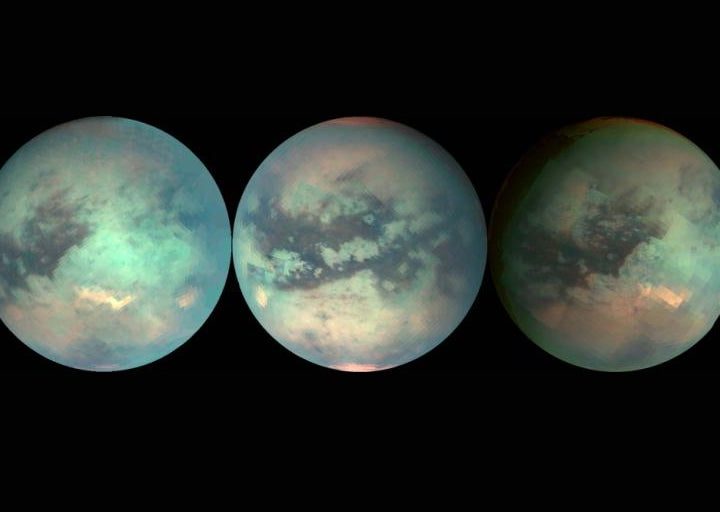
These three mosaics of Titan were composed with data from Cassini’s visual and infrared mapping spectrometer taken during the last three Titan flybys, on Oct. 28, 2005 (left), Dec. 26, 2005 (middle), and Jan. 15, 2006 (right). In a new study, researchers have shown how Titan’s distinct dunes, plains, and labyrinth terrains could be formed.
These three mosaics of Titan were composed with data from Cassini’s visual and infrared mapping spectrometer taken during the last three Titan flybys, on Oct. 28, 2005 (left), Dec. 26, 2005 (middle), and Jan. 15, 2006 (right). In a new study, researchers have shown how Titan’s distinct dunes, plains, and labyrinth terrains could be formed. NASA / JPL / University of Arizona

This seasonal cycle affects how dunes are created as well, formed from hydrocarbons which create sand grains. But sands on Earth are formed from robust silicate grains, and sands on Titan are formed from soft compounds which usually wear down into fine dust. How these compounds could form into grains that make dunes that have lasted for hundreds of thousands of years was an open question.

Recommended Videos

“As winds transport grains, the grains collide with each other and with the surface,” lead author Mathieu Lapôtre explained the problem in a statement. “These collisions tend to decrease grain size through time. What we were missing was the growth mechanism that could counterbalance that and enable sand grains to maintain a stable size through time.”

The researchers found that the answer could be due to a process called sintering, in which a bunch of fine particles joins together into a solid mass due to heat or pressure. This lets the grains grow in size, and is balanced out by the wear and tear of erosion which makes the grains smaller.

This, combined with the seasonal cycle on the moon, can explain how Titan ended up with sand dunes around its equator, plains around the mid-latitudes, and a type of complex terrain called labyrinth terrain near the poles. The different terrains are formed by different amounts of winds, which carry the sediment around, and rainfall and the flowing of rivers, which carve out structures in the terrain. That makes for a seasonal system remarkably similar to Earth’s in some ways, although using different compounds.

“We’re showing that on Titan – just like on Earth and what used to be the case on Mars – we have an active sedimentary cycle that can explain the latitudinal distribution of landscapes through episodic abrasion and sintering driven by Titan’s seasons,” Lapôtre said. “It’s pretty fascinating to think about how there’s this alternative world so far out there, where things are so different, yet so similar.”

Georgina Torbet
Georgina has been the space writer at Digital Trends space writer for six years, covering human space exploration, planetary…
Space is becoming Bezos and Musk’s next data center site, and we have every reason to worry
The AI boom is coming for the night sky
How Vast's space station will look in orbit.

AI data centers already consume vast amounts of electricity and water on Earth, so Silicon Valley has begun looking somewhere considerably more spacious... literally.

Elon Musk's SpaceX and Jeff Bezos' Blue Origin, along with several other companies, have proposed enormous constellations of satellites designed to operate as orbital data centers. However, environmental groups and former space officials are now warning that putting them into orbit at the proposed scale could have severe consequences for Earth's atmosphere and the night sky.

Read more
The first possible exomoon is here, and it makes our Moon look hilariously tiny
Scientists may have found the first exomoon, except this one is the size of Jupiter
This artist’s concept depicts a potential volcanic moon between the exoplanet WASP-49 b, left, and its parent star. New evidence indicating that a massive sodium cloud observed near WASP-49 b is produced by neither the planet nor the star has prompted researchers to ask if its origin could be an exomoon.

We have already discovered more than 6,000 planets outside of our immediate neighborhood. Yet, finding a moon orbiting one of those distant worlds has proved considerably harder. Astronomers may finally have something close to the real deal, but this particular object stretches the word “moon” almost beyond recognition.

Using the European Southern Observatory’s Very Large Telescope in Chile, researchers detected strong evidence for a moon-like object in the CD-35 2722 system. Further observations are still necessary to confirm the discovery, but it could become the first confidently detected natural satellite outside our solar system. There is still one tiny complication though. This moon is apparently massive.

Read more
China’s answer to SpaceX’s reusable rockets literally catches boosters in a net
SpaceX catches boosters on legs. China just used a net.
Ammunition, Missile, Weapon

SpaceX's playbook for recovering a rocket booster generally involves legs, a precisely controlled vertical landing, and either a concrete pad or a drone ship. 

China just managed to pull off something similar, but in a slightly different way, and on July 10, it tested the method as well.

Read more