Wealthy adventurists, rejoice! For a mere $75,000 per ticket, you will soon be able to take a balloon ride up nearly 100,000 feet into Earth’s atmosphere, courtesy of World View Enterprises, whose lofty excursion received approval this week from the Federal Aviation Administration.
World View’s ‘Experience’ voyage promises a “gentle” 90-minute ride to an altitude of approximately 19 miles (30km), where passengers in the “luxuriously appointed space-qualified capsule” will be able to gaze upon “the curvature of the Earth with their own eyes,” according to the company. Passengers will remain at that height for two to six hours before floating back to solid ground, which is said to take between 20 and 40 minutes.
Though the high price tag will shut out most of us, World View CEO Jane Poynter says she hopes the ‘edge of space’ voyage instills in passengers a newfound understanding of humanity, and opens a “whole new realm” for scientific endeavors.
“Seeing the Earth hanging in the ink-black void of space will help people realize our connection to our home planet and to the universe around us, and will surely offer a transformative experience to our customers,” said Poynter in a statement. “It is also our goal to open up a whole new realm for exercising human curiosity, scientific research and education.”
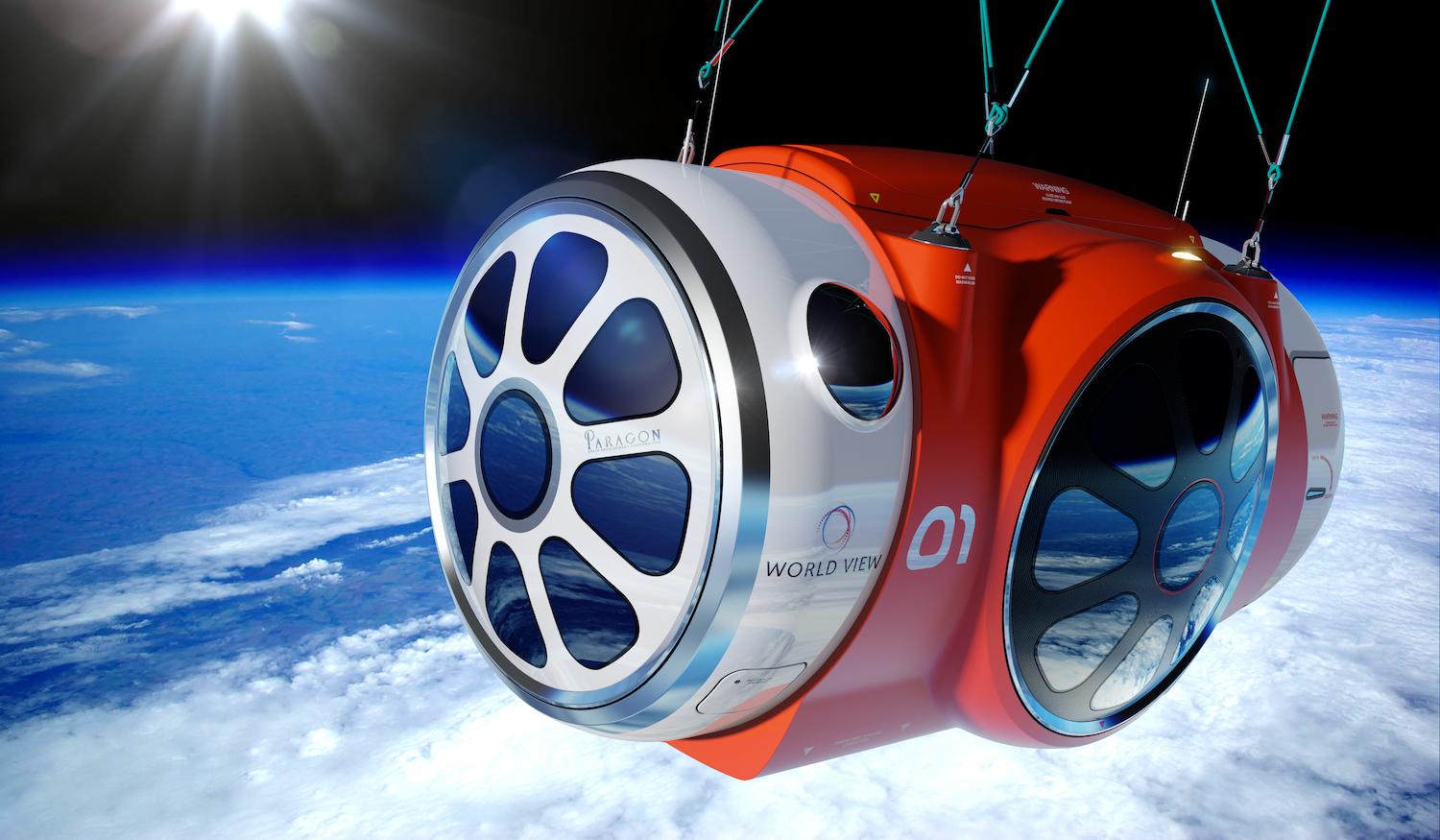
The futuristic space capsule and balloon system was designed by Paragon Space Development Corporation – a company co-founded by Poynter and decorated inventor Taber MacCallum more than 20 years ago – which also develops a wide assortment of equipment for extraterrestrial life, from the NASA’s next-generation space suits to “regenerative life support” systems to allow for plant and animal growth in space.
The capsule holds up to eight passengers, who are protected from the “near-vacuum, radiation, micrometeoroid, and extreme thermal environment of outer space,” according to the FAA’s approval announcement (pdf). It will also be pressurized to allow for normal breathing, and a thermal control system will keep riders comfortable.
A large polyethylene helium balloon will be used to lift the capsule and its riders from a launchpad at Spaceport America in New Mexico, while a steerable parafoil allows the craft to float safely back to Earth – and keeps everyone from plummeting at terminal velocity should the balloon fail.
World View’s high-flying balloon ride is only the latest in a burgeoning commercial space industry. Sir Richard Branson’s Virgin Galactic offers seats aboard its space-capable rocket plane for $250,000 apiece. Meanwhile, Tesla founder Elon Musk’s SpaceX may one day offer $500,000 tickets to Mars.
Fun side note: Poynter and MacCallum first came to fame in the early 1990s after spending two years inside the $200 million Biosphere 2 research facility in Arizona – a feat later parodied in Pauly Shore’s stoner classic Bio-Dome.
Watch a concept video of World View’s balloon ride in action:


