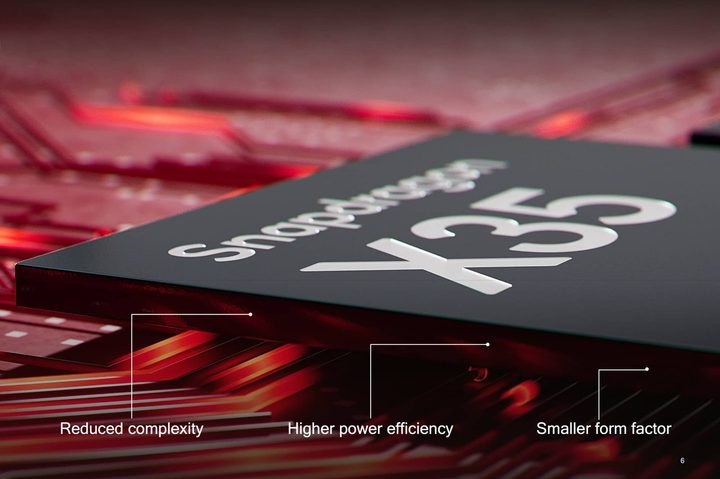
Qualcomm is poised to deliver 5G capabilities to a whole new class of mobile devices with a new modem chip that bridges the gap between today’s best smartphones and much lower-bandwidth devices like payment terminals and home accessories.
Announced today, Qualcomm’s Snapdragon X35 5G Modem-RF system is the world’s first to adopt NR-Light, a new 5G standard for midtier devices that don’t require the power and performance of a 5G-capable smartphone or tablet — but can still take advantage of the lower latency and power consumption offered by 5G technology.
Filling the 5G void
NR-Light, also known as “RedCap” (reduced capability), is a new 5G platform that was finalized last year to fill the void that existed between high-bandwidth 5G chips and radios designed to drive ultrafast mmWave and aggregated sub-6 speeds, such as Qualcomm’s Snapdragon X70, and extremely low-bandwidth Internet of Things (IoT) devices.
The 5G radios used in cell phones consume quite a bit of power. While they arguably don’t use much more than the 4G/LTE radios that came before, the issue of lower-power LTE chips was solved over six years ago — around the time the Samsung Gear S3 and Apple Watch Series 3 both showed up to take wearable cellular devices mainstream.
That was about six years after 4G/LTE smartphones showed up, so Qualcomm is a bit ahead of the game with the Snapdragon X35. Nevertheless, like most new Qualcomm chips, it will take a while to find its way into consumer devices; the company says not to expect the first of these to show up until early next year.
Why you need 5G on a smartwatch
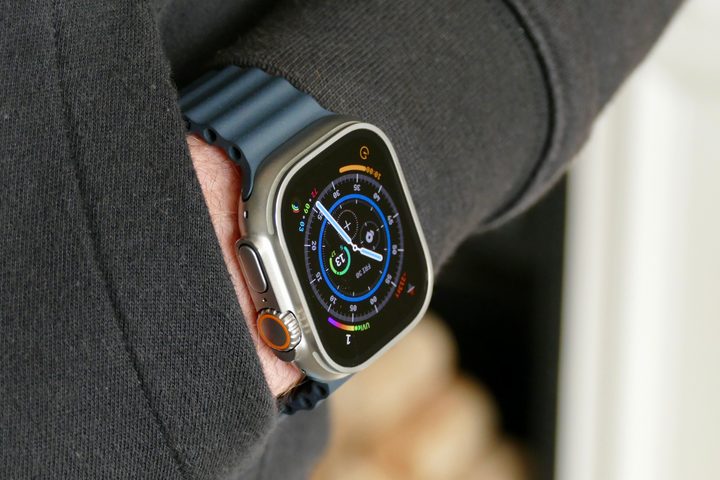
You may be asking yourself why a device like a smartwatch needs 5G. After all, even if you’re strapping on an Apple Watch Ultra or a Galaxy Watch 5 Pro, it’s not like you’ll be streaming videos or downloading large files.
However, it’s important to understand that there’s a lot more to 5G than just raw speed. Sure, the latest 5G chips can push wireless rates into the gigabit range, but few people even need that kind of performance on a smartphone. It may be cool to see high numbers on speed tests, but that’s not what matters the most about 5G.
Instead, the higher bandwidth offered by 5G makes room for many more devices to get connected — and stay connected — even in the most crowded places. That’s already a huge bonus for anybody who has ever attended a concert or football game or tried to stay connected in a busy airport. However, it’s going to become more crucial as even more devices begin to connect directly to public wireless networks rather than localized Wi-Fi networks.

There’s another performance measurement that many folks don’t realize: latency. The big flashy Mbps or Gbps number on your speed test may look impressive, but that only shows you how fast a single stream of data can be delivered to your device. It’s great when downloading large files or streaming a single video, but it’s not nearly as important for the dozens of smaller things we do with our devices every day. Things like checking social media, receiving notifications, tracking workouts, and navigating on a map all require the exchange of many smaller chunks of data, and that’s where the lower latency of 5G comes into play. This is what makes everything smoother and snappier when doing things over a 5G connection.
A big step into the future of 5G connectivity

There’s an even more important reason why every class of mobile device eventually needs to embrace 5G, and that’s simply that it’s the way ahead for wireless technology. It will eventually be necessary for 4G/LTE networks to ride off into the sunset, and the faster that 5G gets adopted across the board, the sooner that can happen — and there’s a very good reason why it needs to.
This isn’t just about decommissioning older technology. Existing 4G/LTE networks are actually getting in the way of 5G reaching its full potential. Most low-band 5G frequencies share the airwaves with 4G/LTE signals, and 5G traffic has to yield to the older and less efficient LTE traffic. Fewer 4G/LTE devices mean better performance for the 5G devices that use those frequencies.
The Snapdragon X35 also isn’t just for smartwatches; although that will likely be one of the most popular uses for it in the short term, Qualcomm envisions its chip powering next-generation XR glasses, personal health monitors, retail terminals, security cameras, and more affordable industrial IoT devices and mass tier connected PCs and routers. In addition to standard 5G data connectivity with peak speeds of up to 220Mbps, it also offers support for Voice over 5G and 4G and precise positioning for locating devices in campus and factory environments.
The Qualcomm Snapdragon X35 will begin rolling out to device manufacturers by this summer, with the first commercial mobile devices featuring the chip expected to arrive in the first half of 2024.