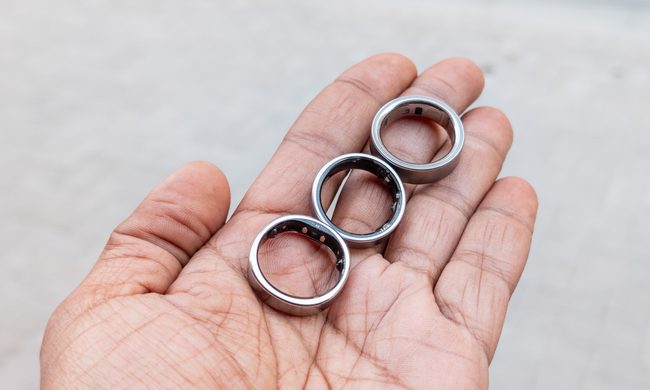
Bangles that purport to infer your emotional state have been fixtures for decades. Arguably the most recognizable of psychoanalytic accessories, the mood ring, was invented in 1975 by two enterprising New York jewelers who bonded a color-changing liquid crystal thermometer with quartz stones. Short of headphones that match songs to your calmness and clip-ons that suss out your stress level, a truly accurate sentiment detector has so far remained the stuff of fantasy.
But Planextra, a startup with a medical pedigree, has achieved what it contends is something historic: one of the world’s most precise emotion-tracking wearables. The Sence, a rectangular plastic band that secures tightly around your wrist, detects 64 different emotions, the company claims. And it does so with a sensor “250 more accurate” than the sensors on most activity bands, rings, and headbands.
Sence didn’t set out to make a wristband, interestingly enough. The company of 13 physicists and engineers, which spent nearly two years refining a method of reading a person’s emotional state based on their heart rate, hoped to license its sentiment-sensing software to Fitbit, Misfit, Apple, or one of the dozens of other incumbents in the wearable industry. But there was a problem: none of the most popular trackers on the market had sensors capable of the detail Sence’s algorithms required. Most relied on photoplethysmography, or a means of measuring heart rate by bouncing visible light off of pulsating blood vessels.
The Sence takes a different tack. It uses electrocardiography (ECG), a technology that records the heart’s electrical activity. (Picture a glowing green EKG machine in a hospital.) It’s not exactly novel — the underlying science has been around for decades, and the Sence is far from the first to implement it. But the company maintains that its sensor, a patent-pending design that the company engineered in-house, delivers medical-grade accuracy.
Three metal contacts arranged in a triangular pattern on the Sence’s underside measure heart rate. The upper two continuously poll the heart’s electrical output, while the third — tuned specifically to the sort of pulses produced by the skin, brain, and other organs — measures electrical interference. The subsequent supersample is the cardiographic equivalent of a “noise cancellation” mode on headphones: outliers and inaccuracies are filtered in real time from the Sence’s output.
It’s all visible in Sence’s mobile companion app for iOS and Android in the form of a bar graph, which shows a readout of both current and historical heart rate. But the Sence’s true magic trick is the app’s “analysis” mode, which performs the wearble’s advertised function: determining your emotion from the distances between electrical peaks.
It’s based on the science of “heart rate variability,” or the valleys between the electrical high points produced by the heart’s right ventricle muscle. Variations in those distances indicate the relative dominance of the body’s sympathetic, or “fight or flight,” nervous system at any given time — shorter distances between peaks imply fear, stress, or anxiety, while longer distances indicate calmness.
But the Sence gets a bit more granular than that. Algorithms spit out a percentage reading for more than 40 emotions including nervousness, euphoria, exhaustion, aggression, calmness, anger, sadness, and enjoyment. It’s like self-psychoanalysis: an analysis within the Sence app may indicate contentedness, for example, but with an undercurrent of anxiousness.
An initial, baseline analysis takes about four minutes, a company spokesperson said, but the Sence takes at least “a few days” to calibrate to the idiosyncrasies of specific heart rates. Once tuned, it performs measurements on 15 minute intervals — measurements that’ll be recorded on a digital calendar, if you choose to attach one.
The real value in Sence, Planexta claims, is the insight it delivers: the ability to look back and see how certain events — meetings and workouts, for example — affected your emotional state. And that has the potential to transform lives for the better, co-founder Tetiana Botsva said. “Our goal was to create something that could help us better understand our overall health with seamless integration and portability,” she says in a press release. “With features like calendar integration, Sence can tell wearers when and why they feel happy, sad, or stressed, and coach them on how to emphasize the good and reduce the bad in their life.”
Time will tell just how the Sence holds up to scientific scrutiny. But if anything about the wearable is for certain, it’s one of the most promising emotion-tracking accessories to hit the market yet.
The Sence launches on Kickstarter today.