
“The Sony Handycam HDR-CX130 is an excellent tool for capturing video memories. It doesn’t have all the features in the world but it won't run you $1,000 either.”
- 30x wide-angle lens
- Excellent AVCHD videos
- 3-inch touchscreen LCD
- Nice compact design
- Poor 3.3MP photos
- Make sure you set LCD to bright when in tough sunlight
- Some inscrutable icons
“Why you can trust Digital Trends – We have a 20-year history of testing, reviewing, and rating products, services and apps to help you make a sound buying decision. Find out more about how we test and score products.“
The Flip is heading for extinction but it’s not the end of the camcorder world. There are tons of options available such as the new Sony CX130, a video maker that blows Flips and their kindred spirits out of the water. Now let’s see if it’s worth more than twice the price…
Features and Design
We’ll admit to camcorder snob status. Pocket Cams like the The Flip never held any quality appeal. For some dumb reason, we preferred camcorders with optical zoom lenses rather than digital zooms, stereo sound versus mono and higher-quality AVCHD video. We also liked shooting with a larger LCD screen and having a more comfortable form factor. What a shock to feel this way! Yet The Flip’s low price and easy uploads ruled the day until corporate incompetence killed it off. For the record, it won’t be really, really dead until the end of 2013. The Flip did one really good thing, however—it forced Sony, Canon, JVC and Panasonic to drive down the cost of their basic AVCHD models. Now you can readily get one for under $300, still more than a Pocket Cam but with capabilities so far superior it’s ridiculous. Enter the new Sony HDR-CX130, one of the company’s lowest-priced high-def video makers available (the CX110 is about $50 less).
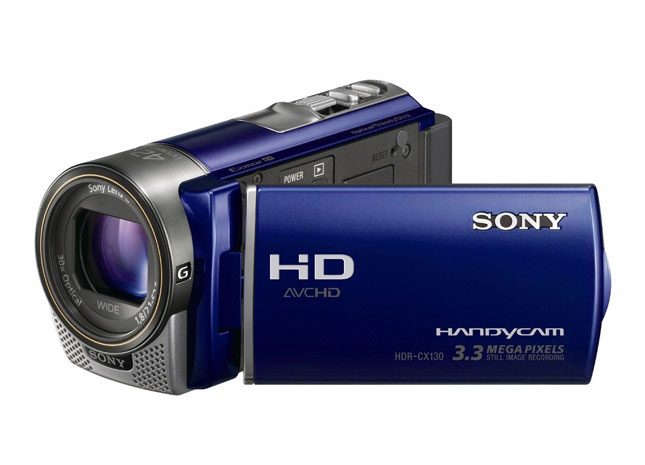
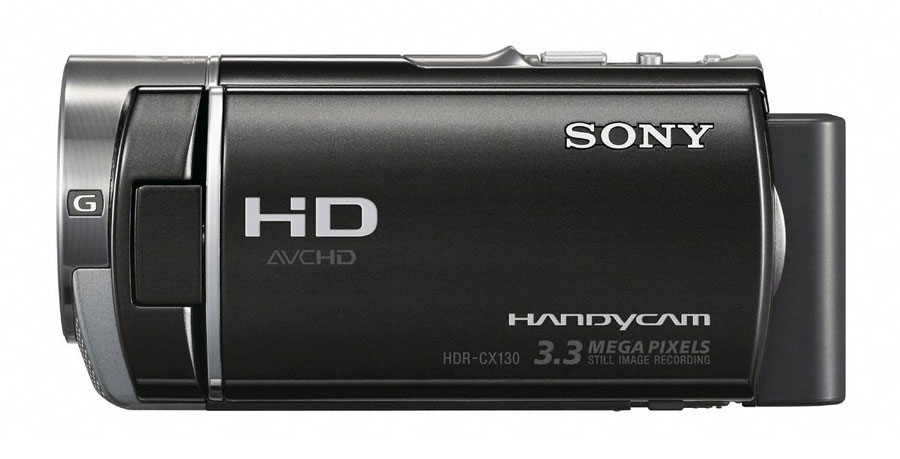
Several things stand out about the CX130: First off, it’s really small, weighing a little less than 11 ounces with the battery, measuring 2.1 x 2.25 x 4.9 (WHD, in inches). We had no trouble carrying it around, simply popping it into a jacket pocket. The camcorder is available in silver, blue and black. Our review sample was a dark royal blue with silver accents and it looked kind of cool. Sony’s to be commended for their soft-stated design with a minimal amount of screaming logos and annoying text. Check out the pictures.
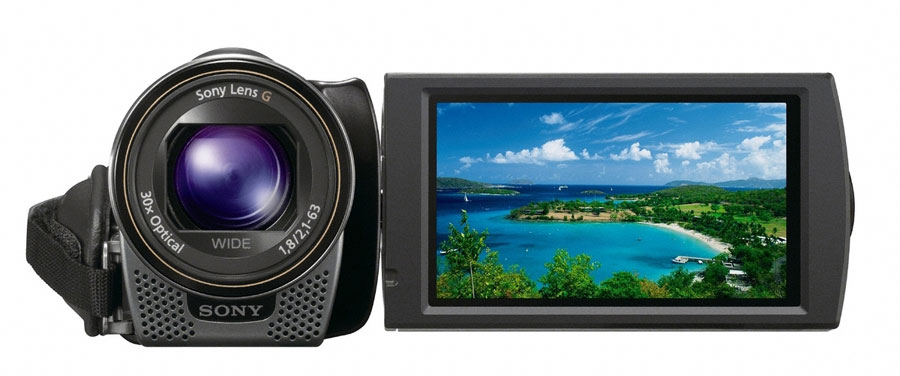
The front of the CX130 has one of great features that puts all Pocket Cams to shame—an optical zoom lens. In this case, it’s a 30x Sony G lens. Better yet, as part of a growing trend, it starts off with a wide angle of 29.8mm and reaches 894mm. Now it’s much easier taking videos indoors and they’ll have a nice perspective with everything you shoot at around 30mm. Needless to say, you can record things you can barely see. You can go zoom crazy but you’ll really appreciate the wide angle–especially shooting an intimate gathering of friends and family. Below the lens, which has an auto lens cover, is a stereo mic; another thing you won’t find on most Pocket Cams.
The right side has a compartment for DC-in and A/V out. Usually we gloss over the adjustable Velcro strap but here Sony’s done something rather ingenious. They’ve designed a USB connector (about 2 inches long) that fits into the strap so it doesn’t flop around. Pull it out and you can connect the camcorder to your computer. Uploading isn’t as simple as the Flip, but it’s a start. We have front USB-ins on our desktop and seeing the camcorder hanging from the short cable initially didn’t inspire confidence, but fortunately Sony supplies a long USB extension cable so we could place it in a less precarious position. As we said, it’s a start. This connection will also charge the battery albeit very slowly.
On the back is the slot for the battery which lasts for 150 minutes, a record button and indicators for your mode (movie/still). You easily switch between them by pressing the mode button on the top of the camcorder. Nearby are a shutter button and a wide/tele toggle switch.
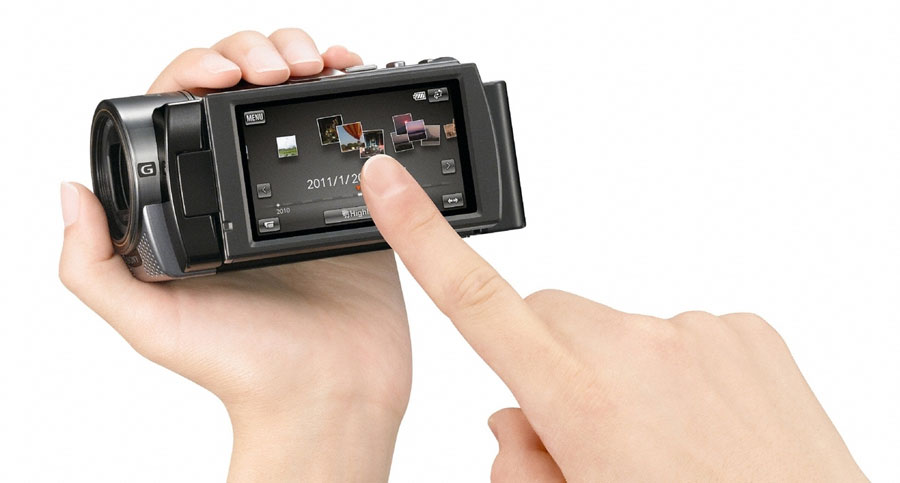
The left side has a flip-out 3-inch LCD touchscreen rated a decent 230K pixels which we’ll get into in the Performance section. On the body are just power and playback buttons as well a small speaker. A compartment has USB and mini-HDMI outs. On the bottom of the Made In China camcorder is a metal tripod mount and a slot for either Memory Stick Pro Duo or SD cards (up to HX Duo and SDXC). Since this is the only memory you’ll have available, a high-speed card of at least 8GB should be the minimum (that’s 35 minutes of 1080/60p best quality footage); 16GB makes more sense. That’ll let you take around 10,500 3.3MP stills in case you were wondering.
What’s In The Box
You’ll find the camcorder, battery, AC adaptor, 70-page Operating Guide, component and A/V out cables and the USB extension cord. The supplied CD-ROM has Picture Motion Browser ver. 5.5 and the full Handycam Handbook as an 108-page PDF.
Performance and Use
The Sony Handycam HDR-CX130 has a ¼-inch 4.2-megapixel backside-illuminated CMOS chip so it captures 1920×1080 video and 3.3MP stills. We set the camcorder to highest resolution in all modes then proceeded to put it through its paces. When done, prints were made while images were reviewed on our monitor and videos shown on a 50-inch Panasonic plasma using the SD card slot.
Before getting into the details, we’ll state the touchscreen worked well—for the most part. We took the CX130 to the Jersey Shore on a very sunny day and the screen was useless at high noon. A tough test, yes but still. Come on, guys. Fortunately, the Bright menu setting saved the day; it wasn’t perfect but we could frame the scenes and use the onscreen controls. In fact, we found ourselves using the onscreen controls to zoom the lens in many instances as well as to stop/start recording. The interface and menu system is very straightforward and understandable. Note: the CX130 has very few manual controls so if you want to adjust aperture and shutter speed, please look elsewhere. Since this is an aim-and-forget model, most people won’t even care – but just be aware. Also this camcorder captures 1080/60p video. In order to engage it, you have to adjust the frame rate in the menu system—it’s not under HD/SD quality which you would think would be the logical spot. That was a bit strange and a few of the small icons were inscrutable but a quick peek at the Operating Guide solved the puzzles. Now onto the results…
 We shot many videos and stills at the Shore as well as indoors to see how the CX130 handled low light. First, the clips of the beach were outstanding. Colors were spot on with the kind of accuracy you’ll love. Good reds, yellows and blues. It captured what we saw—which is just what you want from a camcorder. There was barely a hint of noise and nary a compression artifact in sight. The camcorder handled backlighting very well. We captured the interior of old building on the boardwalk in Asbury Park, panning from the dark walls to a bright sunlit opening, then to the walls on the far side. The CX130 handled these tough exposures every well. We have to state the wide-angle lens is also great indoors as you get a much more expansive view. As for outdoor scenics, it can’t be beat—especially as you have an outstanding focal range. Pocket Cams? A 5x digital zoom is a joke by comparison.
We shot indoors using the Intelligent Scene mode with auto white balance. There were fluorescent lights in the hallway and in Auto the clips were way off; switching to the Indoor WB setting results were much better. The paint now resembled reality rather a hallucination. Still photographs, on the other hand, were mostly a bad dream.

The CX130 takes 3.3-megapixel images and they’re pretty bad. Details were practically nonexistent and sharp edges were hard to come by. Colors were O.K. but without the video’s pop. Our best work came from a close-up of a mime’s face—and even that didn’t have the detail one expects in 2011. Granted we’ve tested some quality digicams lately but large prints are really out of the question. They’d be OK at 4×6 if you didn’t look too closely. That may be harsh but as always we call ‘em as we see ‘em.
Conclusion
The Sony Handycam HDR-CX130 is an excellent tool for capturing video memories. It doesn’t have all the features in the world but it doesn’t cost $1,000. Basically a point-and-shoot with a few tweaks, it does a fine job indoors and out. You’ll be happy with your movies—and the wide-angle 30x zoom is outstanding. Photos aren’t in the same league so our search for the perfect two-in-one device continues.
Highs:
- 30x wide-angle lens
- Excellent AVCHD videos
- 3-inch touchscreen LCD
- Nice compact design
Lows:
- Poor 3.3MP photos
- Make sure you set LCD to bright when in tough sunlight
- Some inscrutable icons