“Sony’s flash-based HDR-CX520V produces respectable video with cool frills like GPS geotagging, if you can swallow the price tag.”
- Compact, lightweight
- Full AVCHD video
- 64GB onboard memory
- 12x optical zoom
- Excellent OIS system and sound
- Expensive
- Flash stills fine, poor unless enough light
- LCD should be better
- No electronic viewfinder
“Why you can trust Digital Trends – We have a 20-year history of testing, reviewing, and rating products, services and apps to help you make a sound buying decision. Find out more about how we test and score products.“
Introduction
It was hard walking the aisles at CES without tripping over mounds of flash memory camcorders like the Flip. Harder to find were higher-quality “real” camcorders with zoom lenses and much better high-definition (HD) performance. Oh, they were there all right – if you could fight your way through the crowds ogling 3D HDTV demos. Once you found them though, one huge trend beat you over the head—the fact that 2010 is a flash memory camcorder world as tape, disk and even HDD models fade away. A fine example of a top-quality unit being the Sony Handycam HDR-CX520V, which is about as far from a Flip as you can imagine. To find out just how far, read onward…
 Features and Design

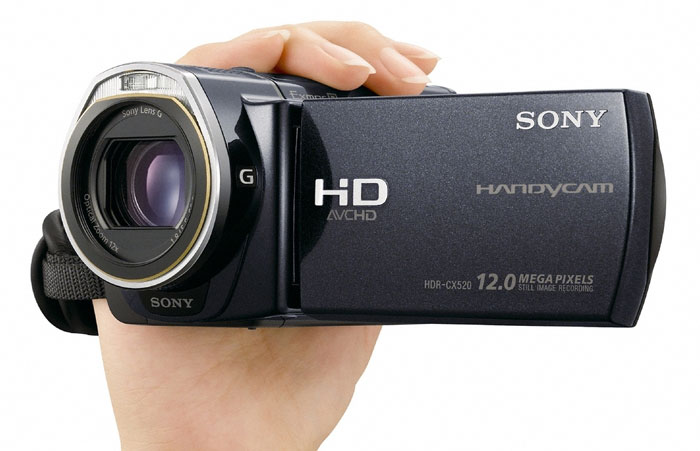
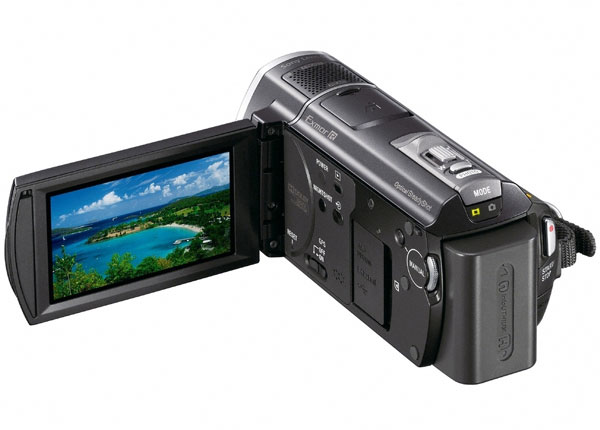
One of the key reasons flash memory video cameras are wildly popular is the fact that they’re so much smaller and lighter than other storage types. Consider that the Sony Handycam HDR-CX520V weighs just a pound with battery, making it easy to carry around without your arm falling off. Since it has 64GB of built-in memory (not counting the Memory Stick Pro Duo card slot), it’ll capture almost 8 hours of Full HD video (460 minutes to be exact) – more than enough for most users. The basic black model has nice, sweeping lines and measures 2.5” wide, 2.67” tall, and 5.37” deep.
The camcorder has a 12x optical zoom (150x digital) with a range of 43-516mm, which blows away any low-cost flash cam, since typically these devices only have digital zooms. Nestled above the better-quality Sony G lens is a flash to help with your stills. On top is a 5.1-channel stereo mic, a hot shoe, zoom toggle switch and a dedicated button for taking snapshots. On the right side is a comfortable Velcro strap and on the body is a GPS sensor for geo-tagging your videos. (Think you’ll find that on a Flip?)
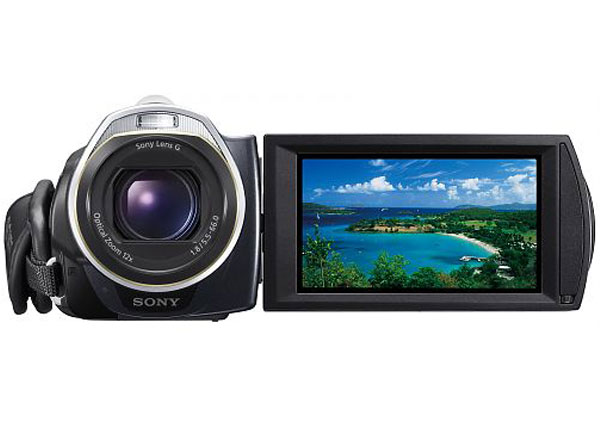 The left side has a swing-out 3” 16:9 format LCD monitor rated an OK 230K pixels. Even with fewer pixels than we’d like, it handled well, even in direct sunlight. As a touchscreen unit, you’ll make almost all of your menu changes by tapping. The menu system is very easy to navigate and you hardly need the supplied abridged 68-page owner’s manual other than to field some options that were a bit hard to discern such as changing the manual settings. Unlike other high-priced camcorders such as the Canon Vixia HF S10/S11, there is no electronic viewfinder. (Thankfully, we didn’t miss it.) There are just a few buttons opposite on the body including NightShot, GPS on/off, power, playback, and one-touch DVD burn along with the card compartment which has the mini HDMI output. There’s also a small speaker and dial to make manual adjustments you dedicate (focus, exposure, AE shift, white balance). On the back are mode (video/camera) and record buttons along with DC-in for charging the battery.
What’s In The Box

The HDR-CX520V comes with everything you need other than a Memory Stick Pro Duo card and a mini HDMI cable. With 64GB of memory onboard, you really don’t need a card unless you use a reader to download stills. The CD-ROM has Picture Motion Browser Handycam software ver. 4.2.14 for handling videos and photos. There’s also a complete 127-page manual as a PDF. With a charged battery we headed to Las Vegas and beyond to conduct a full range of tests.
Performance and Use
All camcorders are ridiculously easy to use, and the HDR-CX520V is no exception. Charge the battery, open the LCD panel, it’ll power up and you’re ready to hit record. This Sony model has a 6-megapixel Exmor R CMOS sensor, meaning it records Full HD 1920x1080i video at 16 Mbps and 6.2MP stills (or 12MP if you opt for the interpolated versions). We tried both, as well as shooting loads of video on the Las Vegas strip at night at best quality. One of the company’s claims about the Exmor R sensor (also found on its digicams is the ability to record in low light with very low noise. Suffice it to say that the Strip and other locations gave it a good workout. It also gave the optical image stabilization a test since we shot videos driving down the canyon of neon.
After recording lots of footage and stills it was time to review the videos on a 50-inch plasma and to make prints of 6- and 12-megapixel photos. Before getting to the $999 question, let’s report that the HDR–CX520V is easy to operate with logically-placed controls, and that the lighter weight made for effortless portability—no small concern for a camcorder. The geo-tagging is a real plus since you can find a photo or video just by tapping the pushpin icon on the maps. This is a definite bonus for vacationers.
 Now for the good stuff. The camcorder did a fine job recording the Strip’s various sights with accurate colors and deep blacks, but there was some noise in darker areas. In other instances where there was a good light source (daylight or good ambient light) results were good as well. They’re just not as superior as the results offered by the Canon HF S10 or JVC –HM400. The key difference—besides sensor size—is the fact the other two models record at 24 Mbps versus 16 for the Sony, making for a very noticeable difference. And the stills were a very mixed bag, leaning toward the bad. Photos taken with the flash and in good light were solid (shot at 6.2MP), but we wouldn’t bother with the 12MP option—there was way too much noise. Furthermore, in both instances, the camcorder did a poor job in low light with speckles galore. This was really disappointing. On the plus side, Face Detection worked well, the OIS did an excellent job smoothing out the shakes and audio quality was top-notch, far better than most competitors.
Conclusion
The Sony Handycam HDR-CX520V is a good, but not great camcorder. You’ll be happy with its video output, yet much less so with still photos, which are of strictly average quality with enough light or with the flash. (The 8MP Canon HF S10/11 and 10-megapixel JVC HM400 being the best rivals we’ve used.) As such, even with its easy-to-use operation and packed feature set including geo-tagging, the unit’s not worth $999, the lowest legitimate online price. Bear in mind that Sony will introduce a new top flash memory model—the CX550V—in February for $1,299. It has a wider-angle lens, but 10x rather than 12x; a larger higher-quality LCD; and a viewfinder along with better compression rates (24 Mbps) with 60P output, making it worth the wait and the extra bucks.
Highs:
- Compact, lightweight
- Full AVCHD video
- 64GB onboard memory
- 12x optical zoom
- Excellent OIS system and sound
Lows:
- Expensive
- Flash stills fine, poor unless enough light
- LCD should be better
- No electronic viewfinder