“The GTX 1060 games smoothly, but Zotac’s amped-up version is pricey.”
- Compact for a GTX 1060
- Smooth 1080p performance
- Cool, low-power operation
- Solid feature set
- Price is higher than similar cards
- No specific feature justifies the price
“Why you can trust Digital Trends – We have a 20-year history of testing, reviewing, and rating products, services and apps to help you make a sound buying decision. Find out more about how we test and score products.“
For the last few generations, Nvidia’s GeForce line has dominated the GPU market. The GTX 750 Ti was the budget card of choice, and still is for some gamers, while the newer GTX 970 stole an astonishing five percent of the Steam Hardware Survey. The GTX 1060 should be poised to strike as the budget card of choice, starting at just $200 for a three gigabyte version, and $240 for twice the graphical memory.
The GTX 1060 can skate by with just 120W of total power, the same as the GTX 960.
But the GTX 1060 faces tough competition from the aggressively priced AMD Radeon RX 480. The newest Radeon is targeting the sub $300 price point as well, a segment where Nvidia has struggled in the past.
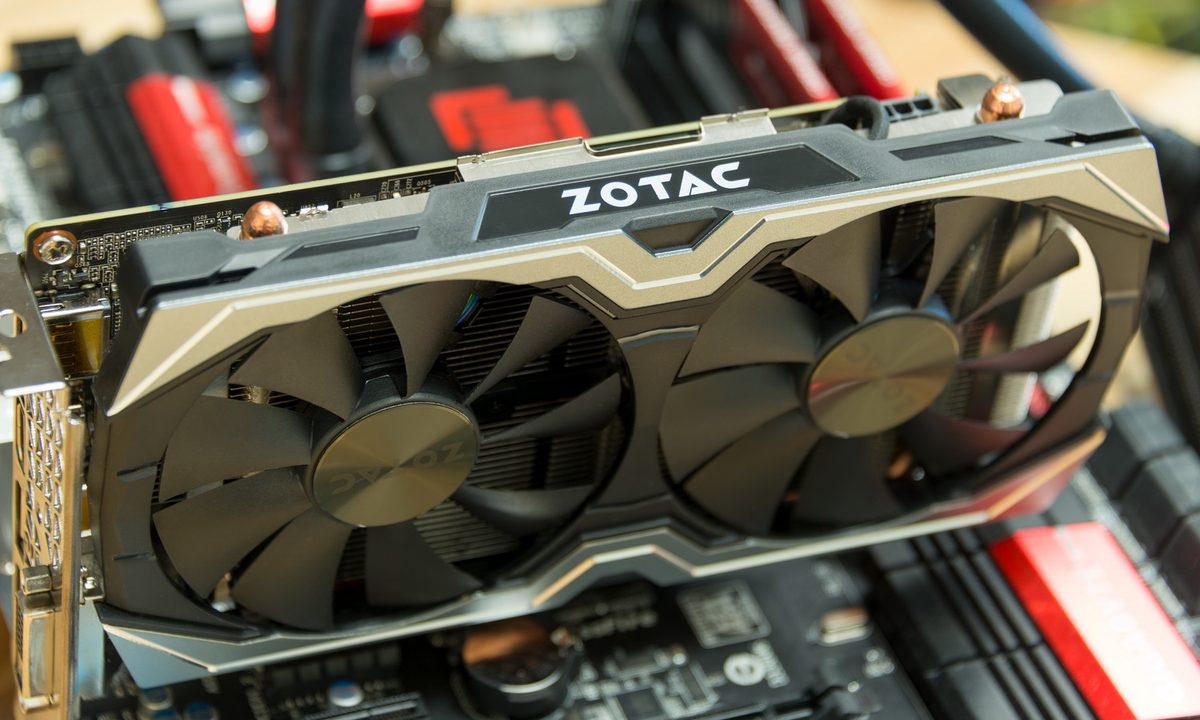
This particular review is of the Zotac GeForce GTX 1060 AMP! A custom card, the AMP! has a unique cooler that makes the card a bit smaller than its peers, and factory overclocking is included. It’s also a 6GB model, offering double the memory found on a barebones GTX 1060.
These features aren’t free, and they inflate the price to $280, putting this Zotac near the top of the GTX 1060 range. Which begs the question – how much is a GTX 1060 really worth?
The Platform
Nvidia’s Pascal architecture brought a number of performance improvements to the GeForce line, but that wasn’t the biggest change. The move to 16-nanometer construction means a huge boost to power efficiency. A GTX 1060 can skate by with just 120 watts of total power, the same draw as the GTX 960.


There are other under-the-hood changes too, like increased support for DirectX 12 (feature level 12_1, to be exact), compatibility with virtual reality headsets like the Oculus Rift and the HTC Vive, support for the new Vulkan API, and Nvidia’s in-game photography engine, Ansel.
The youngest sibling
As the current budget-friendly card in the 10 Series, there are a few key difference between the GTX 1060 and the 1070/1080 above it. It’s a different GPU, in fact, called the GP106 — as opposed to the GP104 found in the higher-end cards. However, both are based on the same underlying “Pascal” architecture.
There are two different versions of the GTX 1060, a 3GB and 6GB model. The version with less graphical memory also features 1,152 CUDA cores, instead of the full 1,280 CUDA cores found in the larger model, but the GPUs are otherwise identical. They both have a 1,506MHz base clock and 1,708MHz boost clock, with GDDR5 memory running at 8Gbps over a 192-bit interface.
Design-wise, the GTX 1060’s PCB is a bit shorter than the GTX 1070 and GTX 1080. On the reference model, the blower fan adds the extra length back to the end, and moves the PCIe power connections out further.
On our Zotac AMP! review model, the whole card is just eight and a half inches long, two inches and change shorter than the GTX 960, and an inch shorter than the GTX 1060 Founder’s Edition. That’s a nice reduction in size, and provides one immediate reason why you’d buy the Zotac model over the reference design.
It’s worth noting the GTX 1060 doesn’t have any SLI connections. That’s probably for the best, as we’ve never been fans of multi-card setups. While they can certainly run impressively in some conditions, the driver issues and power draw are rarely worth the effort. Certainly, there are some who will bemoan the choice, but Nvidia is right. If you want better performance, you should shell out for a better card.
Performance
Now that the technical information is out of the way, we can get down to actual testing. Zotac’s GTX 1060 AMP! is packed with 6GB of GDDR5 memory, and features a modest overclock to a 1,556MHz base clock and 1,771MHZ boost clock.


Our synthetic benchmark provides us with a general idea of where performance testing is headed. Without any of the anomalies caused by specific drivers and games, or by human error, we can draw consistent lines across the performance level of all the cards.
The Zotac GeForce GTX 1060 AMP! comes in just a tad ahead of the Radeon RX 480 8GB, but not by much. Also illustrative is the GTX 960 result, which is about 40 percent lower. The 1060 provides a strong generational leap.


Things look a bit different in our real-world testing. While the GTX 1060 runs all of the games in our test suite smoothly at 1,920 x 1,080, so does the RX 480.
The two cards trade blows across several games, and mostly stay over our 60 frame per second goal until the settings climb at 2,560 x 1,440. The GTX 960 and 950 fall well behind both cards, but they’re also well under $200.
So does the previous generation’s GTX 970, which falls into a slightly higher, but comparable price range. That doesn’t necessarily mean it’s a better choice, though, especially considering the new features and improved power draw, but it’s definitely worth noting.
Our Take
The GTX 1060 AMP! we tested is on the high end, selling for $280 at most retailers.
Which is a problem. The GTX 970 is still a reasonable performer, and can be had for under $300 (in fact, there’s currently a Zotac model currently at $240 on Newegg). It still supports VR headsets, and offers impressive performance at the price point, despite coming from Nvidia’s previous generation.
Is there a better alternative?
The particulars of this card’s value depend on the price you pay. The entry-level GTX 1060, which sells at $200, looks like a great value that beats even the RX 480.
Our more expensive Zotac GeForce GTX 1060 AMP! model, though, skews the equation because its price tag is $80 higher than a stock GTX 1060.
In this price range, you have your pick of the litter, and you may be able to find a better deal with other factory-overclocked GTX 1060 models.
How long will it last?
There’s no such thing as “future proof” in the realm of PC graphics. Video cards are still improving at a rapid pace, so no card will be cutting-edge for more than a year or two. The GTX 1060, being a mid-range card, will soon be replaced by quicker hardware.
This particular model from Zotac will survive better than most GTX 1060s, though, due to its faster-than-stock speeds and its huge memory capacity.
Should you buy it?
At $280, the Zotac GTX 1060 AMP! Edition sits at an awkward price point. It’s too expensive to attract people who were looking at barebones, $200 GTX 1060 models, but also flies closer to the GTX 1070’s $400 price than we’d like. Ultimately, the Zotac’s current price pushes it just outside of earning our recommendation.