AMD’s assault on the general population to bring affordable, high-quality graphics to the masses is now in full swing, as the Polaris-based Radeon RX 470 is slated to hit store shelves on August 4, followed by the Radeon RX 460 on August 8. The former is aimed at providing “brilliant” HD gaming while the latter is built for cool and efficient e-sports gaming. Both follow the Radeon RX 480 that hit the streets two months ago.
For starters, the RX 470 features 32 compute units, 2,048 stream processors, a base clock speed of 926MHz, and a boost clock speed of 1,206MHz. Its hardware includes 128 texture units, 32 raster operator units, a peak texture fill rate of 154.4 gigatexels per second, and a peak pixel fill rate of 38.6 gigapixels per second. The card is capable of up to 4.9 teraflops of performance.
They support all the features you’d expect from Radeon, including FreeSync and the new Wattman overclocking solution.
On the memory front, this card has a 256-bit memory bus, a memory bandwidth of 211GB per second, 4GB of on-board GDDR5 video memory, and an effective memory speed of 6.6Gbps. Overall, this card has a thermal envelope of 120 watts, supports HDMI 2.0, DisplayPort 1.3 HBR, and DisplayPort 1.4 HDR.
According to AMD, the RX 470 provides 1.5x better performance in Battlefield 4 than the Radeon R9 270. Doom (2016) sees a 2.4x performance boost, Hitman sees a 2.2x increase, and Total War Warhammer sees a 2.4x increase. The card even does better in Fallout 4, with a 1.7x improvement over the Radeon R9 270. These results were achieved on a test bed consisting of an Intel Core i7-5960X, 16GB of DDR4-2666 memory, Windows 10, and AMD driver version 16.30.
The smaller, less-expensive Radeon RX 460 has 14 compute units, 896 stream processors, a base clock of 1,090MHz, and a boost clock of 1,200MHz. Also included in this card is 56 texture units, 16 raster operator units, a peak texture fill rate of 57.6 gigatexels per second, and a peak pixel fill rate of 19.2 gigapixels per second. This card is capable of up to 2.2 teraflops of performance.
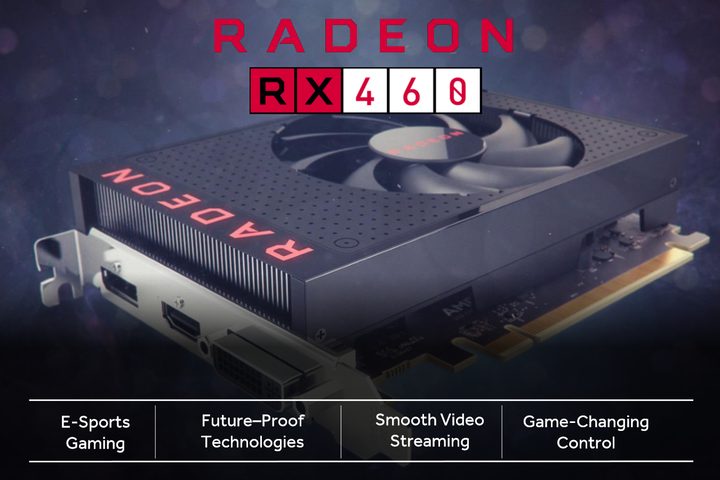
While that base clock speed is faster than the RX 470, this card has a smaller 128-bit memory bus, a memory bandwidth of 112GB per second, an effective memory speed of 7Gbps, and either 2GB or 4GB of on-board GDDR5 video memory. This card also has a thermal envelope of around 75 watts, and support for HDMI 2.0, DisplayPort 1.3 HBR, and DisplayPort 1.4 HDR as well.
On a performance level, this compact graphics card provides 1.3x better performance in DOTA 2 than the Radeon R7 260X. Other performance increases noted by AMD include Counter-Strike: Global Offensive (1.2x), Overwatch (1.3x), Rocket League (1.3x), and Grand Theft Auto V (1.2x). AMD generated these numbers using a test bed consisting of an Intel Core i7-6700K, 8GB of DDR4-2666 memory, Windows 10, and AMD driver 16.20 RC’20.
All three of AMD’s new Radeon RX 400 series cards are optimized for the next generation of APIs, namely Vulkan and DirectX 12. They support all the features you’d expect from Radeon, including FreeSync and the new Wattman overclocking solution.
The pricing on the new cards hasn’t been released, but AMD says it’ll be detailed before the cards hit store shelves. AMD’s Radeon RX 480 4GB currently costs $200, and the 8GB model costs $240. These new entries are some of the least expensive we’ve seen in years, and should bolster the performance of entry-level gaming machines.