People have often talked about “the cult of Apple”, and if a recent BBC TV documentary is to be believed, there could be something in it.
The program, Secrets of the Superbrands, looks at why technology megabrands such as Apple, Facebook and Twitter have become so popular and such a big part of many people’s lives.
In the first episode, presenter Alex Riley decided to take a look at Apple. He wanted to discover what it is about the company that makes people so emotional. Footage of the opening of the Cupertino company’s Covent Garden store in central London last year showed hordes of Apple devotees lining up outside overnight, while the staff whipped up customers (and themselves) into something of an evangelical frenzy. This religious-like fervor got Riley thinking – he decided to take a closer look at the inside of the head of an Apple fanatic to see what on earth was going on in there.
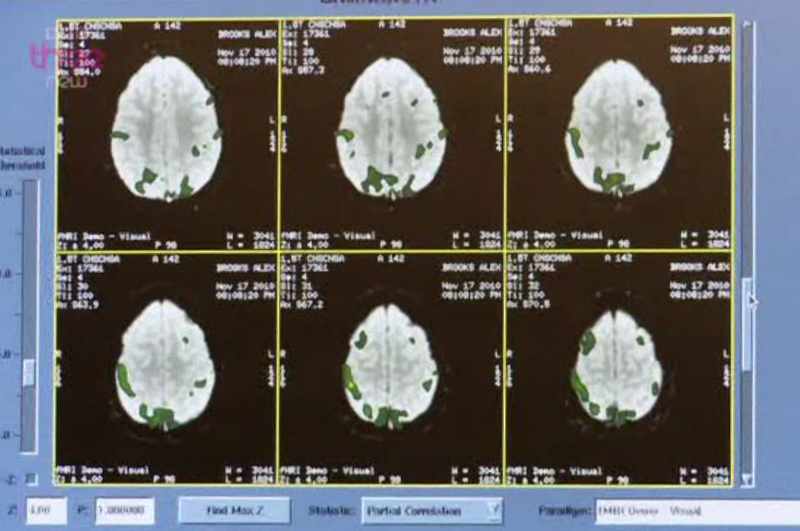
Riley contacted the editor of World of Apple, Alex Brooks, an Apple worshipper who claims to think about Apple 24 hours a day, which is possibly 23 hours too many for most regular people. A team of neuroscientists studied Brooks’ brain while undergoing an MRI scan, to see how it reacted to images of Apple products and (heaven forbid) non-Apple products.
According to the neuroscientists, the scan revealed that there were marked differences in Brooks’ reactions to the different products. Previously, the scientists had studied the brains of those of religious faith, and they found that, as Riley puts it: “The Apple products are triggering the same bits of [Brooks'] brain as religious imagery triggers in a person of faith.”
“This suggests that the big tech brands have harnessed, or exploit, the brain areas that have evolved to process religion,” one of the scientists says. A meeting with the Bishop of Buckingham, who reads the Bible using his Apple iPad, appeared to back up this assertion. He pointed out how the Apple store in, for example, Covent Garden has a lot of religious imagery built into it, with its stone floors, abundance of arches, and little altars (on which the products are displayed). And of course, the documentary doesn’t fail to give Steve Jobs a mention, calling him “the Messiah”.
Secrets of the Superbrands also looks at the likes of Facebook, which has enjoyed phenomenal success in just a few years. “Like Apple, mobile phones and social networks offer an opportunity for us to express our basic human need to communicate. And it’s by tapping into our basic needs, like gossip, religion or sex that these brands are taking over our world at such lightning speed,” Riley says. He concludes: “That’s not to say that clever marketing and brilliant technical innovation aren’t also crucial, but it seems that if you’re not providing a service which is of potential interest to every one of the 6.9 billion human beings on the planet, the chances are you’re never going to become a technology superbrand.”

Somebody please do this with stupid people and pictures of Obama.
It's an interesting area to explore, but Apple's success I think is more easily explained by their very close attention to creating the best user experience possible. From the iPod clickwheel to the iPhone touch screen, and to a lesser extent OS X, they've either done existing tech better (iPod) or created entirely new categories (iPhone).
Whether that 'delight' created by a good user experience is the same as a religious experience is probably a bit doubtful. Religious fervour is more to do with blind acceptance of the words of others not the pleasure gained by achieving tangible goals.
I think there's a lot of truth to the football thing. That's why it's such a problem. I grew up with kids who were literally abused because of their sports performance.
LOL
This is junk science.
I used to be relatively loyal to apple. They lost me when they made the switch to OS X; I was starting to dabble in Linux at the time. Close to the same time too, an Apple-branded monitor died just after the 3 year warranty, my first negative experience with apple hardware, which was usually very solid and reliable. What got me though was that I loved the transparency and consistent support of old software that Apple had stuck with. Apple had good support on their website for systems going back to System 1. OS X represented a break in UI too, the behavior was unintuitive all of a sudden, whereas it had been more or less similar with all the other changes up until that point. And I loved ResEdit. OS X did away with ResEdit and at the same time, Apple took down all their support. I felt abandoned, betrayed, I had been so loyal to them for years. Now they were all about being "cool" and "hip" and they didn't give a damn about sticking to their old philosophy of consistency of interface, and supporting old software. They permanently lost me. And I've been a die-hard Linux fan ever since, I briefly dabbled in Windows although I used Linux as my primary OS for a while, gave up my last *doze machine in 2005, and I have run exclusively linux since. Never looked back.
My concern with this is that they only seemed to study one subject. Thats HARDLY a scientific study. Don’t get me wrong, I dislike apple with the best of ‘em, but I also view things from an objective point of view. They could have done a similar study with anyone passionate about anything. Study a football fanatic’s brain while watching football. Scan a hardcore Johnny Depp fan while watching POTC. Its going to happen with anything that someone puts on a pedestal as Alex Brooks puts Apple on one. (I bet if you scanned my brain while reading Clive Barker or Chuck Palahnuik you’d get the same results!)
Its not that big tech brands are being designed to tap into the same parts of the brain as religion. Its that people are treating technology like they treat religion.
Had to be something powerfull to convince people to buy 2 year old hardware running unix for amounts of money only a “god” would have lol.
I knew it! I'm glad I use Apple products for more than 10 years (so that I'm past the fanboy stage). Now when I post that Windows 7 is faster on my oldish mac mini than OS X I get all kinds of flames from people who are using Apple computers for 1 or 2 years and think Apple is perfection in every way,
You are a trend setter kioshi. Alex Brooks should be worshipping you.
Lili from digitaltrends.com said:
So they scanned ONE man's brain, who is *clearly* not normal and is beyond obsessive, and then claim this indicates that all Apple fans are reacting the same way? That's utterly ridiculous and in no way scientific, regardless of the equipment used in the process.
ironked from digitaltrends.com said:
To me it's a genuine admiration for something that is well thought out and well executed. While I have a PC now, I started out on a Mac in the 80s. There was just something elegant about it. A couple of years ago I finally bought an iPod Nano. I ordered it, having never handling one. Apple just knows how to push the buttons. It's a sterling little thing. Came in an acrylic jewelbox. The slick ergonomics are just so beautiful. It's not hard to desire other Apple products with the same satisfying, tactile, functional, and aesthetic value of engineering.
I have heard of Applee, but what is the Justin Bieber? Is a new flavor of Applee OS? Or, is a new Windows type for ipad things for Windows? Please help me to download this OS? Is the Yankee OS fast?
This article's critic's have a real point. The popular press usually takes any scientific result and overgeneralizes it to the point of ridiculousness. (See this great XKCD for one example of how that works: http://xkcd.com/882/)
And yet there is something interesting in this research. It didn't HAVE to be the case that even one person's brain lit up in response to Apple imagery in the SAME way some peoples' brains light up in response to religious imagery. Yes, they've taken someone who is at a far extreme of the human experience, so any generalization to "apple fans" as class of people is highly suspect at best.
But if passionate religious experience had nothing whatsoever to do with non-religious fandom, then it could well be difficult or impossible to find even one technology fan whose brain lit up that way. So, this research provides some support to the hypothesis that there may be something about passionate religious belief that is not so fundamentally different from experience that has absolutely nothing to do with God.
If you're an atheist, that is probably not unexpected news to you. But if you're highly religious, and believe that the way you feel when you're praying can ONLY be explained by the actual existence of a God who has a direct relationship with you, even one case such as this could rightfully challenge that assumption.
But, in any case, the scientific process usually starts with some observation that hints at a certain direction. More often than not, further research in that direction fails to lead to a successful result. But sometimes it does. You have to start somewhere, and just one interesting data, point such as this one, can be the jumping off point. Perhaps there IS a phenomenon where a somewhat higher percentage of Apple owners than PC owners have those parts of the brains light up. (In fact, I'd guess that that is not so unlikely.)
Obviously, this article is wrong to sensationalize one data point. An article like this can lead people who don't examine it closely to think the larger case has been proven. But that doesn't mean that that one case wasn't worth studying in the first place.
[Er, I've edited my earlier comment to remove two particularly egregious punctuation errors. I wish this user interface supported editing by the author of a comment!]
This article's critics have a real point. The popular press usually takes any scientific result and overgeneralizes it to the point of ridiculousness. (See this great XKCD for one example of how that works: http://xkcd.com/882/)
And yet there is something interesting in this research. It didn't HAVE to be the case that even one person's brain lit up in response to Apple imagery in the SAME way some peoples' brains light up in response to religious imagery. Yes, they've taken someone who is at a far extreme of the human experience, so any generalization to "apple fans" as class of people is highly suspect at best.
But if passionate religious experience had nothing whatsoever to do with non-religious fandom, then it could well be difficult or impossible to find even one technology fan whose brain lit up that way. So, this research provides some support to the hypothesis that there may be something about passionate religious belief that is not so fundamentally different from experience that has absolutely nothing to do with God.
If you're an atheist, that is probably not unexpected news to you. But if you're highly religious, and believe that the way you feel when you're praying can ONLY be explained by the actual existence of a God who has a direct relationship with you, even one case such as this could rightfully challenge that assumption.
But, in any case, the scientific process usually starts with some observation that hints at a certain direction. More often than not, further research in that direction fails to lead to a successful result. But sometimes it does. You have to start somewhere, and just one interesting data point such as this one, can be the jumping off point. Perhaps there IS a phenomenon where a somewhat higher percentage of Apple owners than PC owners have those parts of the brains light up. (In fact, I'd guess that that is not so unlikely.)
Obviously, this article is wrong to sensationalize one data point. An article like this can lead people who don't examine it closely to think the larger case has been proven. But that doesn't mean that that one case wasn't worth studying in the first place.
To me it's a genuine admiration for something that is well thought out and well executed. While I have a PC now, I started out on a Mac in the 80s. There was just something elegant about it. A couple of years ago I finally bought an iPod Nano. I ordered it, having never handling one. Apple just knows how to push the buttons. It's a sterling little thing. Came in an acrylic jewelbox. The slick ergonomics are just so beautiful. It's not hard to desire other Apple products with the same satisfying, tactile, functional, and aesthetic value of engineering.
The aesthetic can't grab me if it doesn't deliver the goods. I was loyal to Apple back in the day because I was convinced they were a good company, with integrity and a good philosophy. When they abandoned that and became all about money and marketing, they permanently lost me.
“This suggests that the big tech brands have harnessed, or exploit, the brain areas that have evolved to process religion.”
That statement is so wrong. The brain didn’t “evolve to process religion”. Religion was never something we dealt with in a natural environment, it is simply one of the things the brain can do. Like videogames, the brain can play them, but they’re artificially made so that we would want to interact with them. In fact, you could say the same thing about religion; it simply harnessed, or exploited those areas of the brain as well, it just did it much earlier.
But what does it mean when Apple's flagship New York store is shaped like the Kaba in Mecca?
An interview with a Bishop and a scan of one brain isn't really massive evidence. It is worth noting that Apple is primarily a US brand (over half of Apple devices are there, only about a quarter are in Western Europe http://www.9to5mac.com/7751/Apples-iPhone-powered…. Only 4% of US folks think they are atheist.
I question the noteworthiness, Matt. There are many variables involved, such as launch dates, legal differences, international trade considerations, not to mention the vagueness of a survey of atheism. For example, many people draw a distinction between atheism and non-theism, and many others do not. I think far greater diligence is required to establish the connection you are asserting.
As any researcher or statistician knows full well, a sample of one is completely and utterly meaningless. Go find 1,000 more people to examine and the result will be statistically viable. Until then, stop wasting people's time with pointless crap like this.
This almost sounds like an April Fool's article. Too good to be true.
I thought it was a hangover
I'm certain the expected scientific rigor has been applied to this claim.
The article claims that the brains of Apple fans respond to Apple products in the same way that someone who is religious responds to their religion. Selecting a random sample would show little more than that not everyone is a fan of Apple, in the same way that not everyone is religious.
This makes me feel a lot better about going to the Apple store every Sunday.
hahaha perfect response.
So they scanned ONE man's brain, who is *clearly* not normal and is beyond obsessive, and then claim this indicates that all Apple fans are reacting the same way? That's utterly ridiculous and in no way scientific, regardless of the equipment used in the process.
Exactly!! I have been using Apple products since the day of the IIE and I in no way think about them 24 hours a day. Scan the brain of a football player and show him images of a football and tell me how he reacts to those images. I bet you get the same results.
Do you mean you mean ][e ?
Step 1) Start with a hypothesis that average Mac fans are overly committed to Mac.
Step 2) Select someone with a MORE than average dedication to the Mac Brand. Examine this person's brain to find that the abnormal behavior is backed up by abnormal reactions in the brain.
Step 3) Announce non-finding that average people react to Apple the way the Ultimate Fanboy subject does.
Is there any science here?
Korbal has a point. There is potential here for good science, but this isn't it. However, neuorology does seem to be throwing up insights into issues such as creativity. Here it's suggesting angles on religious convictions.
Absolutely what I thought when reading the headline:)
What I expected was they took, say, Justin Bieber fan, Apple fan, and Yankees fan for a test. If in this case Apple fan's reaction was brighter, that could be at least something. Being a fan is just that, no matter what is your religion.
To be fair, we are criticizing a second-hand account. Who knows how exhaustive the article's author has been of what was presented in the actual series episode. Has anyone, here, seen the episode?
It explains why people buy anything the an I in front on an annual basis.
it's nice to know window's 7 has the ability to turn people away from mac's and lead them to the path of rightusness.
wiht that said i would like to finish with a quote from the all holy book of window's 7 "Apple is the devil and steve job's is his sidekick"
That's it, I'm banning you from use of your keyboard's apostrophe key.
LOL! :D
So, why did Eve want to move to New York ?
She’d fallen for the Big Apple ! hehehe :P
haha :-) Of course, our clever Yusuf would come up with the “perfect” APPLE!
Look who’s being apple SAUCY! LOL XD
A crab-apple! LOOL! :D
Golly, Yusuf…I can’t think of any “kind of apple” like that :-) lol
Yeah but who knows what kind of apple has a short temper? GgrrrRR?
Haha, Yusuf :-) awesomely hilarious analogy!
@ YT- The new 1st commandment = Command Alt Delete! LOL
I thought the first commandment was when Eve told Adam to eat the apple. Mind this thread’ll be an apple-turnover at this rate! LOL! :D
LOL
@ Rebel Lawless ~ Haha :-) Yep, according to the Bible…interesting thought, maybe APPLE had an “epiphany” when they decided on their company name…LOL :-)
@Denis. Cool as . . . . Thanks for opening the
Sacred Holy Door into the Eternal Shrine of our beloved and much adored Saint Steve.
Naah – an apple a day keeps the Doctor away, surely?
@ Sentinel Gazette – the Apple was the original FORBIDDEN FRUIT!
Hello lets talk. Call me. IAN
LOL :-) Well, “they” have always said certain music has “subliminal messages” hinting at the “occult of satanism”, i.e. good ol’ Rock n’ Roll, like Black Sabbath, etc., so why not APPLE…
Good thing I dont “do’ religion then. I do however have a real life relationship with Christ.
Possible sublimal message ?