  1. Home
  2. Emerging Tech
  3. Health & Fitness
  4. News

Surprisingly flexible 3D-printed bones could be used for treating fractures

Add as a preferred source on Google

Scientists have demonstrated a new, 3D-printed hyperelastic “bone” that could be used in future implants and grafts to help mend a variety of bone-related injuries.

“This is a very unique material that’s sort of a synthetic analog to natural bone,” Ramille Shah, professor of materials science and engineering at Northwestern University in Evanston, Illinois, told Digital Trends. “The unique thing about it is that it is 90 percent hydroxyapatite, which is the main mineral component of bone. However, instead of being very brittle like ceramic, it’s actually very elastic.”

Recommended Videos

Given this unique property, it’s interesting to hear that the hyperelastic abilities of the 3D-printed “bone” — which lets it regain its original shape when squashed or deformed — was actually a happy accident in the lab.
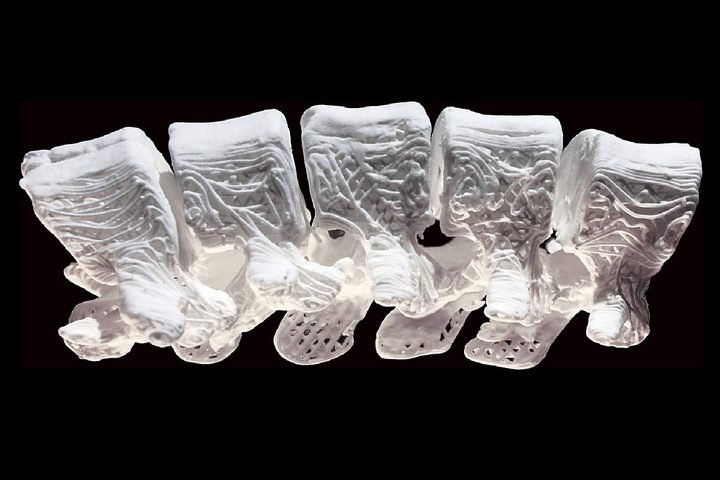
jakus3hr
Image used with permission by copyright holder

“I wish I could say that was something we knew was going to happen, but it took us by surprise,” Shah continued. “We didn’t expect that this material would have the type of properties it wound up having. We were incredibly surprised when we 3D-printed the first samples. We expected it to be a bit less brittle than some [previous experiments], but we didn’t think it would be close to this elastic.”

In a study, Shah and her fellow researchers put human stem cells extracted from bone marrow on a sample of the 3D-printed material, and were able to show that this caused them to mature into bone cells. The bone-like material was also used to help mend spinal defects in rats, as well being utilized to heal the damaged skull of a rhesus macaque monkey.

In addition, the team was able to prove the material was safe by placing it under the skin of mice, which suffered no ill effects. They hope that human trials will follow in the next half-decade.

“This work would fit in well anywhere that bone regeneration is needed — from spine to craniofacial, or any other fractures,” Shah concluded. “Any bones that are broken in the body could theoretically have this material applied.”

Luke Dormehl
I'm a UK-based tech writer covering Cool Tech at Digital Trends. I've also written for Fast Company, Wired, the Guardian…
The AI game-dev boom has a dark side: fewer jobs for the people starting out
Solo creators are thriving with tools like Claude Code and Copilot, but entry-level game roles are disappearing.
Man playing a video game on a desktop with glowing red and blue lights

AI is making it easier than ever for a single person to build a game. That sounds like a win for creativity, and in many ways, it absolutely is. But there is a catch. As generative AI tools help solo developers and small studios do more with fewer people, the same shift is making life tougher for writers, artists, concept creators, and junior programmers trying to break into the gaming industry.

AI is giving solo developers superpowers

Read more
A new AI model wants self-driving cars to think before they swerve
Forget guessing games, this self-driving AI actually shows its work.
Self driving car

Self-driving cars have gotten pretty good at driving. The harder problem is teaching them to drive safely in situations nobody planned for. We have heard horror stories of self-driving cars, behaving erratically in emergency situations, often times delaying first responders from reaching the scene.

A team at Seoul National University, led by professor Jun Won Choi from the Department of Electrical and Computer Engineering, thinks they have cracked part of that puzzle with a new AI model called SafeDrive. The research was recently selected as a highlight paper at CVPR 2026, a distinction that goes only to roughly 3% of all submissions.

Read more
An AirPods-sized mini lab could help catch disease markers in minutes
Meet VPodDuo, an AirPods-sized molecular testing gadget
VPodDuo Mini Medical Device

Home testing could eventually become a lot more convenient. Researchs at the at the University of Illinois Urbana-Champaign has developed the VPodDuo, a pocket-sized fluorescence reader designed to measure sensitive molecular tests outside a conventional laboratory.

Its housing is roughly comparable in size and shape to an AirPods charging case, while Bluetooth connectivity sends results directly to a smartphone. Meaning, you might not have to wait in line anymore.

Read more