  1. Home
  2. Emerging Tech
  3. Mobile
  4. News

This tabletop holographic display pulls media from your smartphone and makes it 3D

Add as a preferred source on Google

Holograms are one of those futuristic technologies that sci-fi movies have been promising us for decades, but that hasn’t actually materialized in a significant way. It’s not that hologram technology doesn’t exist. It totally does — remember the time that holographic Tupac performed at Coachella? The technology is definitely out there; it’s just not as common or widely available as we’d like.

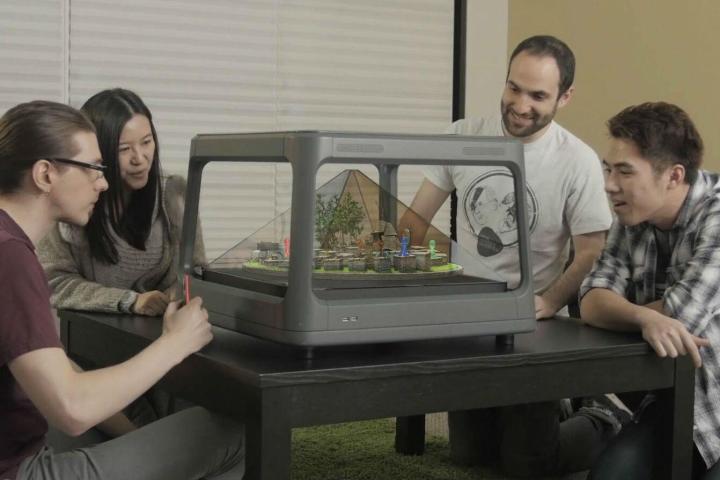
Canadian startup H+Technology wants to change that. The company has developed a unique holographic display that might finally bring holograms into your home. The Holus, as it’s called, is a tabletop holographic platform that takes any digital content — be it from a computer, tablet, or smartphone — and converts it into a three dimensional hologram.

Recommended Videos

Inside the microwave-sized device there’s a coated plexiglass prism. A projector underneath Holus’ lid beams four images of the same object onto the walls of this prism, and thanks to the magic of holography, there appears within the prism a single image to any user looking at it — no matter what side they’re viewing from. Users can control the images with any tablet, smartphone, or computer — so long as the device sports Bluetooth or Wi-Fi.

Holus only exists in prototype form at this point, but if or when it hits the market, it’ll come in two different versions: Pro and Home. The Pro version will be slightly larger, but the main difference is that it’ll come with an SDK license to develop apps for the device. H+ has developed an SDK that supports game engines like Unity3D and Unreal, as well as partner plugins for various input devices.

The device has popped up at various trade shows and conventions over the past few months, and now the company indicates that it is finally ready to bring Holus into the world. To raise money for production, H+Technology has recently launched a Kickstarter campaign — which actually surpassed its ~$40,000 funding goal in less than 18 hours. At time of writing the project is sitting on over $100K in pledges, and still has nearly a month left in the campaign.

If you pledge your support now during the early stages, you can get your hands on a Holus for a pledge of about $850. Barring any major hiccups in the manufacturing process, H+Technology expects to start shipping the device about a year from now in July 2016.

Drew Prindle
Former Senior Editor, Features
Drew Prindle is an award-winning writer, editor, and storyteller who currently serves as Senior Features Editor for Digital…
Students who use AI every day may be falling behind, while moderate users pull ahead
New global testing data suggests more AI in the classroom isn't automatically better.
Logo, Text

I assumed more AI access might help students learn faster. However, a new OECD study dispels that misconception for me and everyone else who gave their children a paid version of AI chatbots, thinking it would help them through their educational journey. 

According to PISA 2025 data from 760,000 students in 91 countries, students who use AI daily score meaningfully worse on standardized tests than their peers. The full picture is more complicated than a simple ban would fix.

Read more
XPENG just put its humanoid robot on the production line, and it walked itself out
IRON clocks in for its first shift
XPENG Iron

XPENG’s humanoid robot has officially joined the workforce, and it even got an employee badge. The Chinese automaker announced on September 8 that its next-generation IRON had completed assembly and autonomously walked off its newly commissioned humanoid robot production line in Guangzhou.

CEO He Xiaopeng then pinned a staff badge onto the robot, symbolically welcoming it to the XPENG team. It is a charming little ceremony for a machine that the company hopes will eventually become a regular part of everyday life. XPENG is moving IRON beyond R&D prototypes toward production-line manufacturing, applying the quality-control systems and manufacturing experience it has developed through its electric vehicle business.

Read more
An AI-designed drug might help slow aging, but we’re not there yet
The results hint at a possible anti-aging effect, but there’s still a long way to go before we know what it means.
medical test tubes

Rentosertib, a drug Insilico Medicine designed almost entirely using AI, was created to treat idiopathic pulmonary fibrosis, a disease that scars and stiffens the lungs over time. But fighting lung disease was only half the plan from the start.

According to a new study published in Nature Biotechnology, the drug's target was chosen specifically because it overlaps heavily with the biology of aging, and the whole trial was designed to test whether treating the lungs could also mean turning back the body's biological clock.

Read more