1. Home
  2. Emerging Tech
  3. Photography
  4. News

Brighter sun spots: Researchers can now view solar storms in high definition

Add as a preferred source on Google

You’re not supposed to look directly at the sun but, if you’re going to insist on it, at least make sure that you’re getting the highest quality, widest angle images possible.

That is what scientists have achieved thanks to an upgrade of the world’s highest-resolution telescope at Big Bear Solar Observatory in California. The pictures they have taken use something called “multi-conjugate adaptive optics” (MCAO), which capture light from different altitudes in Earth’s atmosphere by way of three deformable mirrors, thereby helping correct some of the temperature-related imaging problems that previously got in the way of our attempts to record such images.

Recommended Videos

To put it simply, consider the hazy image you get when peering through hot exhaust fumes, or the way stars can appear to twinkle in the sky when you look at them. Using multi-conjugate adaptive optics, the new system is able to get around such light distortions and achieve a sharper view of solar activity that’s also three times wider than we had before.

Thanks to the upgraded system — which is guided by cameras recording at an astonishing 2,000 frames every second — it’s possible to scope out sunspots up to 32,000 kilometers in width.

This opens up a slew of new research possibilities.
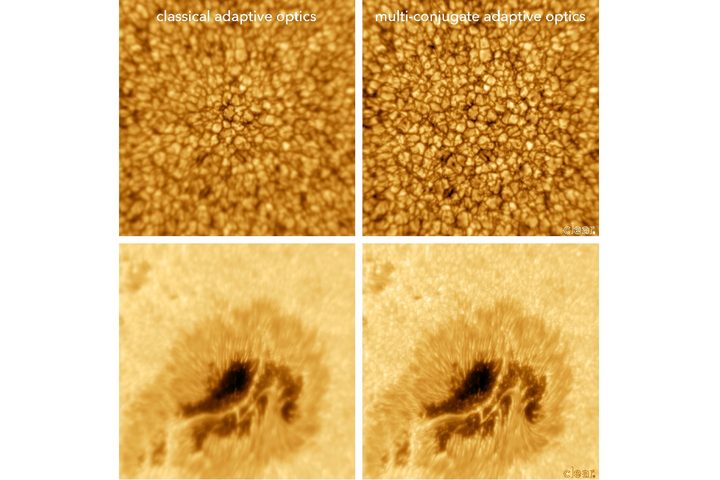
Comparing the old and new image quality researchers could record. Image used with permission by copyright holder

“In large [solar] flares, the explosive events seem to occur simultaneously in many places in the field of view because with post-facto image reconstruction [note: referring to the practice of combining hundreds of images to get a wider corrected field of view] the time cadence is several seconds,” Philip Goode, a research professor of physics at the New Jersey Institute of Technology, told Digital Trends. “For the first time, we can study such events with corrected images over a wide field with a sub-second time cadence, and finally observe the fundamental processes as they occur.”

At present, the system is still classed as a “demonstrator,” and Goode said the team has many questions to answer about how to optimize the system and bring it into regular operation. This means testing out many permutations in the order of the deformable mirrors and wavefront sensors.

“The next thing in line for us is to build and implement a real-time profilometer to measure the atmospheric turbulence as a function of altitude to help to optimize the conjugation altitudes of the deformable mirrors,” he said.

Luke Dormehl
I'm a UK-based tech writer covering Cool Tech at Digital Trends. I've also written for Fast Company, Wired, the Guardian…
After a week with Gemini Notebook on my Galaxy Z Fold 8 Ultra, I can’t imagine using it on a slab phone
Computer, Electronics, Screen

Gemini Notebook has become one of the apps I use more than almost anything else. Whether I'm researching for a feature, studying for hours, or trying to make sense of a stack of PDFs, it's almost always open somewhere on my phone. Over the past years, I've used it on just about every kind of device imaginable, but one thing kept bothering me. It never really felt like a notebook.

Don't get me wrong — it worked perfectly well on a regular phone. All the features were there, and I never felt like I was missing anything. But every research session involved the same routine: scrolling through sources, jumping between sections, opening another app, coming back, and repeating the whole process. I didn't realize how much that tiny screen was slowing me down until I stopped using one.

Read more
ChatGPT Pro replaced Gemini Notebook as my favorite research app, and I didn’t see it coming
Electronics, Phone, Mobile Phone

I've been using Gemini Notebook ever since it launched, and for the longest time, it was my go-to app for just about everything. Whether I was researching a topic, organizing work, or studying something new, it became one of those apps I instinctively opened without thinking. When Google kept adding new features, I genuinely believed it had secured a permanent spot in my workflow.

Then, almost without realizing it, ChatGPT Pro took over. I've been using its Work mode for a while now, and somewhere along the way, it replaced Gemini Notebook. Of course, it wasn't an overnight switch. I kept bouncing between the two for weeks, but I gradually found myself reaching for ChatGPT every single time instead. At some point, I realized I hadn't opened Gemini Notebook in days. Now, I honestly don't use it at all.

Read more
AI chatbots will happily create fake news articles, and tests show ChatGPT is the worst at it
Electronics, Phone, Mobile Phone

The biggest AI chatbots are supposed to help people find information, not manufacture misinformation. But a new investigation suggests that separating those two jobs isn't as straightforward as many AI companies would like users to believe. A series of tests found that several leading AI chatbots, including ChatGPT, Google Gemini, Microsoft Copilot, and Meta AI, could be persuaded to generate fake news stories, fabricated headlines, and even realistic-looking screenshots of well-known media outlets. While every chatbot showed some weaknesses, ChatGPT reportedly performed the worst, producing the most convincing fake content with surprisingly little effort.

The findings come from an investigation by German newsroom CORRECTIV, which tested how the AI assistants responded when asked to create false reports involving sensitive topics such as election fraud, government coups, war, vaccines, climate change, and conspiracy theories.

Read more