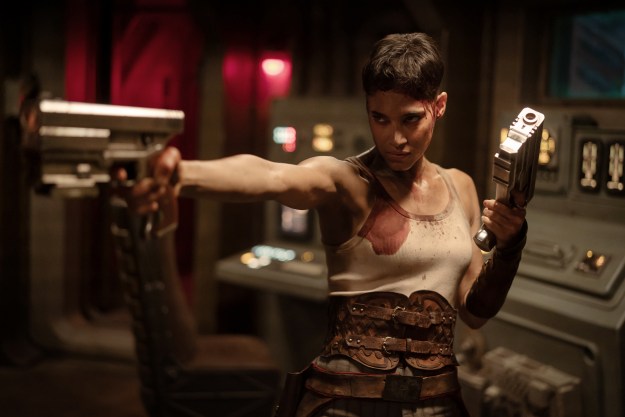
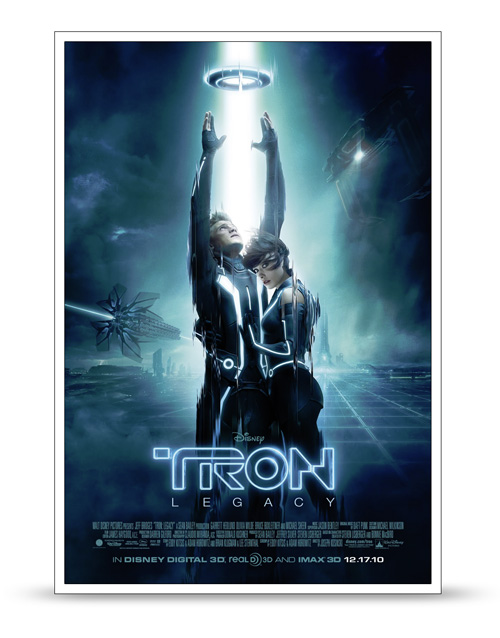
 I have to admit, that I am a Tron nerd. I mention that to explain the fact that I went into Tron: Legacy with pre-conceived notions and high expectations. I loved the original as a kid, and it is one of those movies that just stuck with me. I remember the crap video games, and there might still be an old lightcycle buried in a box somewhere in an attic filled with other pieces of my childhood. I may or may not even have had Tron bed sheets at some point in my life. So needless to say I have been waiting for Tron: Legacy for quite awhile. 28 years, in fact.
Tron: Legacy is a good movie, but not a great one. It will entertain, but it is not what most people will expect. To summarize it quickly, the visuals are stunning, but the plot is weak. That will likely ring a few bells with people after last December’s big 3D experience, Avatar. Both films even opened on the same weekend. Like Avatar, Tron: Legacy will split people between those that can accept the plot and buy into the total experience of the film, and those that can’t. But even at its best, Tron: Legacy is not the film that Avatar was. There is just something missing. Perhaps it is the sacrifice of fun in the name of cool, or maybe it is the visually awesome setting, filled with a handful of interesting characters who are surrounded by a stagnant world. If you can get past all that, you will be left with a decent blockbuster movie that is begging to be part of a new franchise.
Tron 2: Tron Harder
Tron: Legacy is the story of Sam Flynn (Garrett Hudlund), the orphaned son of Kevin Flynn (Jeff Bridges), a computer visionary and CEO that disappeared 20 years earlier after claiming to have witnessed a miracle that would change the world. Over the years everyone, including Sam, begins to suspect that his father simply ran away. Carrying that bitterness, Sam continues to dodge his responsibilities as the primary shareholder of the global corporation Encom, and spends his time rebelling against his heritage.
Kevin’s old friend, and Sam’s sometimes surrogate father Alan (Bruce Boxleitner, who played the role of Alan/Tron in the original film) tells Sam that he received a page from Kevin’s old arcade, which featured prominently in the first film, even though the place had been abandoned years earlier. Despite his skepticism, Sam goes to the arcade and discovers a secret room, housing a computer– and unbeknownst to him– a laser capable of turning the flesh digital and transporting him into a new reality.
Sam suddenly finds himself in a computerized world called the Grid, where he is quickly captured and assumed to be a rogue program. As events unfold, Sam is revealed to be a user rather than a program, and is brought before the leader of the Grid who looks like his father (thanks to some CGI trickery that makes Bridges appear 20 years younger). Sam quickly realizes that it is not his dad, but Clu 2, a program designed by Kevin Flynn to help create the perfect system, but who soon warped that idea. Clu has plans of his own, and they involve the death of both Sam and his father as a means to something much bigger and darker.
Sam is rescued by the beautiful and mysterious Quorra (Olivia Wilde), who takes him to see his real father, who explains the history of the world he created. Following the reunion Sam and Kevin discuss escaping, but the threat from Clu turns out to be greater than anyone initially thought, and the fate of the real world hangs in the balance as father and son attempt to escape Clu’s grasp and return home.
The plot is the weakest part of Tron: Legacy by far. If the paper thin story behind Avatar was enough to sour your experience of the film, then Tron: Legacy is not the movie for you. There are not so much plot holes, as moments when the film just doesn’t seem to bother with explanations at all. Without giving too much away, a good deal of the story revolves around Kevin’s discovery inside the Grid of a new life form known as isomorphic algorithms (ISOs), who Kevin continues to say will totally change the world in every field of science and technology. It is just a given that they will, and he gives absolutely no indication of how they might go about it. You can guess and make your own assumptions, but it is odd and steals some of the thunder from the events of the movie. Instead of being shocked and amazed by the discovery, you might wonder if you missed something.
There are a handful of these moments where the script can best be described as being vague at best, and lazy at worst. There are several times that the movie just seems to expect you to follow along, even though the rules in the essentially alien world are totally different from anything we could possibly guess. But that doesn’t mean they don’t explain things, quite the opposite.
The film is broken up into three distinct scenes that rotate through the film as needed. The first is the buildup to something that is going to inevitably happen. The second are the action scenes which are highlights of the film. The third is exposition–and there is a lot of that. Big chunks of the film are spent as characters explain to Sam what is going on, and what has happened up to that point. Not all of these explanations make total sense, and those that do—while perhaps somewhat necessary—slow the film down. Ironically, for a movie with a fairly shallow plot, there is a lot of time spent explaining it. It is an odd contradiction.
You won’t be won’t over by the plot, so you simply need to accept it if you are going to enjoy the film.
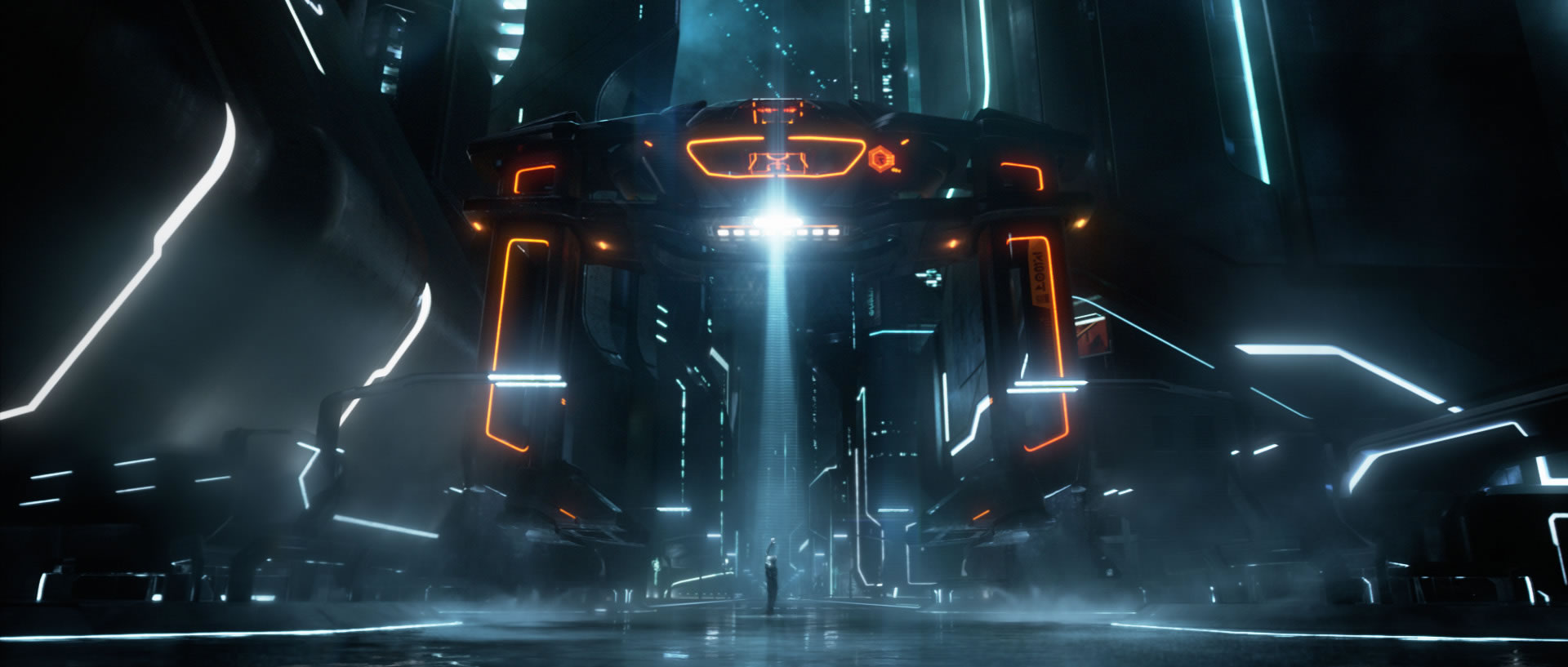
The film is blindingly beautiful, but the tone is exceedingly dark
One of the things that caught me off guard was the tone of this film, which is brought to life by the look and themes of the story. You might expect this sort of movie to be heavy on action, with good natured jokes spread out along the way—the first film was that way for the most part, with the concept of wonder and awe around every corner. Tron had its dark moments, but it also had plenty of humor too. But Tron: Legacy is a dark film in every sense of the word. While the lighting in Tron: Legacy plays a big part in showing off the digital world, it do so by using a bleak and dark backdrop as contrast. Colors play a big part in the plot, but the majority of the world carries a monotone quality that is intentional, but can be somewhat depressing at times.
The world of the Grid is a place of oppression and total control, and that is evident in the look of the one primary city, and adding to that darkness are the themes of the film. There is the story of reunion between father and son, but for the most part the plot is highlighted by tension, fear, and despair. The Grid is a melancholy place, and its creator, Kevin Flynn, is struggling with guilt over his role in it, while Clu is filled with a sense of betrayal from his creator.
Tron: Legacy is not a “fun” film in the traditional sense. That isn’t a judgment on the movie, it is simply an observation of the tone. If anything, Tron: Legacy is more of a drama that has a few action moments worked into it than anything. This dramatic feeling runs from the first few moments until the very end of the film. If you are expecting a silly and lighthearted time, you are in for a surprise.
Tron is pretty
The Grid is a jaw-droppingly awesome place to behold, and the 3D is well incorporated without ever becoming gimmicky. This film is made to be seen on a big screen in 3D, and people waiting for it to be released on DVD or blu-ray are missing out on a remarkable visual experience.
First time director Joseph Kosinski may be responsible for a few of the issues that plague this movie, but he should also be praised for the look, both in terms of the visuals, and the way the scenes are filmed– especially the action which typically takes place in alien settings, yet remain easy to follow. While the plot is weak, like Avatar, this film’s primary focus is on the visual aspects, and in that Tron: Legacy succeeds beautifully. The CGI is amazing, and the look of the city in the Grid is nothing short of stunning. Darkness dominates this film, partly from the tone, and partly because that is the established look of life inside the digital world. It can be somewhat bleak, but it is also original and beautiful.
When the original Tron came out, it was a first of its kind, both cutting edge in terms of technology and imagination. Tron: Legacy seems to have recognized that and gone out of its way to live up to the challenge of its predecessor, despite a nearly three decade gap. In terms of CGI, especially in a live action setting, nothing even comes close to Tron: Legacy. It is an amazing sight.
There is perhaps one noticeable exception to this that you must accept and overlook. While the CGI effects used to make Bridges look 20 years younger for the role of Clu are extraordinary, they are also a bit difficult to accept, especially when he is talking or smiling. There is just something unnatural in the way his lips move, and in some scenes it looks like it is just very good CGI from an animated Pixar movie. That could be explained away within the plot as just being the nature of the program character coming out, but there are enough flashback scenes with Bridges as Kevin Flynn that make it obvious that the technology, while impressive, is somewhat flawed. Like the plot, this is something that you will just have to overlook.
Daft Punk returns
Perhaps just as anticipated as the movie itself is the soundtrack from the electronic duo Daft Punk, who have not released a full album since 2005. The music in the film is all from Daft Punk, and it works on several levels. Besides being just a good soundtrack and one that fans of Daft Punk will happily, and justifiably go buy as a long awaited new album, it adds to the world and the tone of the film. The electronic score is dark, but alway fitting, and it feels like nothing else out there.
Seldom does the music achieve a level where it almost become a character itself in a movie, but it does so in Tron: Legacy. Daft Punk themselves also make a quick cameo, and provide one of the funnier moments of the movie.
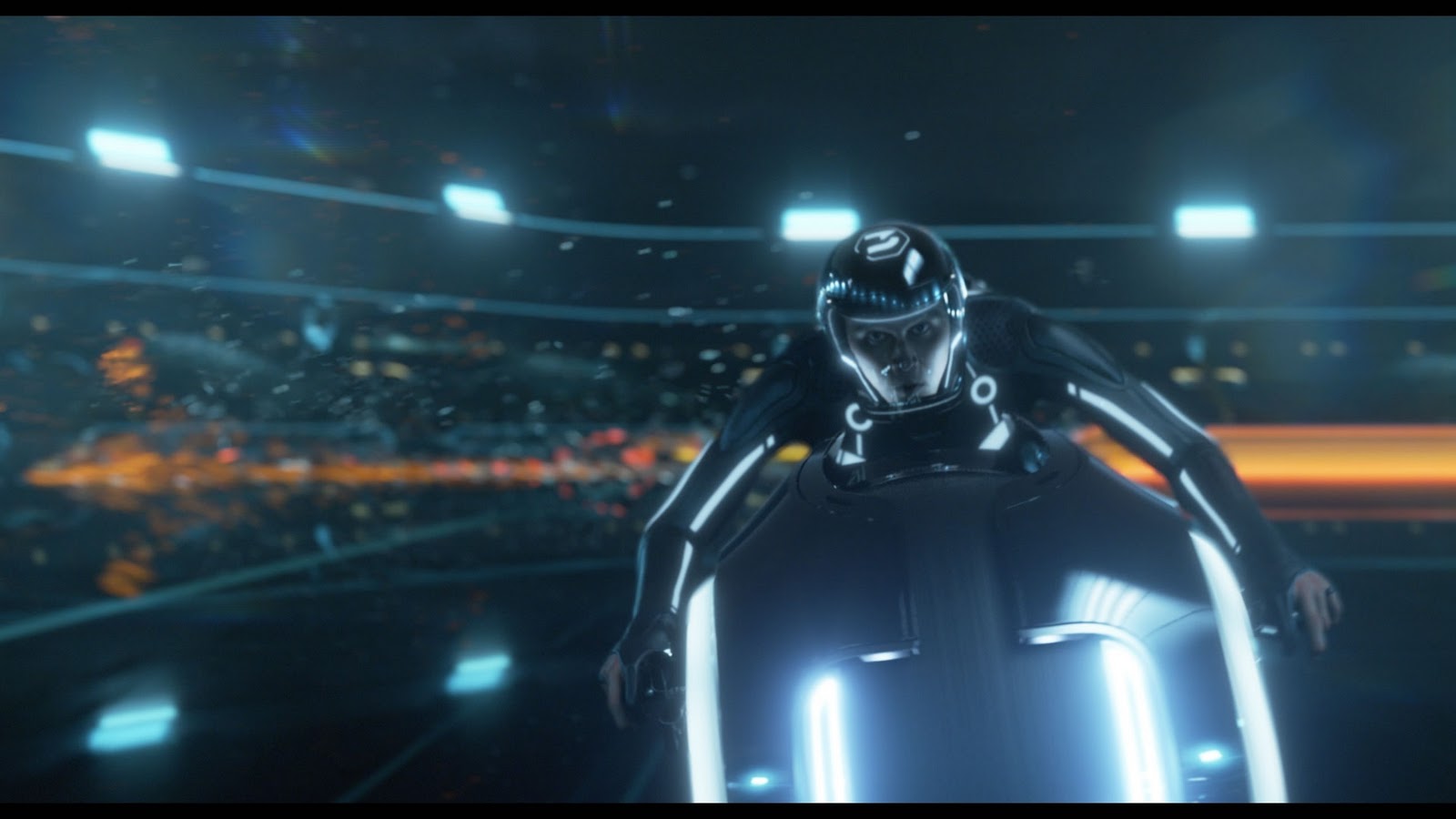
Behind the makeup
The buzz behind the two lead actors who star alongside Jeff Bridges has been getting louder, and both Garrett Hedlund and Olivia Wilde are destined for stardom. Both turn in satisfying and solid performances, and each have the charisma to help carry the franchise on if Disney decides to make another Tron film. Hedlund has two major films coming after Tron: Legacy, including Country Strong with Gwyneth Paltrow, and a role that will no doubt receive intense scrutiny, that of Dean Moriarty in the adaptation of Jack Keouac’s On the Road–which could just as easily alienate people as it could endear them to the actor. Hedlund is being positioned as the star of what Disney hopes will be the Tron franchise, and if that happens, he is more than capable of taking on the pressure of the role. In Tron: Legacy he manages to remain interesting and compelling, even though his character is more a slave to the events than a catalyst for them, and the CGI is the true star of the film. But he turns in a likeable and interesting performance with what he is given.
The beautiful Olivia Wilde also dominates the screen as Quorra, a program that sees Kevin Flynn as a father figure. But rather than approach the character as a tough-as-nails warrior as has become something of the norm these days, Quorra retains an innocence and naivety that makes her endearing. That is down to Wilde, who is also a rising star in Hollywood and is booked for the next two years solid.
Together Hedlund and Wilde seem to have an easy chemistry together that is quickly established and believable. There is also a romantic and flirtatious vibe between them that you accept, but when you start to think about the fact that one is a human and the other is a program, the mind boggles at the weirdness of it. The movie seems to want to skip over this aspect, so it is easy to ignore, and it might be something that is destined to be explored in a potential sequel.
Bridges also turns in a solid performance as both Clu and Kevin Flynn. Of the two, despite the facial limitations of the CGI, Bridges’ Clu is arguably the stronger performances of the two. The plot is a little thin around Clu’s villainous plans, but Bridges manages to convey the program’s sense of betrayal stemming from his and Kevin’s earlier falling out. Clu is still a fairly stereotypical villain, but he is an interesting one. The role of Kevin Flynn is also handled adeptly, but Bridges and the script attempt to continually remind us that Kevin has been out of touch with the world since 1989, so some of his vernacular is from the 80s. That wouldn’t be a huge issue, but when he wears an outfit that is marital arts inspired (in other words mostly robes and a gi), plus he has a bushy beard, it is hard not to see him as the “Dude” from The Big Lebowski– especially when he says things like “radical”, and “hey dude”.
Michael Sheen (The Special Relationship, Frost/Nixon) also appears as the program Castor, proprietor of the “End of the Line Club”. Castor is energetic to the point of insane, and yet Sheen manages to stop just short of being annoying. The role is brief, but critical, and Sheen makes him memorable. Unfortunately that highlights one of the bigger problems of the film. The world of the Grid is dark and oppressive, but it is filled with programs– thousands of them. But by the end of the movie it will be remarkable if you can remember what more than a handful of them looked like. Part of that is due to the plot, but there is a sense of isolation inherent in the movie. The Grid is supposed to be teaming with life, but in the end it feels bleak and desolate. The audience is expected to have some investment in the surroundings, but the characters are already programs– which devalues them automatically because they are by nature, not supposed to be too much like humans. With a little more personality from the city and the few random characters that pop up, that could be forgotten, and the audience would be willing to at least fake an emotional investment with the digital reality, but it is so empty and bleak that you forget all about the fact that it is supposed to be an entire world. The story is specifically about Sam, Quorra, Kevin and Clu, so you can overlook it on paper, but it makes the movie feel a bit lifeless at times.
If you can identify with Sam and Kevin–the only two humans in the Grid– then the rest is incidental, but sometimes the movie feels like a crystal egg– beautiful, but hollow.
Conclusion
Tron: Legacy is a film that has grown on me after leaving the screening. It is not what you might expect, and it really is its own movie despite being a sequel. Having seen the original helps, especially with one big surprise that comes towards the end (but is easy to guess) regarding a loose end from the first film. The plot is weak and sometimes feels like it just forgets to explain what appears to be vital information. It also seems to either raise several questions accidentally that it never intends to answer, or is setting itself up for a sequel which will be dependent on the box office results of the first. The ending of the film resolves the main storyline, but it also leaves itself open for a continuation. Another indicator of this is the brief, blink-and-you’ll-miss-him inclusion of Cillian Murphy (Batman Begins, Inception) in an uncredited role as Edward Dillinger Jr., son of the main antagonists from the first film, Ed Dillinger/Sark/the voice of the Master Control Program (David Warner). Murphy is too big of a star, and the role is too interesting to not have any plans to take it further.
Tron: Legacy is going to be savagely ripped by many who feel that the plot is just something to string together the visuals, just as many criticized the story of Avatar. It is a fair criticism, and for those that focus on plot, Tron: Legacy will feel hollow and lifeless. If you can overlook it, and if you can shake the preconceived notions that may have formed after 28 years of waiting for a sequel, then the movie is an entertaining and visual stunning, albeit not spectacular film.
Pros
Tron: Legacy is the next stage in the future of visual effects that began with Avatar, and is easily one of the best looking movies ever made. Solid performances by the principles. Daft Punk kills it.
Cons
A thin plot that has gaping holes. The CGI to make Bridges look younger is weird. The world around the characters feels empty.