1. Home
  2. Wearables
  3. Emerging Tech
  4. Mobile
  5. News

FingerIO's finger-wagging sonar controls may make smartwatches more usable in the future

Add as a preferred source on Google

Many of us associate the use of sonar with warships, submarines, and other sea-faring vessels, or with animals like dolphins or bats. However, students at the University of Washington have taken the technology and applied it to a smartphone and smartwatch as an alternative control system. so they can be controlled without touching the screen at all, or even just using a mid-air swipe.

It’s called FingerIO, and by using an active sonar system, any surface around your phone could be used as an extension of the touchscreen, where gestures and traces drawn on them would register on the display. For example, tracing a word on the table top next to your phone, would see that word appear on the screen, even though you’re not directly touching it.

Recommended Videos

Although any physical surface could be used, the active sonar is strong enough that it could recognize mid-air gestures, and those made through fabric. In a demonstration video, a phone’s volume is raised and lowered using a mid-air gesture when the phone itself is inside a pocket. The same applies for a smartwatch, where gestures made on your arm, or in the air surrounding the device, activate features.
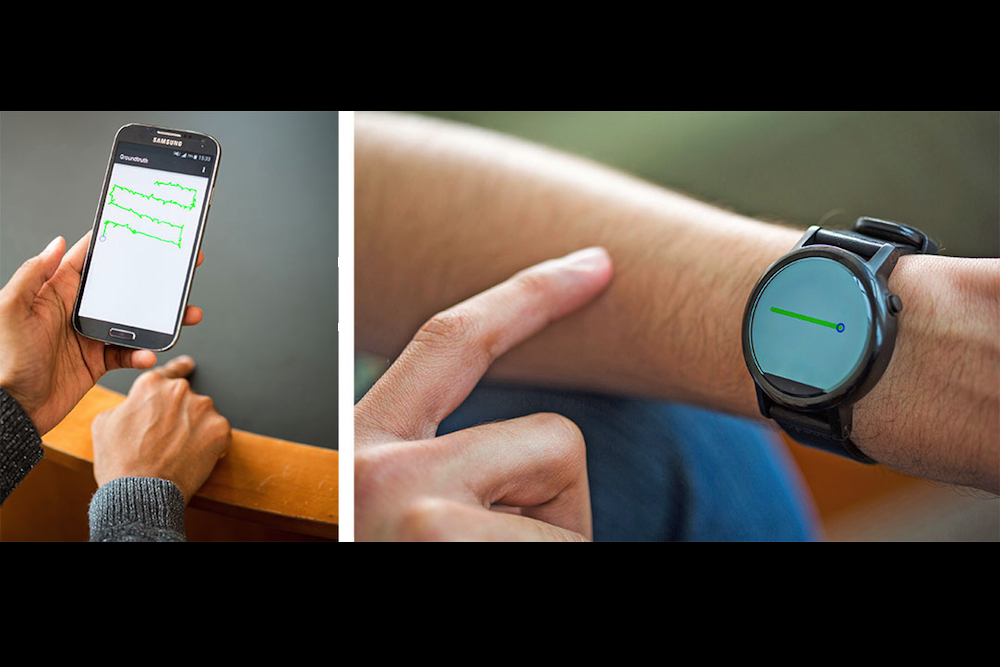
There’s no need for any sensors on your hand, or a special thimble-type finger extension, because FingerIO uses sensors already inside the phone to create the active sonar field. It’s rather simple — the speakers emit inaudible sounds, and echoes are picked up by the dual microphones. Clever modulation then increases the accuracy. The team used a Samsung Galaxy S4 as a test device, and found its audio and microphone setup is good for an average accuracy of 8mm.

Gestures are great, but when they can be made in the general vicinity of a device, there’s a risk of unwanted interaction. To avoid this, FingerIO has a double swipe activation command, made within five centimeters of the device, measuring at least four centimeters for each straight-line swipe. That way, pointing to something in front of you doesn’t suddenly make a call to Uncle Tom.

The group has published a paper on the technology, which points out several drawbacks, including devices requiring a third microphone to enable 3D tracking, and the high power consumption of an always-on sonar system. The test Galaxy S4 lasted for just four hours using the technology. However, it’s early days for FingerIO, and regardless of the current limitations, the active sonar system has been shown to work on an existing smartphone, and a custom-made smartwatch, rather than simply being a concept that may never actually work at all.

Andy Boxall
Andy has written about mobile technology for almost a decade. From 2G to 5G and smartphone to smartwatch, Andy knows tech.
Google may have a fitness tracker in the works with a display and Wear OS
It could be the Fitbit Charge 6 successor
YouTube Music controls on the Fitbit Charge 6.

Google may be preparing a successor to the Fitbit Charge 6, and it could bring a major software change to the fitness band. A mystery device identified as G8BL6 has appeared at the FCC with Bluetooth LE, built-in GNSS, and what appears to be a display. 9to5Google believes the device could run Wear OS and says it would make sense as a successor to the Charge line.

The Charge 6 has not been refreshed since 2023. Google also showed an unidentified fitness band in Pixel 11 ads in August. The device had a tall display and looked closer to a Fitbit Charge than a Pixel Watch. Google never identified it, but the FCC device could be the same product.

Read more
Apple’s best use of AI isn’t happening on the iPhone
Apple Watch understands AI better than the iPhone
Apple Watch Series 12 Audio Intelligence

AI is constantly being shoved in our faces. From your laptop to your phone, every new gadget now ships with some features built around AI. Over the last couple of years, even Apple has tried to make Apple Intelligence sound like the next big thing on the iPhone.

With iOS 27, the argument finally became worth listening to. Siri AI is a great example of this. It can search through personal information and understand what is on your screen before answering specific or broader general questions. Visual Intelligence looks through your phone's camera to understand what you're seeing, and a lot more.

Read more
Meta’s Project Phoenix leak reveals a surprisingly slim mixed-reality headset
A fresh leak gives us our clearest look yet at Meta's rumored Project Phoenix headset, showing a dramatically slimmer smart glasses-like design.
Meta's Quest 3S is a fantastic mixed reality VR headset at a very low price.

Meta's upcoming mixed-reality headset has surfaced in a fresh batch of leaked visuals, giving us our clearest look yet at the company's attempt to make a much slimmer alternative to traditional VR headsets. The images, first spotted by UploadVR, show a smart glasses-like design with several interesting hardware details.

A slimmer build with offloaded hardware

Read more