  1. Home
  2. Cars
  3. Emerging Tech
  4. News

The Exclusive Edition R8 is Audi USA’s first foray into laser lighting

Add as a preferred source on Google

Laser headlights have been a long time coming in the United States. They use a fraction of the power that an LED lamp uses, yet they boast far better range and power in a smaller, more efficient package. Seems like a no brainer, right? Sadly, laser headlights have only recently started to come to our side of the pond, as auto manufacturers have had to cut through miles of regulatory red tape to get the technology approved.

The BMW i8 was the first production car to feature laser headlights in the U.S., but now one of its biggest competitors is bringing its gear stateside. Audi USA has announced that a new version of the 2017 R8 — dubbed the V10 Plus Exclusive Edition — will be its first production car to feature laser light technology. The vehicle will debut later this month at the 2016 LA Auto Show.

Recommended Videos

According to Audi, the Exclusive Edition uses full LED headlights enhanced by a laser high beam module, which greatly improves visibility. The automaker has offered a similar system on the Euro-spec R8 since 2014, and it claims the laser module offers twice the range of standard LED high beams.

Despite how it may sound, laser headlights don’t actually emit a blinding ray of radiation onto the road ahead. Instead, diodes inside a laser module shine several beams onto a phosphor converter, which effectively transforms blue light into white light. Then, the light is projected outward with much improved definition, however the lights only work above 40 mph.

Read more: Classy, wild, and a little bit mean, Audi’s TT RS is a race car in a business suit

When the Exclusive Edition goes on sale, it will wear several enhancements to differentiate it from other R8s. The factory shoes have been scrapped for 20-inch, 10-spoke Y-design wheels finished with high-gloss black, and the exterior itself is offered in Quantum Gray with Titanium Black accents. Inside, racing shell seats and a full leather interior package with orange contrast stitching come standard. Performance wise, the car wears carbon ceramic brakes.

Can’t wait to feast your eyes on these trick laser lights? You’d better get your wallet ready, because just 25 examples of the Exclusive Edition will be sold for a starting price of $229,200. Stay tuned for the vehicle’s debut and much more from the LA Auto Show starting November 14.

Andrew Hard
Andrew first started writing in middle school and hasn't put the pen down since. Whether it's technology, music, sports, or…
Volvo is rolling out Apple Music to over 2 million cars with a simple OTA update
Your Volvo may soon get Apple Music without needing CarPlay
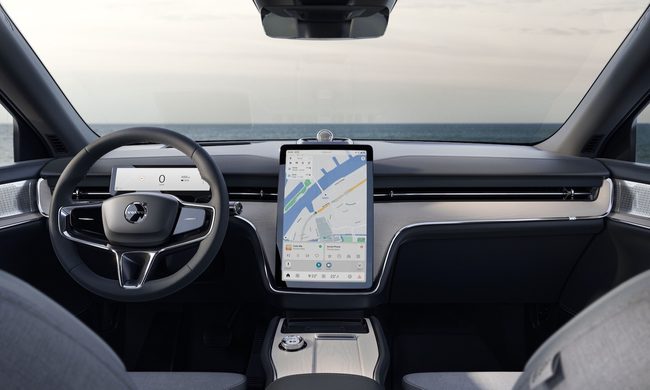
Interior view of the 2024 Volvo EX90.

The line between your smartphone and your car continues to blur. Volvo has announced that it is rolling out an over-the-air software update that brings Apple Music directly to the infotainment systems of more than 2 million vehicles worldwide. Instead of relying on Apple CarPlay or plugging in an iPhone, eligible drivers will be able to stream music natively from their car's built-in system, making Apple Music another integrated feature of Volvo's software experience.

The update is arriving for a wide range of Volvo models, including the EX90, ES90, XC90, S90, V90, XC60, S60, V60, XC40, EX40 and EC40, covering model year 2020 onwards. Availability, however, may vary depending on the vehicle.

Read more
Chery’s latest EV packs flagship tech for the price of a base Tesla, but you can’t buy it
Here's everything packed into Exeed's 2027 Exlantix ES, from its 27-sensor autonomous driving suite to its 860 km range, all starting under $31,000.
Car, Transportation, Vehicle

Chery's premium arm just dropped a sedan that makes you wonder why American EVs cost twice as much for half the tech.

Exeed's 2027 Exlantix ES ships with a driver-assist system called Falcon 700. It is built around an Nvidia Orin-Y chip and a genuinely stacked sensor suite.

Read more
A new AI model wants self-driving cars to think before they swerve
Forget guessing games, this self-driving AI actually shows its work.
Self driving car

Self-driving cars have gotten pretty good at driving. The harder problem is teaching them to drive safely in situations nobody planned for. We have heard horror stories of self-driving cars, behaving erratically in emergency situations, often times delaying first responders from reaching the scene.

A team at Seoul National University, led by professor Jun Won Choi from the Department of Electrical and Computer Engineering, thinks they have cracked part of that puzzle with a new AI model called SafeDrive. The research was recently selected as a highlight paper at CVPR 2026, a distinction that goes only to roughly 3% of all submissions.

Read more