1. Home
  2. Emerging Tech
  3. Web
  4. News

Pink Trombone is a DIY mouth you can manipulate to form sounds

Add as a preferred source on Google

Let’s be honest, if it weren’t for the faint whiff of NSFW material about its name, we would all click a link entitled “Pink Trombone” the moment we saw it.

A new web app created by Neil Thapen, a researcher at the Institute of Mathematics of the Academy of Sciences of the Czech Republic, it’s a pretty awesome creation: A disembodied mouth that you can manipulate to see how sounds are formed.

Recommended Videos

You probably won’t be using it to form any sounds other than guttural “Oh-ah-oo-ee-aa!” type noises but it’s an intriguing look at how the mouth’s soft and hard palate, tongue, lips, and oral and nasal cavity are manipulated to produce vowels and consonants, as well as varying pitch.

“Pink Trombone is an interactive articulatory speech synthesizer,” Thapen told Digital Trends. “That is, it creates speech by modeling — in a simplified way — the physical form and movements of the human vocal tract. Programs like this have been around for a long time, but the examples I’ve seen from academia tend to have unfriendly interfaces. I have tried to make one that is fun to use. You can move the tongue or lips around in real time with your fingers, and see what sound comes out.”
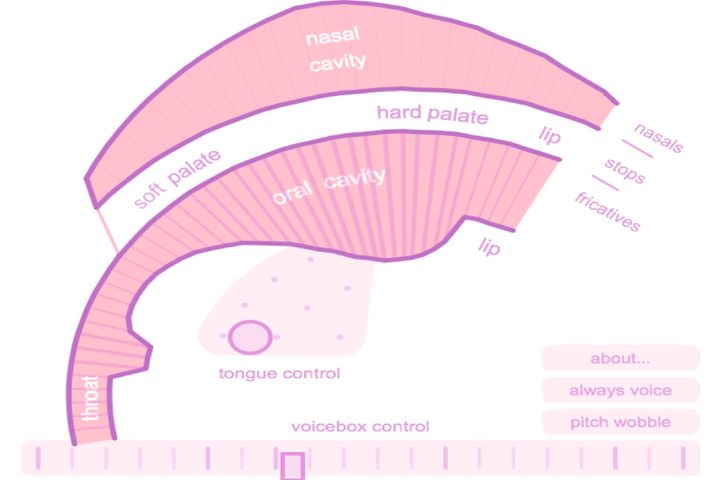
Image used with permission by copyright holder

Thapen said the web app has no real connection with his day job, which is research in logic. Instead, it ties in with his hobby of game development and making “interesting things that are fun to interact with.”

“I started working on it when my daughter began to speak,” he continued. “I was reading about the physical processes involved in speech production and thought it would be interesting to implement them on the computer at the same time as she was doing it in real life. Of course, she ended up learning much faster than I did.”

If you want to try it out, you can do so by clicking the link here. As far as gaining a basic understanding of speech and phonetics, and specifically how speech organs actually work, this is the best “hands-on” education you’re likely to get.


Luke Dormehl
I'm a UK-based tech writer covering Cool Tech at Digital Trends. I've also written for Fast Company, Wired, the Guardian…
Yet another study says AI is bad for elections, and the rabbit hole gets worse
AI may be an election bomb waiting for someone to light the fuse
Voters cast their ballots on Election Day

Another election, another study has concluded that asking an AI chatbot for political guidance is a spectacularly bad idea. Research conducted during Hungary’s 2026 parliamentary election found that ChatGPT and Google Gemini offered not just inaccurate but also inconsistent and unreliable voting advice. The chatbots misclassified voter profiles, overlooked relevant parties, recommended parties absent from the ballot, and sometimes produced materially different answers when given the same information repeatedly.

AI keeps failing the voter test

Read more
Samsung’s humanoid robot ambitions are real, but factories come first
Samsung’s new robotics division has humanoids in its sights, although its immediate business is far more practical factory automation
Robot Touch Human Finger

Samsung wants a place in the humanoid race, but its new robotics push begins with machines built for factories rather than homes.

The CEO-led RX robotics division will initially focus on manufacturing robots. Samsung has separately identified humanoids as a priority, although it hasn’t announced a commercial model or explained where one fits into the division’s immediate plans.

Read more
The future of AI may depend on this one behind-the-scenes change
Running Claude on Android.

Whenever a new AI model arrives, it's easy to get caught up in the bells and whistles. We talk about how much smarter it is, how quickly it answers questions, or how realistic its images have become. But here's the thing: none of that matters much if the AI can't reliably work with the apps and services people use every day.

That's why an upcoming update to the Model Context Protocol (MCP) caught my attention. It isn't a new chatbot or a fancy AI model. In fact, most people will never even know it's happening. But it could quietly make the AI ecosystem a lot healthier. If you've never heard of MCP before, don't worry. Think of it as a shared language that lets AI assistants safely talk to apps like Gmail, Slack, calendars, databases, and countless other services. Instead of every company inventing its own way to make those connections, MCP gives everyone a common rulebook.

Read more