1. Home
  2. Phones
  3. Android
  4. Apple
  5. Mobile
  6. News

Cosy, a robotics startup, can track your position in 3D space with a camera

Add as a preferred source on Google

Three-dimensional depth tracking is a complicated problem without an easy solution. Solutions like Microsoft’s Kinect, Google’s Tango platform, and Leap Motion’s peripheral can pick out walls and other obstacles with the help of custom sensor arrays, but they aren’t exactly plug-and-play — short of some duct tape and a lot of coding, getting them to talk to a robot, smartphone, or other device is an ordeal.

But Cosy, a startup founded by University of Pennsylvania graduate Jonas Cleveland, might have the solution — a software framework that combines neural networking and indoor positioning to pinpoint the location of robots, smartphones, and more in three-dimensional space.

Recommended Videos

And unlike most positional tracking technologies, which rely on infrared sensors to orient objects in rooms and hallways, Cosy’s platform works on any device with a camera. “It doesn’t matter the platform — it works on fixed cameras” Cleveland said. “A lot of folks claim you’re not able to achieve [3D mapping] without using lidar, but we’ve done it. It’s all post processing.”
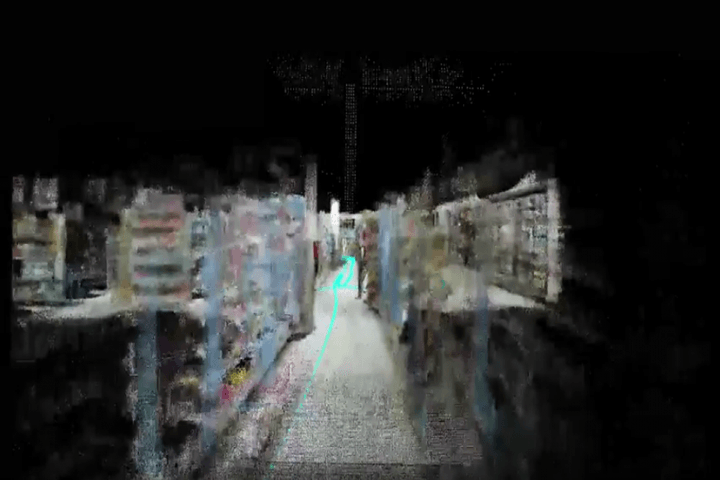
The robot generates a “point cloud” as it runs through the store doing inventory. Image used with permission by copyright holder

It’s a little like Snapchat’s Lenses, which use computer vision and augmented reality to lay digital objects on top of real-world environments. Cleveland wouldn’t spill the beans on Cosy’s tech, some of which is patent-pending. But if it’s anything like Lenses, it takes into account factors like rotation, occlusion, and more in real time.

Cosy is applying it to retail — specifically inventory management. Robots that are four-and-a-half feet tall robots (“about the size of a fourth grader,” Cleveland said) equipped with the startup’s software navigate the store aisles autonomously, taking note of the products on shelves. They relay that data to a central server, which updates the store’s inventory database.

Cosy sees it lightening human workloads. “We’re empowering humans to do other things,” Cleveland said. “People are not very good at tedious and mundane tasks. Inventory is incredibly labor intensive, and very inaccurate — humans hate doing inventory. We’re checking stock and seeing where items are located in the store through software, without human assistance.”

It might not be long before you see a Cosy-powered ‘bot at your local department store. The startup is in talks with three of the top twenty U.S. retailers to deploy the inventory-checking robots in the next year. And in the future, Cosy hopes to adapt the tech to smartphones — Cleveland envisions an app that directs customers to a particular section of a store, for example, or even an exact shelf.

“When you can map indoor space and all the objects, that solves a lot of problems,” said Cleveland.

Kyle Wiggers
Kyle Wiggers is a writer, Web designer, and podcaster with an acute interest in all things tech. When not reviewing gadgets…
Google just canceled its AI Studio mobile app, and it’s not all bad news
Logo, Symbol, Disk

Google AI Studio was on track to make its way to Android and iPhone, giving developers and AI enthusiasts a dedicated place to build prompts and experiment with Google's latest models from their phones.

That's no longer happening. In a post shared by the official Google AI Studio account on X, Google confirmed that it's canceling the standalone AI Studio mobile app before launch. The announcement comes despite the company saying nearly 800,000 people had already pre-ordered the app across iOS and Android.

Read more
Apple may change its iPhone launch strategy, and the standard iPhone could be affected the most
Electronics, Mobile Phone, Phone

Apple's iPhone launches have followed the same familiar rhythm for years. Every September, Apple takes the wraps off its newest flagship lineup, and a few months later, a more affordable "e" model joins the party in the spring. It's a formula that's been easy to follow, but it may not stay that way for much longer.

Reports have been pointing toward a major shake-up starting with the iPhone 18 lineup, and we've covered those rumors over the past few months as well. Rather than unveiling every new iPhone at the same event, Apple is reportedly planning to split its releases across two seasons. If that happens, the standard iPhone could miss its usual September debut for the first time, marking one of the biggest changes to the company's launch strategy in years.

Read more
Google’s long-awaited AirTag rival just leaked ahead of launch under a familiar name
Electronics, Computer Hardware, Hardware

Google has spent the last few years expanding Android's Find Hub network, making it easier to track lost devices and accessories. But there's been one obvious piece missing from the puzzle: a first-party tracker of its own. That may finally be about to change.

According to a report from 9to5Google, Google's long-rumored Pixel Tag has finally broken cover. The accessory has appeared in multiple online listings, with the report also revealing what seems to be its first leaked image, offering an early look at Google's answer to Apple's AirTag and Samsung's Galaxy SmartTag.

Read more