1. Home
  2. Emerging Tech
  3. News

MIT developed an algorithm that will make drones more agile at high speeds

Add as a preferred source on Google

We don’t think we are going out on a limb when we say that autonomous drones are going to be big. But, like the archetypal protagonist at the start of any hero’s quest, they need to learn a few things first.

One such challenge is how to fly quickly while managing to dodge obstacles. The reason this is hard for drones is because their cameras can only process images up to a certain speed since they have to do it frame by frame. Anything faster than 30 mph causes a bit of a headache.

Recommended Videos

That is where a new research project from the Massachusetts Institute of Technology comes into play. It builds on a technology called the Dynamic Vision Sensor (DVS), invented by researchers in Zurich. The DVS continuously visualizes scenes by looking for changes in brightness. This is similar to the way that the human brain senses visual information and means that it can work at short, microsecond intervals much faster than regular cameras.

The problem is the amount of processing time it requires due to the huge mass of data. By the time an obstacle has been detected and a control outputted, a drone would have already crashed.

MIT’s work represents a step forward. It is an algorithm that is able to isolate very specific changes in brightness, which has the effect of reducing complex scenes to their most essential elements.

“The DVS has had a lot of empirical successes,” lead author Prince Singh, a graduate student in MIT’s Department of Aeronautics and Astronautics, told Digital Trends. “However, there [hasn’t previously been] a concrete algorithm that can process the sensor’s ambiguous data to, for instance, control a dynamic system such as a drone. My work addresses the control of any system that has a linearized representation by making sense of the DVS’s ambiguous data. This work unifies the empirical successes observed, and most importantly, one doesn’t need knowledge of the problem’s geometry, as was the case for works until now.”

Singh is currently presenting the work at the Institute of Electrical and Electronics Engineers American Control Conference in Seattle. Next up, the plan is to publish a paper on the work. Hopefully, it won’t be too long after that before drones — and other autonomous robots — can take advantage of this high-speed breakthrough.


Luke Dormehl
I'm a UK-based tech writer covering Cool Tech at Digital Trends. I've also written for Fast Company, Wired, the Guardian…
Google just canceled its AI Studio mobile app, and it’s not all bad news
Logo, Symbol, Disk

Google AI Studio was on track to make its way to Android and iPhone, giving developers and AI enthusiasts a dedicated place to build prompts and experiment with Google's latest models from their phones.

That's no longer happening. In a post shared by the official Google AI Studio account on X, Google confirmed that it's canceling the standalone AI Studio mobile app before launch. The announcement comes despite the company saying nearly 800,000 people had already pre-ordered the app across iOS and Android.

Read more
Google Earth’s AI misadventure lasted only a day. It was a tale of dangerous ignorance.
Nuclear reactors, tanks, and historical destruction on a life-like satellite map? Yeah, that's bad.
Nano Banana AI image generator representation.

Technology behemoths are clearly not reading the room, or they are just moving faster than they should when it comes to AI deployment. Google has already stuffed its Gemini AI in every corner of its software stack, from Android to daily productivity tools like Gmail that are used by hundreds of millions of users every day. AI is everywhere. Not all of it is bad, mind you. But in a few places, it just feels forced.

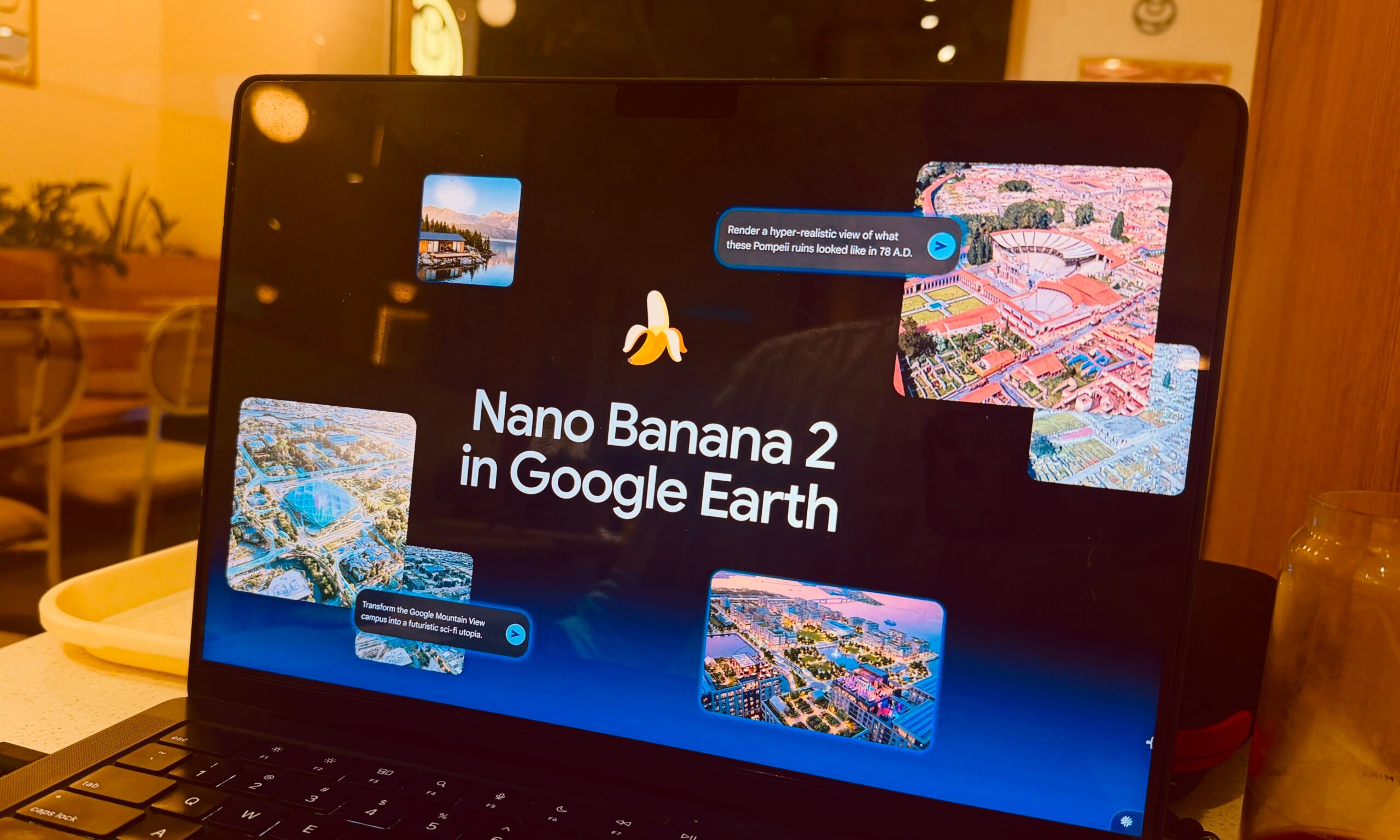
In its latest AI-fication experiment, the company targeted Google Earth. The idea was to let the audience use its Nano Banana 2 AI image generator and make images that can be placed on the map view. On paper, it's a cool idea. What would the Colosseum of Rome look like in your urban neighborhood? Yeah, fun stuff like that.

Read more
Google’s new AI gives robots better balance, smarter hands, and teamwork capabilities
Google just made robots a lot less clumsy and a lot more helpful.
Gemini robotics 2.0

Google DeepMind just brought sci-fi robots closer to reality, and it is very exciting. Building on its original Gemini Robotics model, the company has introduced Gemini Robotics 2, an AI system designed to help robots think, move, and even work together. Unlike most robots today, which rely on pre-programmed routines or someone controlling them remotely, this new system lets robots figure things out on their own when situations get unpredictable.

Can robots finally handle whole-body tasks?

Read more