“Why you can trust Digital Trends – We have a 20-year history of testing, reviewing, and rating products, services and apps to help you make a sound buying decision. Find out more about how we test and score products.“
Video game narratives too often feel like tacked-on ways to fill the gaps between action. They rarely strike a cord, make you think deeply, or make you question your beliefs. Some times, that’s okay. Games are, after all, active by design: Making a game fun to play often takes priority over the precision or weight of its narrative. Not always, though. Tacoma, the new Sci-Fi game from Gone Home developer The Fullbright Company, goes the opposite way. It is a game wholly concerned with telling a story. In the process, it has become one of the most insightful, provocative games in recent memory. Find out why in our Tacoma review.
“Fullbright’s depiction of 2088 is as fascinating as it is terrifying.”
From its premise alone, it’s easy to come to that conclusion. Both games could fall under what players call a “walking simulator,” an interactive narrative experience without any possibility of failure. In both games, the protagonist explores an enclosed, lifeless space, uncovering the hidden story of that place through notes, art, audio logs, and other details. They are compact narratives that only reveal themselves through thorough investigation.
It would be unfair to label Tacoma as “Gone Home in space,” though. Gone home was a character study disguised as a mystery. Tacoma delivers a real mystery while diving deeply into not just its characters, but the galaxy they live in. By retooling the way we ingest and digest both impactful and inconsequential information, Tacoma takes one giant step forward for Fullbright. In doing so, it has delivered a follow-up that nearly perfects its unique, poignant brand of storytelling.
Play, pause, rewind, repeat
The year is 2088. You’re Amy Ferrier, a technical subcontractor from the California Republic. With the assistance of Mindy, your AI companion, you dock onto the Tacoma orbital station. Upon entering the station, the station’s AI directs you to fit yourself with augmented reality earpieces. A sign on the wall with small typeface declares that everything that occurs on Tacoma is recorded and property of the Venturis Corporation.
Tacoma recently housed six contractors — four female, two male – but they’ve gone missing. Reports of a meteor colliding with the station — eliminating oxygen circulation and suppressing external communication — lead us to the question: What happened to the six contractors who worked and lived on Tacoma? We aren’t told if the crew is dead or alive. All that remains are AR recordings scattered across the station’s departments.


Over the course of a few hours, the picture of what occurred mere hours ago on Tacoma takes shape. Most of the AR logs chronicle the days of panic, but they not necessarily to whatever led to the crew’s disappearance. Your job is to piece the jumbled fragments together — an oddity here, a revelation there — and form a coherent understanding of the situation.
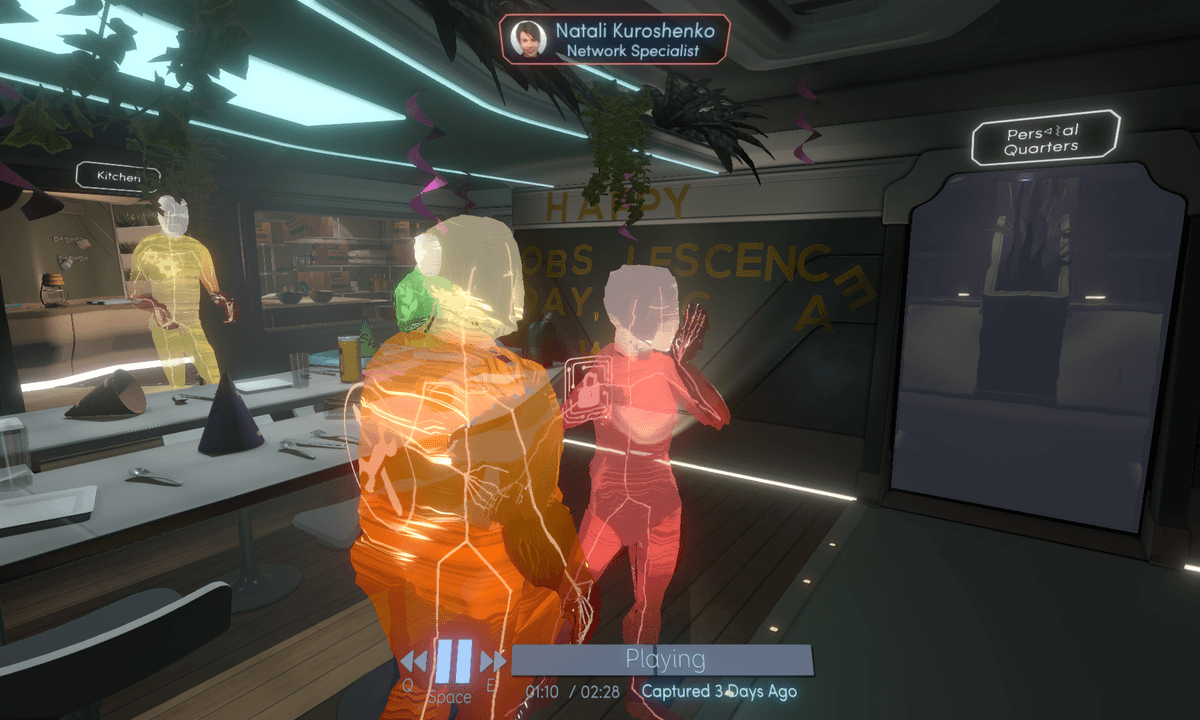
While AR logs play, the crew members appear as holograms. You follow the bright-colored silhouettes around like a ghost, taking the same steps they took, listening to their seemingly private discussions. And while what they say is often important, so are their surroundings. At certain points in the recordings, you can interact with a crew member’s AR desktop to read text messages, emails, and documents pertaining to the mission.
These recordings can be paused, rewound, and sped up. In most cases, you’ll need to play them multiple times to glean all details, following different crew members as they diverge to hold separate conversations.
Doling out clues like breadcrumbs in mixed media, particularly personal writing, harks back to the Gone Home playbook, but in Tacoma, what you read carries new meaning. As Amy, you can look at the clues from all angles, and read what crew members were viewing while in conversation. It’s sometimes deeply personal, but comparing and contrasting their discussions with what they were concerned with internally adds an additional layer to each discovery.
2088: A Space Odyssey
For a game set exclusively on a relatively small space station, Tacoma does an exceedingly good job creating a global sense of how things are in 2088, not just on Earth, but throughout the solar system. Governments have drastically changed, and corporations still reign supreme. Amazon is bigger than ever, and customer loyalty is exchanged for goods and services. Fullbright’s depiction of 2088 is as fascinating as it is terrifying. Aspects of this vision elicit optimism, while others distill chilling anxiety.
While Tacoma comes to a rather clean conclusion, it’s by no means definitive. The door remains open for questions. You may find some of those answers by boarding Tacoma again. Others are destined to be pondered long after you exit the orbital station.