
It may look like some strange artifact out of a steampunk novel, but a new and tiny pill-sized device developed by researchers at RMIT University in Melbourne, Australia, is actually a functioning ingestible gas sensor that could one day help save you from a severe gut-related problem.
“We have developed an electronic capsule that measures gas biomarkers as it travels through your gut,” Dr. Kyle Berean, a research fellow in RMIT’s School of Engineering, told Digital Trends. “The gases are generally produced by the microbial communities that live inside you, your microbiome. Our capsule can sense how these communities are interacting with the food your feed them, the environment they are living in, and how they are working together as a community. The capsule itself is a standard 000 size — [making it the equivalent of a] fish oil tablet — and measures H2, CO2 and O2. It transmits this data out of the body to a handheld receiver. This receiver is then Bluetooth-linked to a mobile phone application that is both giving feedback to the user, as well as updating the cloud, giving the practitioner access to the data in real time.”
At present, there are very few diagnostic tools at hand for a gastroenterologist, a physician who specializes in diseases of the gastrointestinal tract and liver. There are endoscopies and colonoscopies, but these cannot help if there are no visual markers present to indicate a problem. Another approach focuses on analyzing gases generated in the gut — although a method based on breath tests can yield lots of false positives and negatives because the few relevant molecules present in the lungs, in concentrations of just a few parts per million, are diluted by the breath.
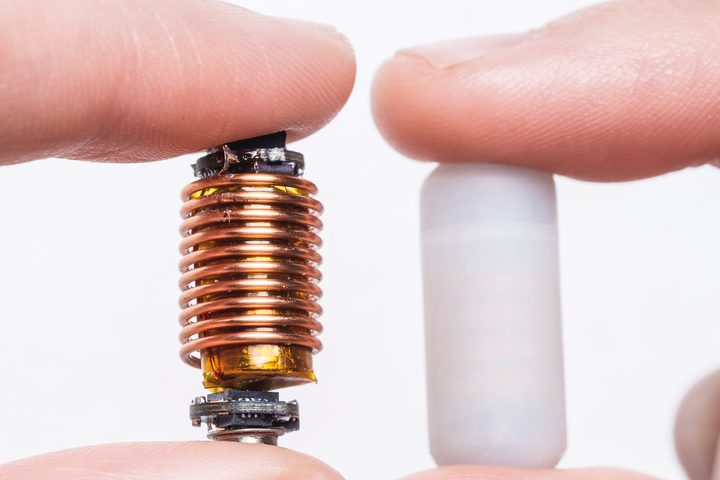
The team’s new ingestible gas sensor aims to change the game by measuring these gases at the point of production to increase accuracy. The swallowable device consists of two gas sensors, a temperature sensor, microcontroller, radio-frequency transmitter, and silver-oxide batteries — all contained inside an inch-long polyethylene shell. The disorders it could help diagnose include irritable bowel syndrome , small intestinal bacterial overgrowth, and general motility problems, as well as inflammatory bowel disease. It could even conceivably be used to indicate potentially fatal diseases such as colon cancer.
“Currently we have just completed the phase 1 trial on 26 healthy individuals proving the capsules’ safety and efficacy,” Berean said. “We have created a commercial vehicle, Atmo Biosciences, where we are currently looking for capital to start our phase 2 trials. These trials will take place on approximately 300 patients to prove the clinical significance. As someone who suffers from gut disorders myself, I feel quite strongly about getting this to patients as quickly as possible.”


