“Why you can trust Digital Trends – We have a 20-year history of testing, reviewing, and rating products, services and apps to help you make a sound buying decision. Find out more about how we test and score products.“


Samsung’s M.2 drives are everywhere. They’re found in everything from off-the-shelf desktop PCs to custom-built gaming behemoths. Honestly, if you’ve touched a desktop computer in the last decade, you’ve probably used a Samsung M.2 drive. There’s a good reason for that. They’re quick, reliable, and forgettable. That’s a good thing for a storage device. Storage should lurk in the background, toiling in obscurity. If it rises to your notice, chances are it’s because something’s either very wrong, or very right. In the 1TB Samsung 860 Evo’s case, well, let’s just say it’s anything but forgettable.
Bigger on the inside
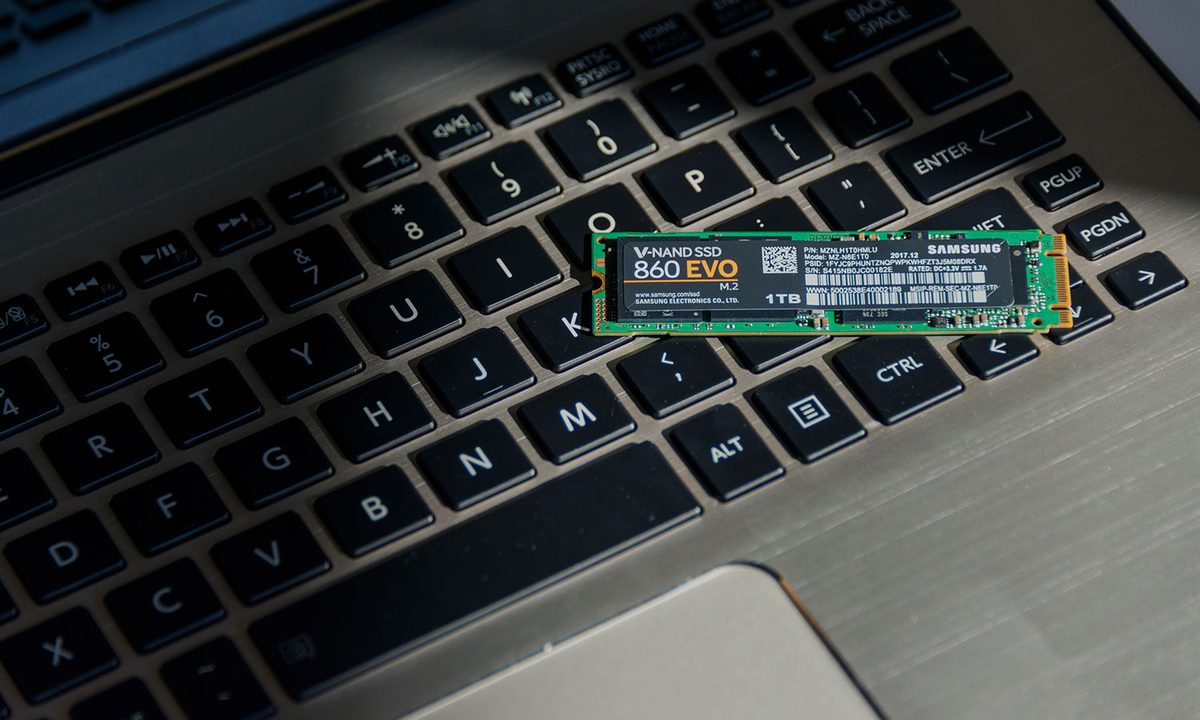
Like all M.2 drives this little guy is about the size of a stick of gum, or a flash drive someone flattened with a hydraulic press. Point is, it’s small. It’s almost too small when you’re installing it in your computer it’s easy to lose in the shuffle of a messy desk. That didn’t happen during our review. We never misplaced it or briefly panicked because we thought maybe we lost this expensive piece of hardware. Not even for a second, promise.

Anyway, once you slot it into your PC and get it formatted, you might find yourself doing a double-take. A single terabyte might not seem like much these days, but there’s a disconnect between what 1TB of digital space actually feels like and what the Samsung 860 Evo looks like. It’s not a big hunk of steel that slots into a drive bay on the front-side of your PC. The Samsung 860 Evo occupies the space usually reserved for 256GB operating system drives, and once that extra terabyte shows up on your PC, it’s hard not to smile. It’s like opening the door to a phone booth and stepping into an aircraft hangar.
Quick enough
There’s a pleasant disconnect between what 1TB of space feels like and what the Samsung 860 Evo looks like.
During our tests we saw the 860 Evo hit a consistent read speed of 556 megabytes-per-second, and write speed of 515 MB/s. It’s not the quickest drive we’ve ever tested, not by a long shot — but it is the quickest 1TB desktop SSD we’ve ever tested, if only just.
It beat out the two runners-up, the WD Blue 3D NAND 1TB SSD, and the SanDisk Ultra 3D NAND 1TB SSD by a few megabytes-per-second. The WD Blue hit a read speed of 540 MB/s and a write speed of 511 MB/s, while the SanDisk Ultra hit 539 MB/s and 510 MB/s.
The important thing to note about the Samsung 860 Evo’s competitors is their respective size. Both the WD Blue and SanDisk Ultra we tested were 2.5-inch drives, the kind that slot into the front-side of your desktop. That means they’re not quite as convenient, despite being in the same price range as the 1TB Samsung Evo, which will set you back about $330. The 1TB WD Blue runs about $286, and the 1TB SanDisk Ultra starts at about $280. So, while you could save some cash going with one of these other drives, they’re nowhere near as compact and convenient as the 1TB Samsung 860 Evo.
Bottom line
Whether you’re upgrading an existing PC, or building one from scratch, the $330 Samsung 860 Evo M.2 1TB is an excellent choice. It is a bit expensive, but keep in mind what you’re getting — a terabyte of storage space, and enough speed that it’s never going to hold you back in everyday use. If you bought one today, it’d be the most future-proof component in your PC for several years at least.