What’s 50 years old and in the best shape of its life? It’s not the shirtless guy that stars in cheesy fitness commercials on television. We’re talking about Subaru’s American division. Strong products and clever advertising allowed it to emerge from its niche and become one of the largest, most enviable auto-makers in America. It outsold Mazda and Volkswagen combined in 2017. It’s not showing signs of slowing down anytime soon, either.
Subaru continued its model offensive at the New York auto show by introducing the all-new 2019 Forester. The crossover falls in line with the company’s most recent design language thanks in part to an upright front end characterized by styling cues like a hexagonal grille and c-shaped inserts in the lights.
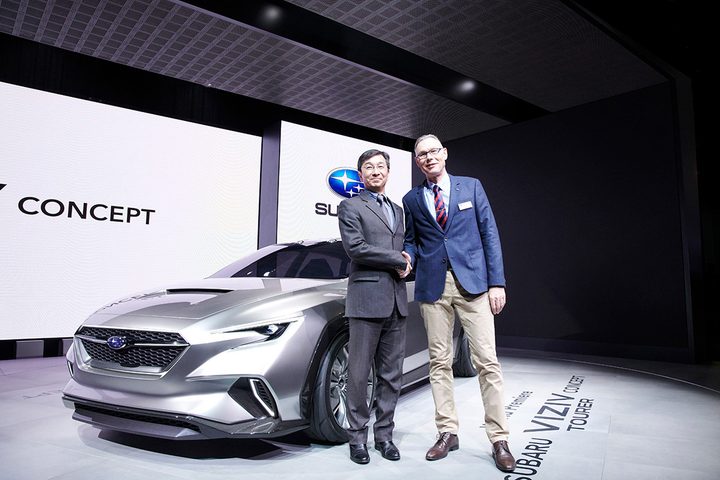
We sat down with Mamoru Ishii, the head of the company’s design department, to find out where the design language comes from and where it’s going next.
Speaking through an interpreter, Ishii told us Subaru’s design philosophy primarily conveys two key qualities: dynamic and solid. Designers regularly tweak the ratio between the two. In the case of the Outback, his team set it at about 50/50. The smaller Impreza puts a bigger emphasis on the dynamic side, while the new Forester leans more towards the solid end of the spectrum. Of course, the BRZ coupe is all about dynamism. It’s also solid, but it doesn’t need to show it.
To Subaru, the term “crossover” means thinking outside the box and combining the best attributes to create a unique car.
“It’s not just a simple addition. It’s more like a crossover of two different design thoughts,” explained Ishii. In this case, the term crossover doesn’t refer to the body style taking over the automotive world. To Subaru, it also means thinking well outside of the box and combining the best attributes from different segments to create a unique type of car. The Outback, for example, has turned into an SUV-wagon cross over the past two decades.
The VIZIV Tourer concept introduced recently at the Geneva auto show represents another example of Ishii’s approach to design. It’s not just a wagon; it also has a high-performance side that channels Subaru’s motorsport heritage.
“Crossover means different bodies in one form. Different values, too, like practicality and performance. It’s not necessarily a specific body style,” Ishii opined.


He instructs his team to maintain the same theme throughout the lineup to create a family resemblance. At the same time, he asks for a visible degree of differentiation between each model line to avoid falling into the Russian doll styling rut. Subaru’s cars need to look different from each other.
“We use a combination of the hexagon grille and the c-shaped lights to define each model’s character. Each one of our cars has a different combination of those cues. The front grille has the hexagon motif, it’s a symbol for stability; it shows strength, like a honeycomb structure,” he explained. The c-shaped lights are inspired by the flat configuration of the four- or six-cylinder engine found under the hood of every Subaru model.
“We use a combination of the hexagon grille and the c-shaped lights to define each model’s character.”
Looking ahead, we could see a lot more crossovers – in both senses of the term. Many predict the automotive industry is on the cusp of a design revolution. EVs will allow stylists to explore new shapes and proportions, while autonomy while make it possible for auto-makers to reinvent the interior. Ishii takes a more cautious approach than many of his colleagues.
“Electrification gives us the freedom to use more space, but at the same time we need to have a specific structure to absorb the impact in a crash. We have to ally these two at the same time. We take the safety of our cars very seriously,” he pointed out.
Subaru has emerged as the ride of choice for outdoorsy and adventurous motorists. In the near-term future, Ishii plans on taking the brand’s design language forward by listening to what customers want and staying in tune with market trends. The aforementioned VIZIV Tourer illustrates a possible addition to the company’s portfolio of car, though it hasn’t been approved for production yet. The company has other ideas, too, but there’s one model that will remain in the past: the WRX hatchback.
“We don’t have plans to bring back a WRX hatch to the market,” he told us.