  1. Home
  2. Emerging Tech
  3. News

Amazing software turns 3D scans into knitted objects, no grannies required

Add as a preferred source on Google
Carnegie Mellon University

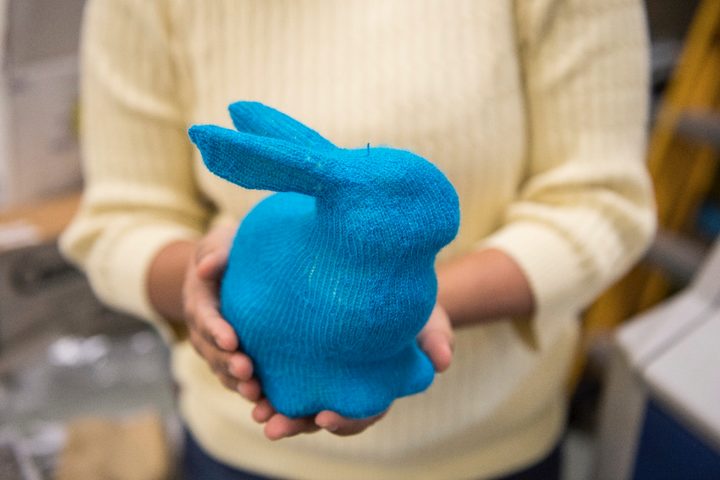
When people talk about those most likely to lose their jobs to automation, chances are that grannies aren’t the first people who come to mind. But knitting needle-wielding grannies, busy churning out tiny knitted jumpers for their grandchildren, could soon find themselves at risk of techno-replacement thanks to new research coming out of Carnegie Mellon University’s Textiles Lab.

Computer scientists there have developed software that’s able to transform 3D models into stitch-by-stitch knitting instruction for V-bed automated knitting machines. The result is a system that could one day take any 3D scan of an object and transform it into a knitted object, with minimal human intervention.

Recommended Videos

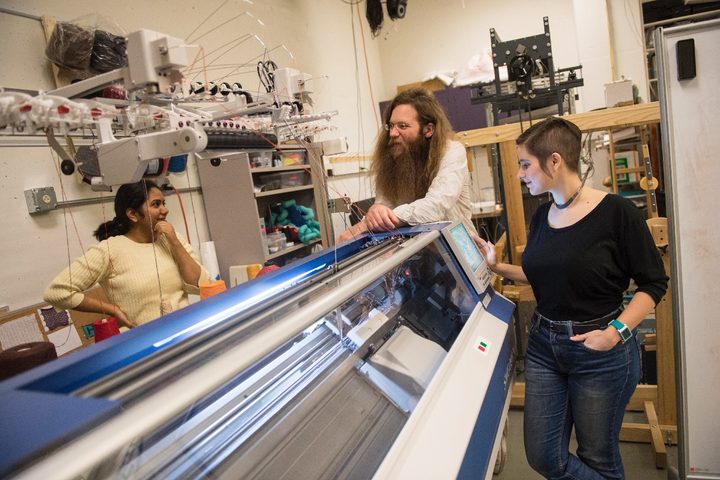
“A 3D model usually consists as a set of points and encodes how they are connected to represent a shape,” Vidya Narayanan, a doctoral student working on the project, told Digital Trends. “Knitting machines cannot directly work with such an input. A knitting machine consists of hundreds of needles on which loops or stitches can be created and moved around. The input to such a machine needs to specify exactly where stitches or loops must be added and how they must be moved.”
Carnegie Mellon University

Carnegie Mellon’s system works by taking a 3D model as its input, and then computes the necessary stitches and their connectivity so that the shape can be replicated through knitting. After this, it works out the order in which loops must be generated, assigns needle locations for each loop, and calculates the necessary instructions to ensure the finished structure looks as intended. And you thought making a car drive autonomously was complex!

For now, though, it seems that granny may be safe from total replacement. That’s because, while the tech is certainly impressive, there is still room for improvement.

“Noticeably, this version of our system only generates stockinette patterns, and does not support textures or patterns,” Narayanan continued. “But it is indeed possible to generate knit objects with interesting patterns such as laces and cables, as well as color work. This also calls for ways to encode aesthetic considerations and provide more user control in the pattern generation process.

“Secondly, our project was focused on the geometry — getting the shape right. Modeling yarn stress is also important for functionality. Soft knit objects can deform in unintuitive ways, simulations will go a long way in making better design tools for such systems. We are now looking at understanding and solving these problems.”

Luke Dormehl
I'm a UK-based tech writer covering Cool Tech at Digital Trends. I've also written for Fast Company, Wired, the Guardian…
Starlink V5 is here, and it’s lighter, smarter, and far more efficient
The next-generation satellite internet kit promises improved efficiency while maintaining high-speed connectivity.
Starlink V4 vs V5

Not every hardware upgrade needs to be about speed. With Starlink V5, SpaceX is betting that a lighter design and lower power consumption matter just as much. The company has officially introduced its next-generation Starlink V5 kit, featuring a smaller and lighter design with significantly improved power efficiency.

Smaller, lighter, and far more efficient

Read more
Frontier joins the Starlink club with high-speed in-flight internet
The carrier plans to roll out SpaceX's satellite-powered Wi-Fi across its fleet starting in 2027.
Frontier Starlink partnership featured

If there's one thing budget airlines aren't exactly known for, it's great onboard Wi-Fi. In Frontier Airlines' case, it hasn't offered in-flight internet at all. That's about to change. Frontier Airlines has announced a partnership with SpaceX's Starlink to bring high-speed, low-latency internet across its fleet. Installations will begin in early 2027, making Frontier the first ultra-low-cost carrier in the United States to adopt Starlink's satellite-powered connectivity.

Streaming, browsing, and even gaming at 35,000 feet

Read more
OpenAI’s first hardware product sounds more like a companion than a speaker
The AI company is reportedly building a mobile home device that understands context and proactively helps users.
OpenAI press image

For months, rumors have suggested that OpenAI's first hardware product could be a wearable AI device, or perhaps even the beginning of its long-term smartphone ambitions. As it turns out, the company's first gadget may be something far simpler, yet arguably far more ambitious. It will help control smart-home appliances, play media, answer questions, respond to messages, and tap into the range of capabilities offered by OpenAI's ChatGPT, according to people familiar with the matter.

OpenAI's first AI device could end up being a speaker, following plenty of hype that the company is actually working on a wearable AI device and might even launch a smartphone down the road. According to a Bloomberg report, the speaker will serve as a human-like AI companion that will integrate directly with the smart home ecosystem.

Read more