Pokémon Quest caught a lot of folks off-guard with its surprise release. Launched last week on the Switch, some have called it one of the best free-to-play Pokémon games around (us included). However, a fair bit of the game’s nuance seems intentionally obfuscated. That’s fine, to a point, but it can be a bit tough to figure out the best strategies for leveling up your Pokémon and exploring the game’s Tumblecube Island.
So, consider this our official guide for beginners — a quick way to help you get started. While Pokémon Quest is currently only on the Switch, most if not all of these recommendations should hold for the mobile version when it launches in late June.
Starting tips
The first thing you’ll want to do, especially if you’re looking to advance quickly and play effectively, is follow the same advice that every Pokémon game doles out pretty early on: Pay attention to Pokémon types and their match-ups. In Quest, though, this gets a bit easier. Each new area you visit will show the “bonus type” for that map, and any Pokémon with that type will receive a massive boost to their combat power for the whole run. So it’s generally advisable to pick out one or two pocket monsters you’ll want to have to fill in gaps, and then build your team for each stage based on the types that are strongest there.
With two Pokémon of that type, you’ll often have little trouble clearing the area. You can check the types you’ll need as you unlock new locations, too. Then you can start trying to track down the Pokémon you’ll need, which leads into recipe-crafting …
A prelude to recipes: Finding the right ingredients
Your single best and most reliable tool in the pursuit of boosting your Pokémon collection is to get your recipes down. In each stage, as you progress, you’ll pick up crafting ingredients. These each have different properties and can go into your cooking pot in any number of combinations. What Pokémon show up will depend on their type, appearance, and preferences.
But here’s the catch: You can only have one recipe going at a time (unless you want to shell out real-world money), and how fast it finishes cooking depends directly on how many missions you and your team of Pokémon attempt (you don’t need to succeed to make progress). So this is where thinking ahead to what types of Pokémon you’ll need for upcoming stages comes in. Making matters a bit tough is that each recipe is hidden from you until you learn it. So, we’re here to demystify some of them.
Here are the eight basic ingredients and two advanced ones, and their respective properties:
Basic
Tiny Mushrooms: Red, soft and small
Bluk Berries: Blue, soft, small, sweet
Apricorns: Yellow, hard, small, plant
Fossils: Hard, gray, small, mineral
Big Roots: Big, red, soft, plant, precious
Icy Rocks: Blue, hard, mineral, precious
Honey: Yellow, soft, sweet, precious
Balm Mushrooms: Gray, soft, precious, mushroom
Advanced
Rainbow Things: Can substitute for any other ingredient
Mystical Shell: Used for mystical and rare Pokémon
As you may have noticed, some of these have “precious” as a designation. These ingredients can be hard to work with, because they don’t often have the same traits as their smaller analogs, but adding even one into a recipe will boost your odds of getting a rare or otherwise special Pokémon. And that’s really the key — looking at ingredients lists for these recipes and modifying them to get the strongest and best Pokémon you can that has the traits you need.
Recipes
Most of the recipes you can use will be type-specific. A few, however, will pull just any old Pokémon, or one that fits a certain color palette (though what the game classifies as each color can sometimes be a bit of a stretch). As stated above, you can and should modify these recipes where possible. For instance, a Mulligan Sew can be made with any things you have, but if you toss in one of each of the precious materials, you’ll likely get a rare and powerful Pokémon. We’ve also translated the game’s internal jargon into something you can understand. Just look at the base recipe and go through the list, finding the one that’ll give you the best Pokémon with the ingredients you have on hand. You’ll get a lot more mileage from your supplies this way, as opposed to looking up the example recipes found elsewhere.
With that in mind, here are the 18 recipes:
Mulligan Stew
Ingredients: Whatever
Draws: Whatever
Red Stew
Ingredients: At least four red things
Draws: Reddish Pokémon
Blue Soda
Ingredients: At least four blue things
Draws: Blueish Pokémon
Yellow Curry
Ingredients: At least four yellow things
Draws: Yellowish Pokémon
Gray Porridge
Ingredients: At least four gray things
Draws: Grayish Pokémon
Brain Food
Ingredients: Three sweet things and two hard things
Draws: Psychic types
Get Swole Syrup
Ingredients: Three sweet things and two mushrooms
Draws: Fighting types
Hot Pot
Ingredients: Three mushrooms and at least one red thing
Draws: Fire types
Honey Nectar
Ingredients: Four sweet things and three yellow things (the easiest way is to mix berries and honey)
Draws: Bug types
Light-As-Air Casserole
Ingredients: Three minerals and two plants
Draws: Flying types
Mouth-Watering Dip
Ingredients: Four soft things and three blue things
Draws: Water types
Plain Crepe
Ingredients: Three sweet things and two gray things
Draws: Normal types
Mud Pie
Ingredients: Two minerals and three soft things
Draws: Ground types
Stone Soup
Ingredients: Four hard things and two minerals
Draws: Rock Types
Sludge Soup
Ingredients: Four mushrooms and three soft things (mushrooms are soft, so to amp this up and get a rare, you can dump in five balm shrooms, for example)
Draws: Poison types
Watt-a-Risotta
Ingredients: Four soft things and three yellow things
Draws: Electric types
Veggie Smoothie
Ingredients: Four plants and three soft things
Draws: Grass types
Team Composition and Training for the Right Moves
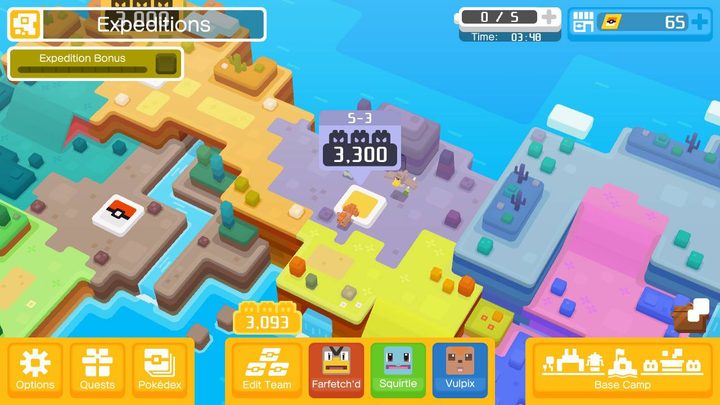
Our last major tip for incoming players is to pay very close attention to team composition. Obviously, the types matter, but in Pokémon Quest, your monsters will also be assigned either close combat or ranged combat. How they are arranged and how you’ve got your different attack types set out plays a major role in how they handle enemies. In general, if you have one that’s up front, enemies will attack them first. Which isn’t to say that you can’t pick a squishy standard-bearer, but that takes additional planning.
On one of our best teams, for example, we lead with Raichu (a fairly defense-poor Pokémon), who was a close-range fighter. It led with paralysis-causing moves, and then the foe would be unable to use special abilities. An additional Pokémon, Cloyster, used team defense-boosting attacks to keep Raichu from taking on too much hurt. Then, Alakazam held down the other flank, dishing out massive amounts of damage, and keeping itself (mostly) from taking damage, as it’s the squishiest of the three.
Pokémon Quest, on first pass, might seem like a really stripped-down version of the classics. In many respects, it is, but the knowledge you can apply from the other games is surprisingly helpful — just maybe not in the ways you’d expect. Synergizing your squad can be a tricky balancing act at times, but the dividends it yields are worth it.