With two rumored screens, Microsoft may be positioning its highly anticipated foldable PC as the ultimate convertible computing device. Known by its Andromeda code name and widely believed to debut as the Surface Phone, Microsoft’s dual-screen PC could be used in up to five different configurations, depending on the orientation of the screens. This is up from the three configurations found on many hybrid laptops, like HP’s Spectre x360 and Lenovo’s Yoga series.
Code from Windows 10 build 17704 obtained by Twitter user @h0x0d reveals that Microsoft is creating different usage scenarios based on how the screens are oriented around the 360-degree hinge. The screens can show different content and be used in different context based on the positioning of the hinge, and the device can operate in closed, flat, convex, concave, and full modes.
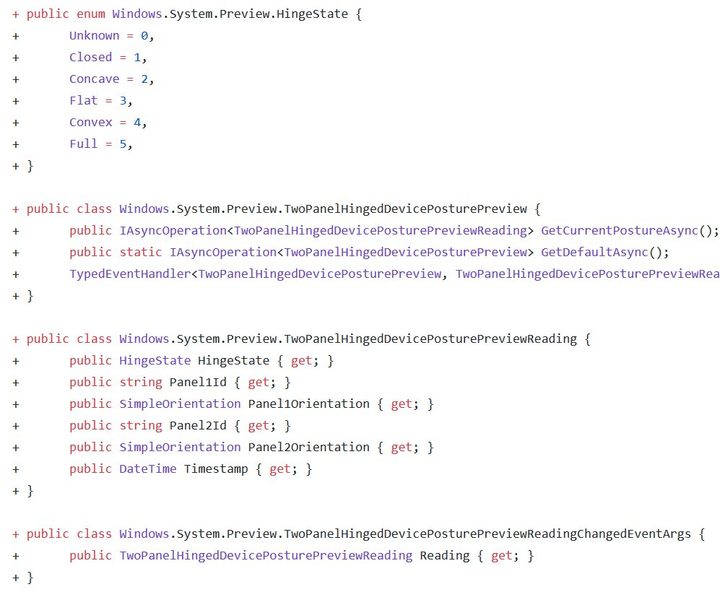
Presumably, closed mode is where the screens face inward, concave is similar to today’s laptop mode, convex is similar to tent mode, flat could be similar to tablet mode where the screens are fully opened to create a larger combined display surface, and full mode could represent both screens facing outward. Modern hybrid laptops today can convert to only laptop, tablet, and tent modes.
Although it’s not exactly clear how Microsoft will design the user experience around the modes, MS Power User reported that “the API would mean applications will be able to respond to changes in the orientation of the device, with Microsoft in patents suggesting that in tent mode the device could display an alarm clock and in convex mode one side could present an on-screen keyboard like a laptop to users.”
Microsoft’s Andromeda has been showing up in a number of leaks recently, and it’s reported that the device could be announced as early as late this year. Although there is a lot of anticipation around Andromeda — Microsoft debuted the concept initially as part of its Courier project nearly a decade ago — Microsoft isn’t the only one rumored to be working on dual-screened devices. Intel recently showed off a few concepts under its Tiger Rapids codename, which the chipmaker said would get adopted into commercial designs from Lenovo and Asus. Dell is also rumored to be working on its own dual-screen PC under the Project Januss code name. Unlike the Tiger Rapids concepts that Intel is pioneering with Lenovo and Asus, however, Andromeda may take on a form factor that’s more compact than a laptop and the device could represent Microsoft’s newest push into the smartphone and mobile computing space.
Additionally, Microsoft’s recent work on its Windows 10 operating system may suggest that the company is ready to embrace having a second glass screen replace the keyboard portion of a laptop. Microsoft’s testing SwiftKey integration to make it easier to type on glass, and the company is bringing inking support to the Windows 10 Mail and Calendar apps, a move that may make a dual-screen device more appealing to paper planner addicts.