If you’re looking for a new super-compact Next Unit of Computing (NUC) from Intel, the company is gearing up to launch five new “Bean Canyon” models with eighth-generation processors. Dates and prices are unknown for now, but they will be more “mainstream” than the skull-bearing “Hades Canyon” NUC released at the beginning of the year.
According to a leaked slide, there will be two short models measuring 1.41 inches tall and three larger versions measuring two inches tall that can host a 2.5-inch hard drive or solid-state drive. But unlike the “Hades Canyon” NUC, these five mini PCs don’t rely on Intel’s module packing discrete AMD Radeon graphics, but instead solely rely on an integrated Iris Plus Graphics 655 component.
Here are the processors used in Intel’s “Bean Canyon” NUC:
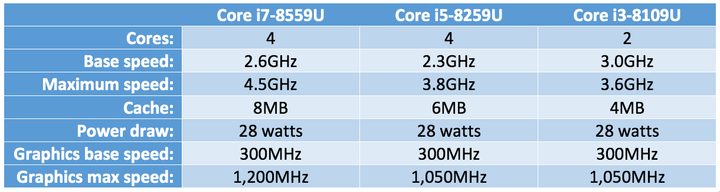
These three processors were part of Intel’s third wave of eighth-generation chips released in April, following desktop processors in late 2017 and the first batch for ultra-thin laptops in August 2017. All three chips listed above draw 28 watts of power, which is higher than the 15-watt chips used in previous NUC designs. The integrated Iris Plus Graphics 655 component has a base speed of 300MHz across the board while the Core i7 chip has the highest boost speed of the trio.
Now here are the actual “Bean Canyon” NUCs Intel has in the works:
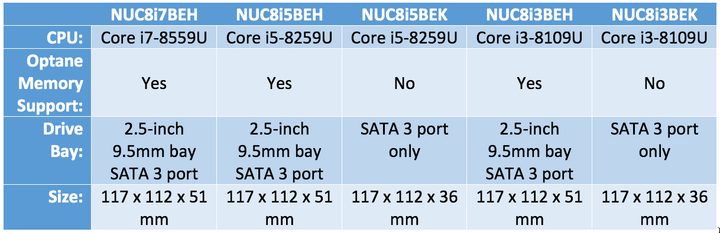
Note that two of the five NUCs don’t support Intel’s Optane memory, which is used to boost the performance of hard drives. The larger models pack an empty drive bay for a 2.5-inch hard drive or SSD while the smaller models only provide a SATA port. All NUCs are barebones anyway, thus you’re required to purchase memory and storage separately in addition to the cost of Intel’s NUC.
The “Hades Canyon” NUC released by Intel earlier this year doesn’t target the mainstream market but sets its eyes on gamers. Packed inside is the Core i7-8809G module: An all-in-one package/chip containing four seventh-generation processor cores and integrated HD Graphics 630, dedicated HBM2 memory for graphics, and 1,536 Radeon RX Vega M GH discrete graphics cores. All three portions are connected by “fast lanes” and housed in one single package.
That said, the “Hades Canyon” NUC starts at $898, but that’s without memory and storage. It provides two slots supporting up to 32GB, two M.2 slots for card-style storage, two SATA ports for your typical hard drive or SSD and a handful of outputs including Thunderbolt 3, Type-C and Type-A ports, and more. If you’re wanting a super-compact gaming PC that hides in the shadows, “Hades Canyon” would be a good option.
But if you want a similar form factor but without the gaming frills, the “Bean Canyon” may be your best pick for good performance without the huge bulk of a desktop PC. Perhaps we’ll hear more about these NUCs later this year as the summer comes to a close and students head back to school.