AT&T signed a deal to be the exclusive wireless distributor of Magic Leap’s products in the United States. First up to bat will be the Magic Leap One Creator Edition headset that will be sold in select stores in Atlanta, Boston, Chicago, Los Angeles, and San Francisco later this summer. AT&T will add additional markets at a later date.
“We’re designing and offering the future of entertainment and connectivity, and this exclusive arrangement — in combination with our 5G leadership position — will open up new opportunities and experiences,” AT&T CEO John Donovan said in a statement.
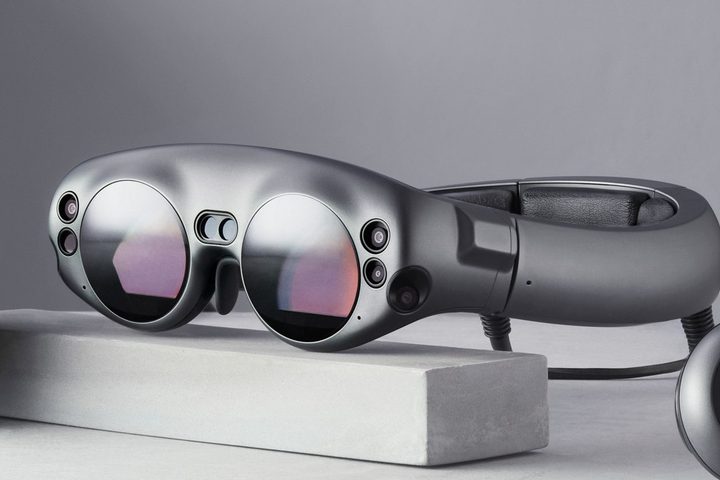
Magic Leap One is a lightweight augmented reality headset that throws digital objects into your view of the real world. The device includes cameras for full-room tracking and spatial awareness, meaning it can detect objects such as chairs, boxes, bushes, and so on. The camera can also record video, which lights a red LED while recording.
Unfortunately, we don’t know the full details regarding all the hardware powering Magic Leap’s upcoming AR headset although the company finally revealed in Wednesday’s Twitch livestream that it will be based on Nvidia’s Tegra X2 all-in-one chip. A previous livestream in June gave us our first look at what’s to come, revealing that the headset won’t support prescription glasses. Instead, you’ll need to purchase subscription lenses that you manually insert into the device … or wear contact lenses.
Even more, Magic Leap One is designed for indoor use only. Attached to the headset will be a hockey puck-style miniature PC, aka the Light Pack, that clips onto your pocket: It doesn’t support clipping onto a belt. Moreover, despite its size, you can’t slip it into your pocket because it’s a miniature computer that requires ventilation. Shoving it into your pocket will overheat the device.
On a connectivity front, the Light Pack will include a Wi-Fi connection for networking, Bluetooth for peripherals, a USB-C port, and a headphone jack. The headset will provide audio “holes” rather than built-in headphones to generate “sound fields” (3D spatial audio?). The headset itself will ship in two sizes.
Bundled with the headset and Light Pack will be several swappable brow and nose pieces to better fit your face. Also included are a controller supporting six-degree-of-freedom while providing trigger and bumper buttons on the bottom, a single button on the top that may serve as a “home” button, and a touchpad sporting glowing LED markers.
To make the augmented reality aspect come alive, the headset relies on the company’s proprietary digital light-field photonics.
“Our light-field photonics generate digital light at different depths and blend seamlessly with natural light to produce lifelike digital objects that coexist in the real world,” the company says. “This advanced technology allows our brain to naturally process digital objects the same way we do real-world objects, making it comfortable to use for long periods of time.”
Right now, Magic Leap is only serving up a Creator Edition model for developers. Both the price and release date are unknown outside the “summer” launch window, but at least now we know who will distribute the headset in North America. AT&T’s involvement indicates Magic Leap One Creator Edition will have cellular connectivity and access to AT&T’s “content platform.”
Magic Leap indicated on Wednesday that the upcoming summer launch was made possible partially by an investment from AT&T. Money from the U.S.-based wireless carrier helped Magic Leap complete its Series D equity funding round.
Updated July 11: Added information to reflect a recent live stream announcing the launch window and processor.