  1. Home
  2. Emerging Tech
  3. Health & Fitness
  4. News

New light-emitting implant zaps cancer tumors with incredible precision

Add as a preferred source on Google
Toshinori Fujie

Remember that light-emitting tracking device that Arnold Schwarzenegger’s character memorably pulls out of his nose in the 1990 movie Total Recall? A similar device might one day be implanted in your body to help you battle cancer.

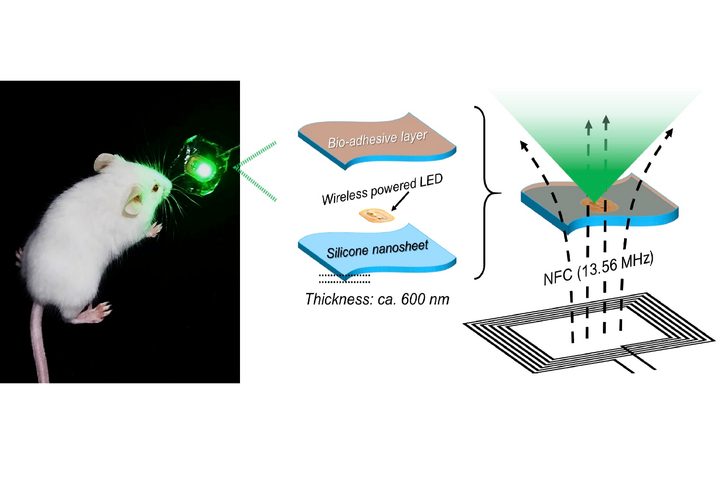
The implantable device, which is held in place by sticky bioadhesive “nanosheets,” was developed by researchers at Japan’s Waseda University. It consists of an LED chip that’s wirelessly powered by NFC, the same technology used for mobile payment solutions like Apple Pay.

Recommended Videos

When tested under the skin of mice with cancer, the device was shown to be capable of effectively shrinking their tumors. It does this by using something called photodynamic therapy (PDT), a treatment which is already being used to fight some cancers. Photodynamic therapy requires the patient to take a drug that makes certain cells vulnerable to light. An endoscope is then used to shine light on the tumor for up to 45 minutes. However, this approach can make it difficult to control dosage, which is where the Waseda University’s new technology comes into play.

“The device can be easily pasted to the target tumor owing to the ultra-flexibility of [our] nanosheets, without conventional suturing,” Professor Toshinori Fujie, who led the research, told Digital Trends. “The beauty of this study is we succeeded in decreasing the light intensity, about 1,000-fold smaller than the conventional therapy, [so as to] avoid thermal damage of normal tissue — yet realized effective treatment of cancer by local light irradiation, thanks to the bio-adhesive nanosheet.”

According to Fujie, the approach could one day be used to help treat cancerous tumors in parts of the body like the brain or pancreas. These organs make it risky to use conventional cancer-treatment approaches, such as surgery or radiotherapy, because of the possibility of damaging surrounding healthy tissues, nerves, and blood vessels.

“Definitely, we should push forward this technology from benchside to bedside to improve the quality of life of patients,” Fujie continued. “We hope to start the translational research as soon as we solve the legal regulation in medical device developments. To this end, our next research is to consolidate the protocol and clinical design to show the effectiveness in the appropriate lesions, which cannot be accessed by conventional PDT, such as hard-to-detect micro-tumors and deeply located lesions.”

A paper describing the work was recently published in the journal Nature Biomedical Engineering.

Luke Dormehl
I'm a UK-based tech writer covering Cool Tech at Digital Trends. I've also written for Fast Company, Wired, the Guardian…
Yet another study says AI is bad for elections, and the rabbit hole gets worse
AI may be an election bomb waiting for someone to light the fuse
Voters cast their ballots on Election Day

Another election, another study has concluded that asking an AI chatbot for political guidance is a spectacularly bad idea. Research conducted during Hungary’s 2026 parliamentary election found that ChatGPT and Google Gemini offered not just inaccurate but also inconsistent and unreliable voting advice. The chatbots misclassified voter profiles, overlooked relevant parties, recommended parties absent from the ballot, and sometimes produced materially different answers when given the same information repeatedly.

AI keeps failing the voter test

Read more
Samsung’s humanoid robot ambitions are real, but factories come first
Samsung’s new robotics division has humanoids in its sights, although its immediate business is far more practical factory automation
Robot Touch Human Finger

Samsung wants a place in the humanoid race, but its new robotics push begins with machines built for factories rather than homes.

The CEO-led RX robotics division will initially focus on manufacturing robots. Samsung has separately identified humanoids as a priority, although it hasn’t announced a commercial model or explained where one fits into the division’s immediate plans.

Read more
The future of AI may depend on this one behind-the-scenes change
Running Claude on Android.

Whenever a new AI model arrives, it's easy to get caught up in the bells and whistles. We talk about how much smarter it is, how quickly it answers questions, or how realistic its images have become. But here's the thing: none of that matters much if the AI can't reliably work with the apps and services people use every day.

That's why an upcoming update to the Model Context Protocol (MCP) caught my attention. It isn't a new chatbot or a fancy AI model. In fact, most people will never even know it's happening. But it could quietly make the AI ecosystem a lot healthier. If you've never heard of MCP before, don't worry. Think of it as a shared language that lets AI assistants safely talk to apps like Gmail, Slack, calendars, databases, and countless other services. Instead of every company inventing its own way to make those connections, MCP gives everyone a common rulebook.

Read more