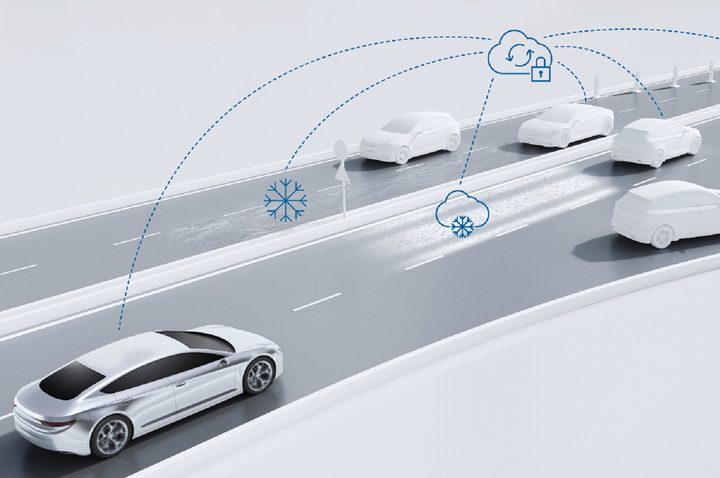
German engineering and electronics company Bosch has joined forces with Finnish weather expert Foreca to inform self-driving cars about the road conditions they’re operating on. This cloud-based, cloud-detecting technology could play a key role in one day making autonomous cars suitable for places that experience extreme weather.
The technology stems from a simple, widely accepted premise: Humans drive differently depending on whether they’re on dry asphalt, rain, snow, or mud. Even the smartest autonomous and semi-autonomous cars will need to adjust how they drive, too, in order to keep their passengers safe and comfortable. There are also freakishly extreme cases where a car that isn’t fully autonomous will need to tell its driver to take over because it’s no longer capable of driving on its own.
Bosch and Foreca explain they designed the road conditions service to warn a car about changes in the weather ahead of time so it knows what to expect. For example, if the service detects a rainstorm on the route, the car’s onboard computer will receive a message that includes the location of the storm and its intensity. The car will then know precisely where it needs to slow down to reduce the risk of hydroplaning and where it’s safe to speed up again. Or, if the conditions are too hazardous, it will inform the driver that autonomous technology will no longer be available in, for example, six miles.
Bosch will roll out its road condition service globally in 2020, though it hasn’t revealed which car(s) will be the first to get it. Early on, the service will rely largely on cloud-based weather data provided by Foreca to paint a digital picture of the meteorological conditions around the car. Bosch plans on gradually integrating vehicle data into the system as the number of vehicles equipped with car-to-car and car-to-infrastructure technology grows. They’ll eventually share information like the inside and outside temperature, whether or not the windshield wipers are on, and how often the ESP kicks in to keep the car pointed in the right direction.
It will take a while before the technology relies solely on shared information. Some cars — including Volvo and Mercedes-Benz models — already share weather information when possible but Bosch predicts providing reliable weather data for Europe’s roughly 50,000-mile freeway network would require about 20 million connected cars all talking to each other. Imagine how many connected cars America would need to cover its 4.1 million miles of paved and unpaved roads.