Elon Musk’s Boring Company has received permission from the Hawthorne (California) City Council to build a prototype for a lift designed to connect an above-ground garage to an underground tunnel, The Mercury News reported.
The Loop Lift prototype will connect from a private residence owned by the company to an existing one-mile Hyperloop tunnel near Musk’s SpaceX company.
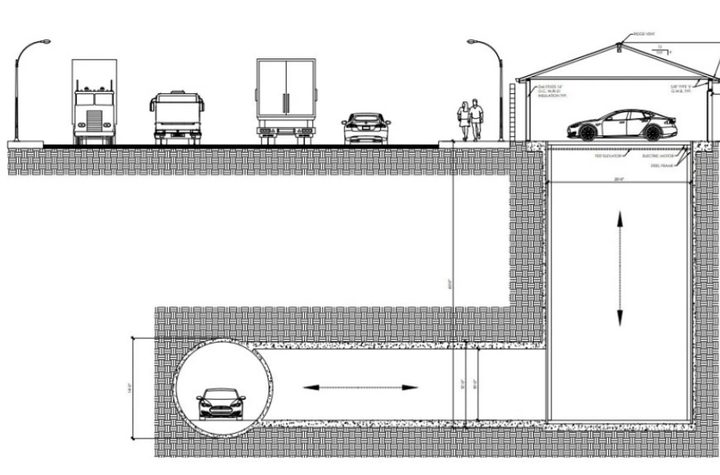
The tunnel and lift concepts are intended to reduce future traffic, but concerns about vehicle congestion led the Hawthorne City Council to add conditions to its approval for the prototype project. To secure the go-ahead to build the vehicle elevator, the Boring Company agreed to keep everything literally on the “down-low.”
Vehicles involved in testing the Loop Lift will not enter or exit the garage from the street, but via the elevator connected to the tunnel. The Hyperloop entrance is on the SpaceX campus.
The test tunnel isn’t destined to connect to Hawthorne’s transportation system. The Boring Company uses the underground structure for research and development. When the Loop Lift is functional, it will also serve as a demonstration site.
The Boring Company isn’t focused on building an elevator in every garage, according to the company’s project description: “The purpose is to demonstrate that a lift can be built in very small footprints and within existing buildings, whether they are houses, office buildings, or retail parking lots. Looking forward, one could have a lift in the basement of every office building, allowing extremely convenient commutes.”
Inspired by Los Angeles traffic congestion, which the company describes as “soul-destroying,” Musk’s enterprise suggests a network of underground tunnels as the best solution.
Adding lanes to surface roadways is a limited response to crowded highways. In densely populated areas, it doesn’t take long to encroach on private property. This starts a long, expensive process that includes moving or demolishing houses and other buildings.
Flying cars or tunnels enable 3D solutions to the demand for more space for vehicles, according to the Boring Company, which favors underground solutions.
“Unlike flying cars, tunnels are weatherproof, out of sight, and won’t fall on your head. A large network of tunnels many levels deep would fix congestion in any city, no matter how large it grew (just keep adding levels),” the company states.
With complementary goals of cutting tunnel costs and construction time, each by a factor of 10 or more, the Boring Company hopes to make its Hyperloop concept attractive and affordable for cities and potentially nationwide, especially in highly populated regions.
In pursuit of The Boring Company’s vision, company representative Grett Horton told the Hawthorne City Council: “What we want to do is show proof of concept and as quickly as possible. We are not asking to go around the public process. Yes, we do move fast. We are trying to revolutionize transportation and don’t want to get bogged down.”