  1. Home
  2. Emerging Tech
  3. News

Shipping crate filled with 3D-printing robots may be the future of construction

Add as a preferred source on Google
Autodesk

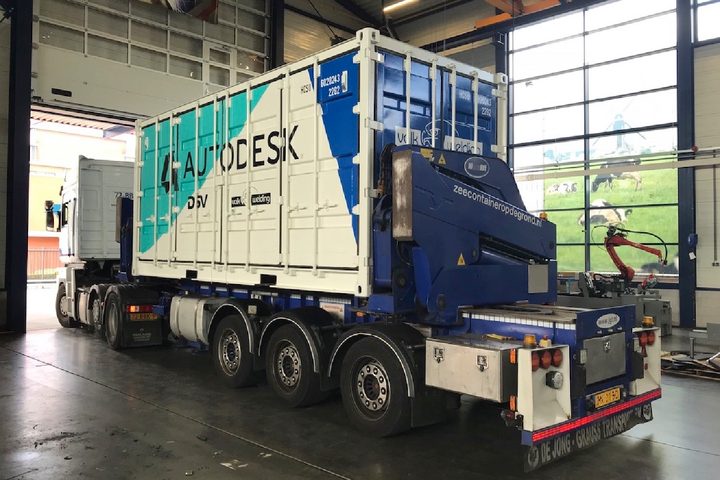
Autodesk might have made its name with its AutoCAD computer-aided design software, but its latest high-tech project is far more focused on hardware. The company has teamed up with Netherlands-based company Dura Vermeer to create a robot-filled shipping container which may very well represent the future of construction work. It is being shown off at this week’s Autodesk University Las Vegas, a massive conference connecting people from industries like manufacturing and architecture, which kicked off on Monday, November 12.

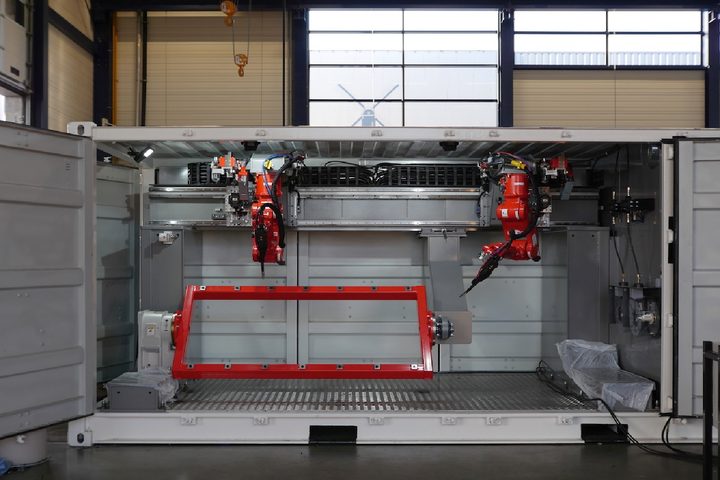
Described by Autodesk as a “large-scale additive manufacturing toolbox,” the new shipping container contains twin Panasonic TS-950 robots, ready to be deployed on construction sites. It is designed to be carried on the back of a truck. These robots can be deployed for 3D printing large, strong, durable metal components for construction. As a result, the hope is that building sites will have to transport fewer components, since they can instead print them as and when required. This also opens up new design possibilities due to the fact that generative algorithms can be used to create components to the exact technical specifications required. Think of it as a supply chain in a box, and you won’t be far off the mark!
Autodesk

“As we rethink the way we build things, it’s not just optimization, but imagination, that will get us ahead,” Autodesk noted in a blog post about the new technology. “For the construction industry, imagine what you could do with the ability to make large parts out of steel or other metals right on the spot. What could you do with this technology if it could be available anywhere in the world — even right there on a construction site? We asked this question of our customers, then we went to work making it a reality.”

Recommended Videos

The company points to the fact that a combination of growing global population, increased climate change, dwindling natural resources, and a skilled labor shortage will make it difficult to meet the current demand of building 13,000 new buildings every year through 2050. As a result, technologies such as this (and other similar projects, such as attempts to 3D print houses) will become increasingly important.

There’s no shipping date announced so far but, hopefully, it won’t be long before similar technology moves beyond the prototype phase and into the real world.


Luke Dormehl
I'm a UK-based tech writer covering Cool Tech at Digital Trends. I've also written for Fast Company, Wired, the Guardian…
Google just canceled its AI Studio mobile app, and it’s not all bad news
Logo, Symbol, Disk

Google AI Studio was on track to make its way to Android and iPhone, giving developers and AI enthusiasts a dedicated place to build prompts and experiment with Google's latest models from their phones.

That's no longer happening. In a post shared by the official Google AI Studio account on X, Google confirmed that it's canceling the standalone AI Studio mobile app before launch. The announcement comes despite the company saying nearly 800,000 people had already pre-ordered the app across iOS and Android.

Read more
Google Earth’s AI misadventure lasted only a day. It was a tale of dangerous ignorance.
Nuclear reactors, tanks, and historical destruction on a life-like satellite map? Yeah, that's bad.
Nano Banana AI image generator representation.

Technology behemoths are clearly not reading the room, or they are just moving faster than they should when it comes to AI deployment. Google has already stuffed its Gemini AI in every corner of its software stack, from Android to daily productivity tools like Gmail that are used by hundreds of millions of users every day. AI is everywhere. Not all of it is bad, mind you. But in a few places, it just feels forced.

In its latest AI-fication experiment, the company targeted Google Earth. The idea was to let the audience use its Nano Banana 2 AI image generator and make images that can be placed on the map view. On paper, it's a cool idea. What would the Colosseum of Rome look like in your urban neighborhood? Yeah, fun stuff like that.

Read more
Google’s new AI gives robots better balance, smarter hands, and teamwork capabilities
Google just made robots a lot less clumsy and a lot more helpful.
Gemini robotics 2.0

Google DeepMind just brought sci-fi robots closer to reality, and it is very exciting. Building on its original Gemini Robotics model, the company has introduced Gemini Robotics 2, an AI system designed to help robots think, move, and even work together. Unlike most robots today, which rely on pre-programmed routines or someone controlling them remotely, this new system lets robots figure things out on their own when situations get unpredictable.

Can robots finally handle whole-body tasks?

Read more