  1. Home
  2. Emerging Tech
  3. Wearables
  4. News

A Fitbit for chickens? Sounds silly, but it could revolutionize poultry farms

Add as a preferred source on Google
Amy Murillo

There was a time, not that long ago, when wearable devices were only the province of humans. How far we’ve come since then! Here in 2018, there are high-tech wearables available, regardless of whether you’re a tiny grasshopper or a significantly larger animal like a cow.

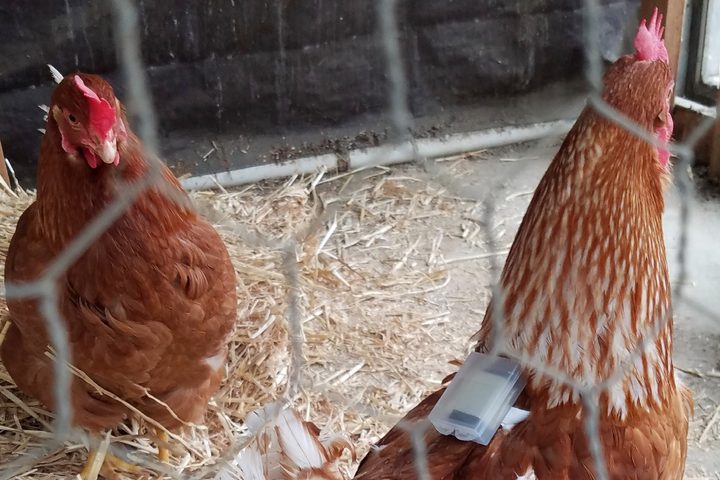
Sitting neatly between these two size extremes is a new project coming out of the University of California, Riverside. Researchers there have developed a sort of “Fitbit for chickens.” It’s essentially a miniature backpack that’s capable of analyzing behavior — such as revealing if a chicken is pecking, preening, or dust-bathing — with an accuracy level of more than 85 percent. This is thanks to an algorithm trained on data gathered during the study. Crucially, the algorithm can also inform when something goes wrong, such as an outbreak of blood-drinking parasites.

Recommended Videos

“We are interested in studying chicken behaviors, but traditional behavior studies required the researchers to make in-person observations or watch hours of video,” Amy Murillo, one of the researchers on the project, told Digital Trends. “Both techniques limit the number of animals that can be observed and the total observation time. In our study, we used sensors with 3-axis accelerometers to track chicken movement. These sensors are worn by chickens and can collect data for long periods of time — continuously for up to two weeks on one battery charge.”

Alireza Abdoli, who also worked on the project, notes that the plan is not that every chicken is outfitted with its own sensor. While this could provide useful information, it would also be highly impractical. Instead, the idea is to use it as a tool to gather information on chicken health, and then apply those lessons to the brood at large.

“We are interested in knowing how ectoparasite infestations — mites or lice — impact chicken behaviors,” Murillo said. “So our next step is to use these sensors on birds with or without infestations to see if there are detectable behavioral differences. If significant behavioral differences are found, then it may be possible one day for commercial producers to use behavioral changes in their flocks to assess ectoparasite infestations. This may be especially useful for detecting early mite or louse infestations, or for assessing the success of a mite [and] louse control program on poultry farms.”

Longer term, she said the technology could be commercialized to help farmers assess the health of their chicken broods. Doing this would save considerable time, since at present farmers must manually check their chickens one a time to seek out mites. However, this commercialization is still a way off.

“Our next step is to evaluate chicken behavioral differences using these sensors on healthy versus unhealthy birds,” Murillo said.

Luke Dormehl
I'm a UK-based tech writer covering Cool Tech at Digital Trends. I've also written for Fast Company, Wired, the Guardian…
Your future AR glasses might finally stop making the real world look weird
Researchers have developed a new display technique that keeps virtual objects realistic without dimming the real world.
Samsung AR Glasses

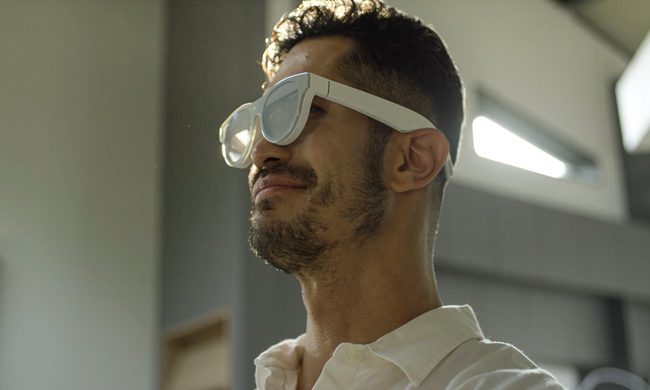
One of the biggest promises of augmented reality is blending digital objects seamlessly into the real world. Ironically, today's AR glasses often make the real world harder to see. Researchers at the Shibaura Institute of Technology (SIT) in Japan, led by Assistant Professor Xiaodan Hu in collaboration with Dr. Yan Zhang and Professor Xubo Yang from Shanghai Jiao Tong University in China, and Professor Kiyoshi Kiyokawa from Japan's Nara Institute of Science and Technology, have developed a new AR display technique that aims to make virtual objects look realistic without reducing visibility of the real world. The study was published in IEEE Transactions on Visualization and Computer Graphics.

The biggest AR problem isn't virtual objects; it's everything around them

Read more
Anti-surveillance clothing is getting cheaper, but don’t expect an invisibility cloak
Affordable shirts now claim to confuse facial recognition, although their protection depends heavily on the camera and software watching you
Chart, Plot, Adult

Anti-surveillance clothing is starting to look less like an art-school experiment and more like something you could actually wear outside. Shirts designed to confuse facial recognition systems now cost about as much as ordinary streetwear, although buying one won’t make you disappear.

The Guardian reports that designers are using face-like prints, unusual cuts and infrared lights to interfere with computer vision. These techniques target specific weaknesses, so their success depends on what happens to be watching you.

Read more
This spinning drone hides in plain sight using a visual illusion
This drone doesn't turn invisible. It tricks your brain into thinking it has.
Phantom Twist

For decades, engineers have chased the dream of an invisible drone. The usual approaches have involved transparent materials, camouflage coatings, or complex optical systems that bend light around an object. Researchers at Northwestern University decided to take a completely different route. Instead of hiding the drone itself, they chose to fool the human eye.

The result is Phantom Twist, an experimental drone that spins so rapidly it almost disappears into the background. It's not technically invisible, but to anyone watching, it looks more like a faint blur than a flying machine.

Read more