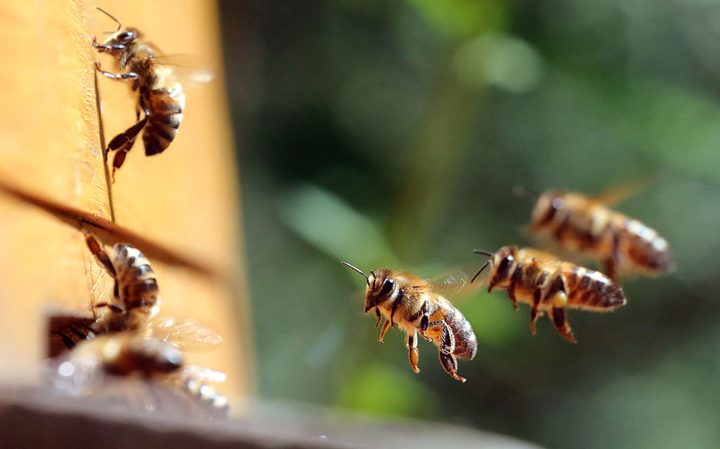
Bees are amazing creatures. Not only can they fly at speeds of up to 15 mph and communicate with others through dance, but they have also been shown to have personalities and to be surprisingly cognitively complex. Last year, a study found that bees can understand the concept of zero, joining a small number of animals like parrots and monkeys who have this ability.
Now a new study has found something even more remarkable: Bees can do basic arithmetic. Researchers from the Royal Melbourne Institute of Technology (RMIT) in Australia, with collaborators from the University of Toulouse in France, worked together to test bees’ ability at mathematics, technically called numerical cognition. The researchers wanted to see whether bees could use colors as representations for numbers and use those colors for addition and subtraction.
Here’s how it worked: Individual bees were trained to visit a Y-shaped maze. On one size of the maze was tasty sugar water which bees want to collect, and on the other side was bitter quinine which they avoid. As bees are known to return to locations where food is available, it was easy to train the bees to keep coming back into the maze and to learn how it worked.
Once the bees knew the maze, the arithmetic element was added. When the bee entered the maze they would see a number of shapes between one and five. These shapes were either blue, which meant the bee had to add one to the total number, or they were yellow, which meant the bee had to subtract one from the total. Then the bee would move into the main chamber where there were two paths available. One path was marked with the correct answer and lead to the sugar water, while the other path was marked with a wrong answer and lead to the quinine.
At first, the bees picked a side randomly. But after 100 learning trials, they managed to pick the correct path an incredible 80 percent of the time. The bees seemed to understand that blue meant plus one and yellow meant minus one, and to be able to perform the required addition or subtraction. Interestingly, individual bees learned differently with some performing better than others, though researchers were not sure whether this was to do with the randomized way the tests were presented or to do with individual variations in cognitive abilities.
These findings are important because they show how individuals with very small brains are able to perform relatively complex cognitive tasks. “If maths doesn’t require a massive brain, there might also be new ways for us to incorporate interactions of both long-term rules and working memory into designs to improve rapid A.I. learning of new problems,” author of the paper and associate professor at RMIT, Adrian Dyer, said in a statement.
The findings are published in the journal Science Advances.