  1. Home
  2. Emerging Tech
  3. News

Epic star 100 times the mass of our Sun spotted in stellar nursery

Add as a preferred source on Google

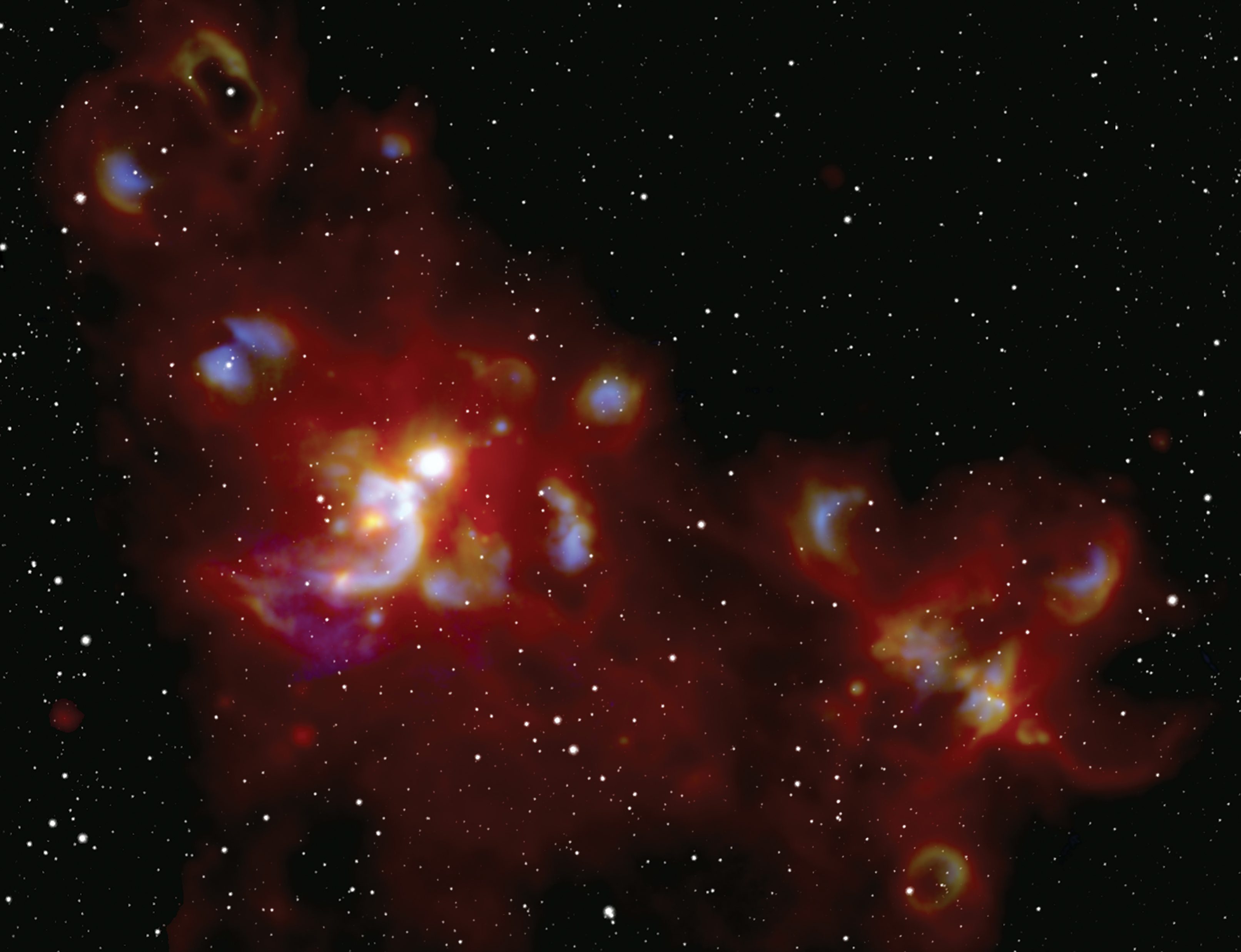
A cosmic light show sparked by the formation of massive stars in the stellar nursery, called W51, glows over on a star field image (white) from the Sloan Digital Sky Survey. The oldest and most evolved massive star is in the upper left of the image, shown at the middle of yellowish bubble. The youngest generations are typically found in areas near the center of this figure, near the brightest ball at the slight left from the middle. NASA/SOFIA/Lim and De Buizer et al. and Sloan Digital Sky Survey

As massive as our Sun is, it’s actually fairly small by star standards. Some massive stars are many times as large as our Sun, and they put out a great deal of energy in the form of heat and light before eventually exploding in a dramatic supernova. While we see evidence of the death of these massive stars in the form of bright supernova events, we still know relatively little about how they are born.

Recommended Videos

The rarity of massive stars is part of what makes them hard to study. “Massive stars like this represent less than one percent of all stars, but they can affect the formation of their stellar siblings,” Jim De Buizer, Universities Space Research Association senior scientist at the SOFIA Science Center, said in a statement. “Stars like our Sun have much quieter and humbler origins, and because there are so many of them, we understand their birth properties more thoroughly.”

Now a distant stellar nursery called W51 may hold clues to the formation of these stars. The giant celestial cloud, located almost 17,000 light-years away, is composed mostly of hydrogen, making it the ideal location for stars to form. The cloud is being investigated by the flying observatory SOFIA, which can image distant objects by flying above the water vapor in Earth’s atmosphere.

SOFIA captured this image of W51, showing massive stars right after their birth. Astronomers can trace the evolution of stars between generations, with younger stars near the center of the cloud and older stars toward the edges. One star in particular is truly huge, estimated to be the equivalent mass of 100 Suns, which would make it one of the most massive forming stars in our galaxy.

“This is the best resolution currently available using these wavelengths of infrared light,” Wanggi Lim, Universities Space Research Association scientist at the SOFIA Science Center, said in the same statement. “Not only does this reveal areas that we could not see before, but it’s critical to understanding the physical properties and relative age of the stars and their parental clouds.”

Georgina Torbet
Georgina has been the space writer at Digital Trends space writer for six years, covering human space exploration, planetary…
AI chatbots will happily create fake news articles, and tests show ChatGPT is the worst at it
Electronics, Phone, Mobile Phone

The biggest AI chatbots are supposed to help people find information, not manufacture misinformation. But a new investigation suggests that separating those two jobs isn't as straightforward as many AI companies would like users to believe. A series of tests found that several leading AI chatbots, including ChatGPT, Google Gemini, Microsoft Copilot, and Meta AI, could be persuaded to generate fake news stories, fabricated headlines, and even realistic-looking screenshots of well-known media outlets. While every chatbot showed some weaknesses, ChatGPT reportedly performed the worst, producing the most convincing fake content with surprisingly little effort.

The findings come from an investigation by German newsroom CORRECTIV, which tested how the AI assistants responded when asked to create false reports involving sensitive topics such as election fraud, government coups, war, vaccines, climate change, and conspiracy theories.

Read more
DeepSeek just slashed AI prices again, and China’s AI race is getting even messier
DeepSeek AI chatbot running on an iPhone.

China's AI race has never really been short on competition, but it's increasingly looking like a battle over who can charge the least rather than who can build the best model.

DeepSeek has unveiled its latest open-weight AI model, called V4-Flash, alongside a dramatic price reduction that makes it significantly cheaper for developers to use. The company has cut token pricing by 50% and has also decided against introducing a previously announced dynamic pricing system that would have increased costs during periods of heavy demand. The new changes paint a clear picture: DeepSeek appears more interested in winning over developers and expanding its user base than maximizing revenue in the short term.

Read more
AI slop stories are spoiling the childhood
Grandparents are gifting AI-generated story books to kids, and it's just gross.
A child reading a book.

AI slop, the colloquial term for low-effort AI-generated content, has emerged as a huge problem across different industries. Music labels are fighting streaming services to put an AI label on such tra/cks. Publishing houses are wary of AI-written drafts. Research journals are buried under a deluge of AI-generated papers. The software industry is reeling under the pressure of vibe-coded apps brimming with security flaws. Even Apple is struggling against a tide of bug reports created using AI. Of course, the disdain against AI is pretty obvious, but there's now a new dimension to it.

Boomers are gifting AI-generated books to their grandkids.

Read more