  1. Home
  2. Emerging Tech
  3. News

Researchers develop flexible brain-machine interface for controlling wheelchairs

Add as a preferred source on Google

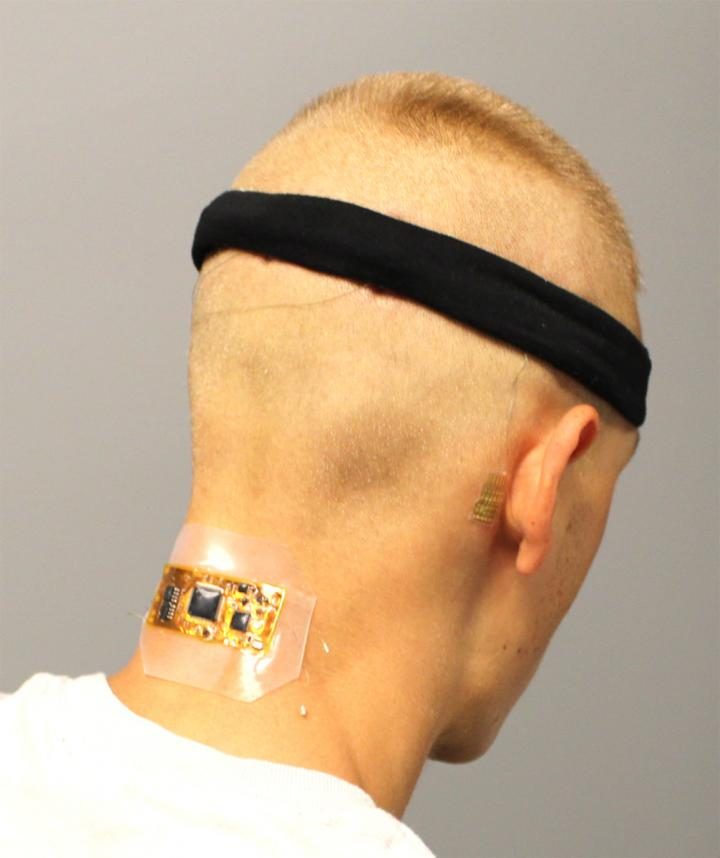
Test subject who has flexible wireless electronics conformed to the back of the neck, with dry hair electrodes under a fabric headband and a membrane electrode on the mastoid, connected with thin-film cables. Courtesy Woon-Hong Yeo

From Facebook to Elon Musk, technology visionaries are working on the promise of brain-machine interfaces (BMIs) to do everything from creating a sixth sense to controlling hearing aids. One major application area for the technology is allowing people with physical disabilities such as spinal injuries to more easily interact with their environment by controlling a wheelchair, interacting with a computer, or operating small robots.

Recommended Videos

However, current BMI systems require the use of a large, bulky system called an electroencephalograph (EEG). Traditionally, EEG signals are measured using a cap that covers the entire head. So researchers wanted to find a way to miniaturize the technology and make it more discreet and usable in everyday situations.

A group from the Georgia Institute of Technology, the University of Kent, and Wichita State University have worked together to develop a portable EEG system that can be attached unobtrusively at the base of the neck. The flexible, wireless sensors come in a patch that is attached to the skin, along with other electrodes held in place by a headband. The EEG data is processed within the flexible patch and then sent wirelessly to a computer via Bluetooth, which can work at distances of up to 15 meters.

“This work reports fundamental strategies to design an ergonomic, portable EEG system for a broad range of assistive devices, smart home systems, and neuro-gaming interfaces,” Woon-Hong Yeo, an assistant professor in Georgia Tech’s School of Mechanical Engineering and Department of Biomedical Engineering said in a statement. “The primary innovation is in the development of a fully integrated package of high-resolution EEG monitoring systems and circuits within a miniaturized skin-conformal system.”

To test whether the system worked, the researchers took six able-bodied people that demonstrated that they could use it to control an electric vehicle and a small robotic vehicle. The next steps will be to improve the electrodes and to test the system to see whether it works for people with motor impairments. It could be a way for people with disabilities to interact with computers and machines in a more comfortable and practical manner. “This miniaturized, wearable soft device is fully integrated and designed to be comfortable for long-term use,” Yeo said.

The work is published in the journal Nature Machine Intelligence.

Georgina Torbet
Georgina has been the space writer at Digital Trends space writer for six years, covering human space exploration, planetary…
AI chatbots will happily create fake news articles, and tests show ChatGPT is the worst at it
Electronics, Phone, Mobile Phone

The biggest AI chatbots are supposed to help people find information, not manufacture misinformation. But a new investigation suggests that separating those two jobs isn't as straightforward as many AI companies would like users to believe. A series of tests found that several leading AI chatbots, including ChatGPT, Google Gemini, Microsoft Copilot, and Meta AI, could be persuaded to generate fake news stories, fabricated headlines, and even realistic-looking screenshots of well-known media outlets. While every chatbot showed some weaknesses, ChatGPT reportedly performed the worst, producing the most convincing fake content with surprisingly little effort.

The findings come from an investigation by German newsroom CORRECTIV, which tested how the AI assistants responded when asked to create false reports involving sensitive topics such as election fraud, government coups, war, vaccines, climate change, and conspiracy theories.

Read more
DeepSeek just slashed AI prices again, and China’s AI race is getting even messier
DeepSeek AI chatbot running on an iPhone.

China's AI race has never really been short on competition, but it's increasingly looking like a battle over who can charge the least rather than who can build the best model.

DeepSeek has unveiled its latest open-weight AI model, called V4-Flash, alongside a dramatic price reduction that makes it significantly cheaper for developers to use. The company has cut token pricing by 50% and has also decided against introducing a previously announced dynamic pricing system that would have increased costs during periods of heavy demand. The new changes paint a clear picture: DeepSeek appears more interested in winning over developers and expanding its user base than maximizing revenue in the short term.

Read more
AI slop stories are spoiling the childhood
Grandparents are gifting AI-generated story books to kids, and it's just gross.
A child reading a book.

AI slop, the colloquial term for low-effort AI-generated content, has emerged as a huge problem across different industries. Music labels are fighting streaming services to put an AI label on such tra/cks. Publishing houses are wary of AI-written drafts. Research journals are buried under a deluge of AI-generated papers. The software industry is reeling under the pressure of vibe-coded apps brimming with security flaws. Even Apple is struggling against a tide of bug reports created using AI. Of course, the disdain against AI is pretty obvious, but there's now a new dimension to it.

Boomers are gifting AI-generated books to their grandkids.

Read more