1. Home
  2. Wearables
  3. Apple
  4. News

Touch ID may turn up next on the Apple Watch, new patent suggests

Add as a preferred source on Google
 

Apple has patented a new design for the Apple Watch that would embed a Touch ID into the side of the watch — something Apple Watch fans have wanted for a while.

Recommended Videos

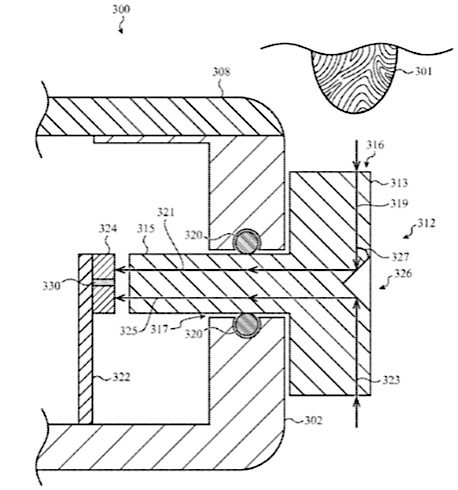
The patent was initially filed in November 2018 and was published on Thursday, February 6, 9to5Mac originally reported. If Apple were to go through the process and actually implement the idea, the Touch ID sensor would be located on the watch’s Digital Crown (the circle on the side that allows you to return to the Home Screen.

Apple explains in the patent how the Touch ID would work:

“In order to sense the motion of the user’s finger, a crown as described herein may include a window on the part of the crown that the user touches when interacting with the crown. The window may allow an image of the user’s finger to be captured by an image sensor that is positioned within the housing. The image sensor, which may include an image-sensing element (e.g., a charge-coupled device (CCD)) in conjunction with associated processors and other components within the electronic watch, may determine how the user’s finger has moved and control the operation of the electronic watch accordingly,” the patent reads.
Apple

So essentially, you could simply touch the Digital Crown on your Apple Watch to unlock it. Currently, the only two ways to unlock your Apple Watch is to enter your PIN on the watch’s touchscreen or to use your iPhone to unlock it. The addition of Touch ID on the Apple Watch would definitely make it easier and quicker to unlock and use the watch.

Still, patents don’t always come to fruition, but we can certainly speculate that future iterations of the Apple Watch may include Touch ID.

The current Apple Watch Series 5 came out with new and improved features when it debuted last fall. New features like an always-on display, updated fitness and health tracking, and make phone calls with your watch (with the cellular model).

Digital Trends reached out to Apple to comment on the new Touch ID patent and if we can expect to see it in an upcoming Apple Watch model. We will update this story once we hear back.

Allison Matyus
Former Digital Trends Contributor
Allison Matyus is a general news reporter at Digital Trends. She covers any and all tech news, including issues around social…
This smart ring makes a blood pressure promise Apple and Oura still won’t
The $399 Signal Ring provides actual systolic and diastolic readings, but it’s launching as a wellness device without FDA clearance
Oura Ring 4, Galaxy Ring and RingConn Gen 2 in the palm of a hand

Vital Signals has unveiled a $399 smart ring that goes further than Apple and Oura currently dare. The Signal Ring displays numerical blood pressure readings without requiring an arm cuff for initial or recurring calibration.

Bloomberg reports that preorders open July 16, with shipping scheduled to begin in October. The ring can collect readings during the day and overnight, then display the results through an iOS or Android app.

Read more
HTC’s smart glasses are apparently coming to the US, but HTC hasn’t said so
Amazon briefly listed the VIVE Eagle for a September 1 launch, while HTC still says the $499 glasses are only available in Taiwan
A woman wearing the HTC Vive Eagle smart glasses

HTC’s VIVE Eagle smart glasses could finally be heading to the US. Apparently, Amazon got the memo before HTC was ready to share it.

Notebookcheck spotted six versions available for preorder at $499, each carrying a September 1 release date. Amazon has since pulled the pages, so new orders are closed and anyone who already placed one is left wondering whether it still counts.

Read more
Don’t expect smartwatches and fitness bands with replaceable batteries anytime soon
Turns out even the EU thinks your smartwatch is too small for a battery swap.
Wristwatch, Arm, Body Part

The EU has a habit of pushing tech companies to adopt meaningful changes in their product. It's the reason your iPhone finally has a USB-C port, and it's also why companies now have to offer spare parts and repair support for electronics for several years after launch. So naturally, many of us assumed wearables were next in line for mandatory swappable batteries. Turns out, the EU just went the other way.

So what did the EU announce?

Read more